
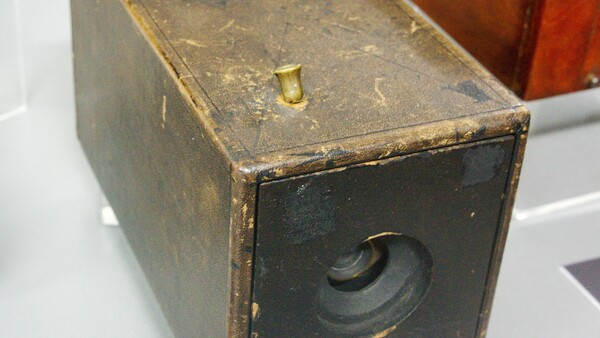
At a fashionable beach resort in the 1890s, a posted notice reportedly warned bathers about a brand-new menace with blunt words: "PEOPLE ARE FORBIDDEN TO USE THEIR KODAKS ON THE BEACH." Around the same stretch of years, hand cameras were barred for a time from the Washington Monument. The thing you now do a hundred times a day without a second thought spent much of its first century as behavior that respectable people wanted stopped, fined, or outright banned.
The Kodak Fiend Arrives
Cameras existed long before anyone panicked about them. For decades a camera meant a tripod, a dark cloth, glass plates, and a photographer who needed your cooperation because you had to hold still. You knew when your picture was being taken because taking it was a production. That changed in the summer of 1888, when George Eastman put a small wooden box on the market and called it the Kodak.
The original Kodak sold for $25, a serious sum at the time, and it came pre-loaded with a roll good for 100 exposures that produced round photographs about two and a half inches across. You did not develop anything yourself. When the roll was finished, you mailed the entire camera back to Rochester, where the factory processed the film, reloaded the box, and shipped it back with your prints. The slogan said the whole thing in eight words: "You press the button, we do the rest." The Metropolitan Museum of Art credits that machine with turning photography from a specialist craft into a mass hobby almost overnight.
The Kodak was expensive enough to keep it mostly in the hands of the comfortable classes, but Eastman was not finished. In 1900 he introduced the Brownie, a cardboard box camera that sold for a single dollar and was marketed so that even a child could work it. That was the machine that truly saturated the country. Within a few years it had put cameras into millions of American homes. A technology that in 1885 still meant plates, chemistry, and enough patience to have taught yourself the craft was, twenty years later, an everyday household object, and the sheer scale of that spread is what turned a novelty into something people felt they had to regulate.
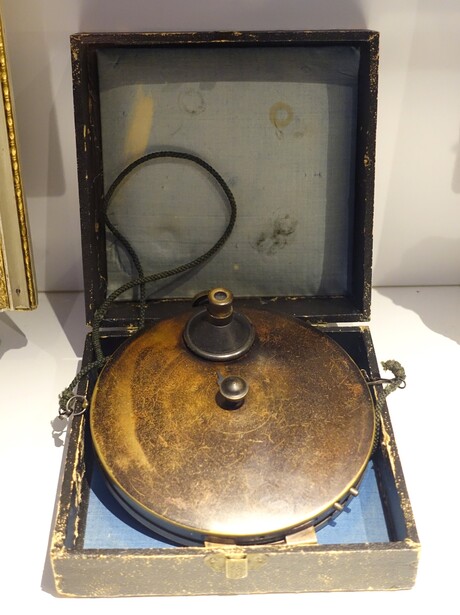
Eastman did not invent the idea of a camera you could carry and aim without anyone noticing. His own patent language placed the Kodak in an existing category with a telling name: the detective camera. Through the 1880s, inventors sold cameras disguised as parcels, hidden in hats, and built into pocket watches. The most successful of them hung around your neck under your clothes. An American named Robert Gray patented a flat, circular camera meant to be worn beneath a waistcoat and demonstrated it in December 1885 to the New York Society of Amateur Photographers, an organization whose existence says most of what needs saying about how established amateur photography already was. The New York firm of C.P. Stirn bought the rights and had it produced in Berlin as the Concealed Vest Camera. Its fixed-aperture lens poked through a buttonhole and was shaped to look like an ordinary button. It sold more than 18,000 units, which tells you how many people wanted to take pictures of others without being seen doing it.
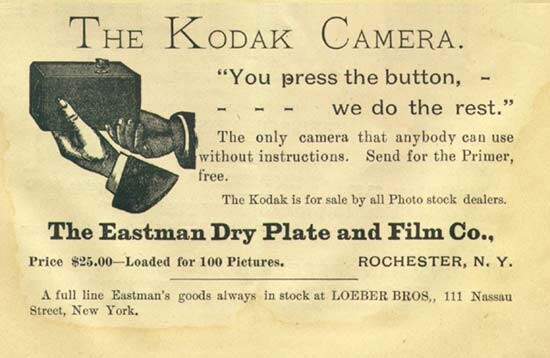
Put those two developments together, a camera an amateur could work without training and a camera you could hide, and you get a new social figure the press named the "Kodak fiend." The timing is worth pinning down, because the fiend was not a product of the dollar camera. The phrase belongs to the 1890s. He was already at large in the era of the $25 Kodak, a decade before the Brownie put a camera in every house. He carried his box everywhere and pointed it at everything. Newspapers ran the warning "Beware the Kodak." One account of the era describes camera obsessives so absorbed in snapping pictures that they would lose track of the world around them and miss their trains. What made the fiend frightening was not the equipment so much as the loss of consent. For the first time in human history, your likeness could be captured, kept, and passed around by a stranger, and you might never know it happened.
A Ban at the Monument and a Fight on the Sand
The backlash was immediate and, by modern standards, remarkable. The beach was the front line, because a beach in the 1890s was one of the few public places where respectable people appeared in less than full dress. The Science and Media Museum documents how the hidden-camera craze curdled quickly into public disgust. Resorts posted their forbidding notices. In Britain, one widely reprinted 1893 item claimed young men had formed a "Vigilance Association" whose stated purpose was "thrashing the cads with cameras who go about at seaside places taking snapshots of ladies emerging from the deep." Whether the association was real or a joke almost does not matter. The sentiment behind it plainly was.
Trains were a second battleground, because a railway car trapped strangers together for hours. Period reports describe women on trains trying to smash the camera of a man they suspected of pointing it at them. The Washington Monument ban fits the same pattern, an official response to a device that turned every visitor into a potential surveillance operator. None of these rules lasted, because none of them could. There were too many cameras and too few ways to police them, and within a generation the snapshot was simply part of life.
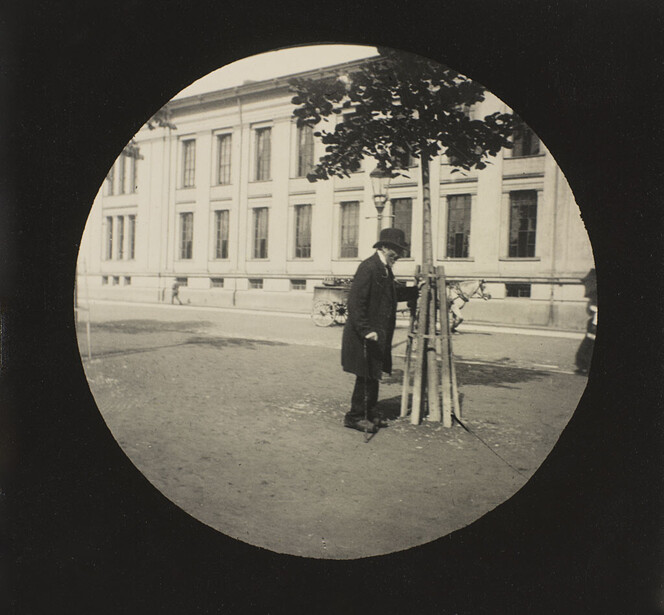
The photographs that terrified people are, ironically, some of the most charming images to survive from the decade. In Norway, a university student named Carl Størmer spent the mid-1890s walking the streets of Kristiania, now Oslo, with a concealed camera hidden in his coat, quietly photographing passersby, friends, and even the playwright Henrik Ibsen. He captured people mid-laugh and mid-stride in a way formal studio portraits never could. Størmer later became a world-famous scientist, and his secret street photographs are now treasured precisely because they are candid. At the time, they were exactly the kind of image the vigilance committees wanted to stop.
The Law Invents a Right to Privacy
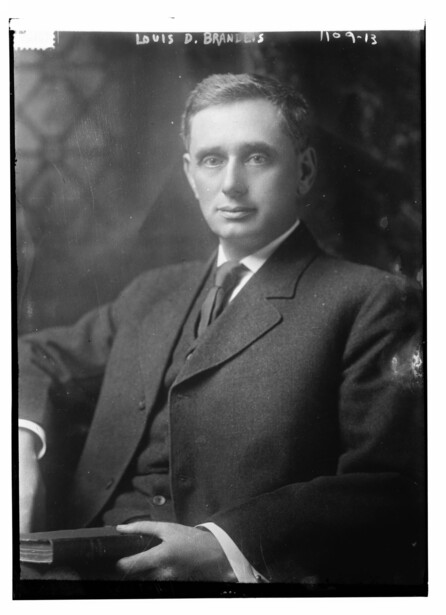
Bans on beaches were emotional. The deeper response was legal, and it produced one of the most influential documents in the history of American law. In December 1890, two Boston attorneys, Samuel Warren and Louis Brandeis, published an article in the Harvard Law Review titled "The Right to Privacy." Brandeis would later sit on the Supreme Court, and legal scholars still call this essay one of the most important law review articles ever written. It is usually described as a reaction to the camera. It is better described as a reaction to the press, in which the camera is one of the two instruments named.
The two lawyers named the threat directly. "Instantaneous photographs and newspaper enterprise have invaded the sacred precincts of private and domestic life," they wrote, warning that new mechanical devices threatened to make good on the prophecy that "what is whispered in the closet shall be proclaimed from the house-tops." They argued for something the common law had never quite recognized, a right simply to be let alone. The camera is in that argument, and so is the newsroom, and the newsroom takes most of the heat. The press, they wrote, "is overstepping in every direction the obvious bounds of propriety and of decency," and gossip "is no longer the resource of the idle and of the vicious, but has become a trade." The legal scholar Amy Gajda later turned up roughly sixty newspaper stories covering Warren and his family, including intrusive reporting on family tragedies, which is the likeliest explanation for why a Boston lawyer took the subject quite so personally. The stranger who could capture your image and publish it without permission was one instance of a larger complaint, not the whole of it.
Courts took years to catch up, and the early cases were unkind to plaintiffs. In 1902, a young woman named Abigail Roberson discovered her portrait printed on some 25,000 advertising posters for a flour company, used without her knowledge or consent. She sued, and New York's highest court rejected her claim. The public reaction to that decision was loud enough that the New York legislature responded the next year by passing a statute making it illegal to use a person's name or likeness for advertising or trade without written consent, the first privacy law of its kind in the country. Three years later, in 1905, the Georgia Supreme Court went further in the case of Paolo Pavesich, whose photograph had been used in a life insurance advertisement, and became the first state high court to recognize a broad right to privacy outright. The camera did not just change photography. It helped write a new branch of American law.
Cameras on Trial
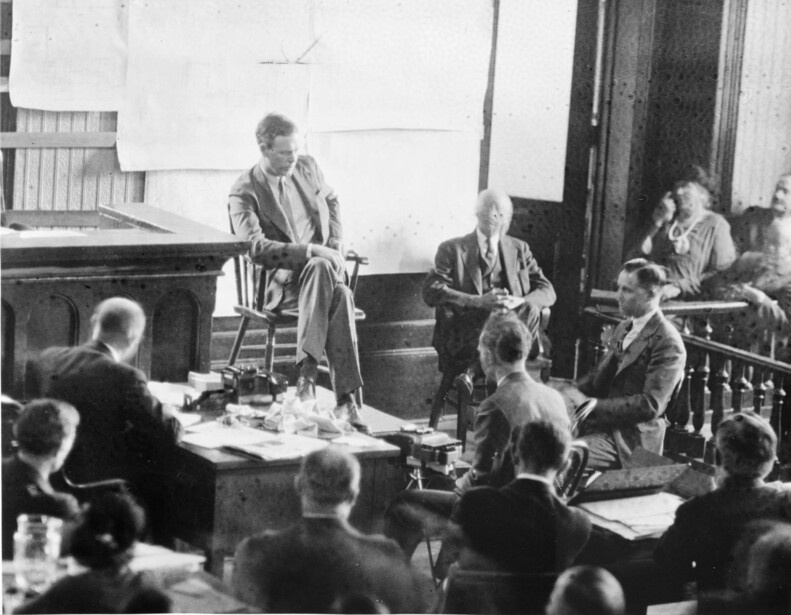
If the beach was the first place cameras were banned, the courtroom is the place they stayed banned the longest, and the reason is a single trial. In January 1935, Bruno Richard Hauptmann went on trial in Flemington, New Jersey, for the kidnapping and murder of the infant son of Charles Lindbergh, the most famous aviator on earth. About 700 journalists descended on the small town, among them roughly 120 news cameramen. The judge had agreed to limited newsreel filming with restrictions, but the coverage spiraled into a spectacle. Photographers jostled, flashbulbs fired, and footage that was supposed to stay out of the proceedings ended up in theaters.
The legal profession recoiled. In 1937, the American Bar Association adopted Canon 35 of its Canons of Judicial Ethics, declaring that photographing and broadcasting court proceedings degraded the dignity of the court and risked creating misconceptions in the public mind. Canon 35 was not a law, but state courts across the country adopted its logic, and cameras vanished from American courtrooms for decades. The federal system made it a formal rule. Rule 53 of the Federal Rules of Criminal Procedure, added in 1946, states plainly that a court must not permit photographs to be taken in the courtroom during proceedings or the broadcasting of those proceedings. That rule is still in force today, and in 1972 the Judicial Conference of the United States broadened the prohibition in the federal courts to cover broadcasting, televising, recording, and photographing in the courtroom and the areas right around it.
The Supreme Court took its own hard line, and the handful of exceptions prove how strict it was. At least three photographs of the Court in session have ever been published, every one of them taken surreptitiously and all three inside about five years. In 1932, the German photographer Erich Salomon faked a broken arm to hide a camera, caught the justices at the bench in the Old Senate Chamber, and Fortune ran the picture that October. In May 1937, an unidentified young woman cut a hole in her handbag, hid a small camera inside so only the lens peeked out, and practiced shooting from the hip until she could take a frame without looking. Time published it that June, the first photograph to show all nine justices in session and the only one made in the Court's new building. The third ran in New York's Daily News on October 5, 1937, showing the bench the previous day, when Hugo Black took his seat for the first time. Nobody knows who took it. To this day, the Supreme Court allows audio recordings of its arguments but no cameras of any kind.
The higher courts never fully reversed course, but they did bend. In 1965, the Supreme Court threw out the fraud conviction of Texas financier Billie Sol Estes, ruling that the chaotic television coverage of his trial had denied him due process. Sixteen years later, in the 1981 case Chandler v. Florida, the Court changed direction and held that the Constitution does not forbid states from letting cameras into their own criminal trials, and that a defendant who objects has to show the coverage actually prejudiced his trial. That decision opened the door to the televised state trials that later became national events. Federal criminal trials and the Supreme Court itself, though, stayed closed to the lens. Rule 53 still bars a camera from a federal criminal proceeding, and the Supreme Court has never let one in at all. Civil cases are where the federal courts have given any ground, and not much: a pilot ran in fourteen district courts from 2011 to 2015, and the Ninth Circuit allowed three of them, Northern California, Western Washington and Guam, to carry on afterward, with the court running the camera itself rather than a broadcaster. That is why the highest court in the country is still one of the few major American institutions you cannot photograph at work.
When Your Camera Made You a Suspect
War turned camera bans from a matter of manners into a matter of survival. In both world wars, governments treated the private camera as a potential espionage tool, and pointing one at the wrong thing could get you arrested. When Britain went to war in September 1939, the War Office issued the Control of Photography Order, which prohibited photographing or filming almost anything connected to the war effort, from troop movements and docks to damaged buildings and crashed aircraft. In the United States after Pearl Harbor, authorities restricted photography along stretches of the coastline, treating a camera near a harbor or a defense installation as a threat.
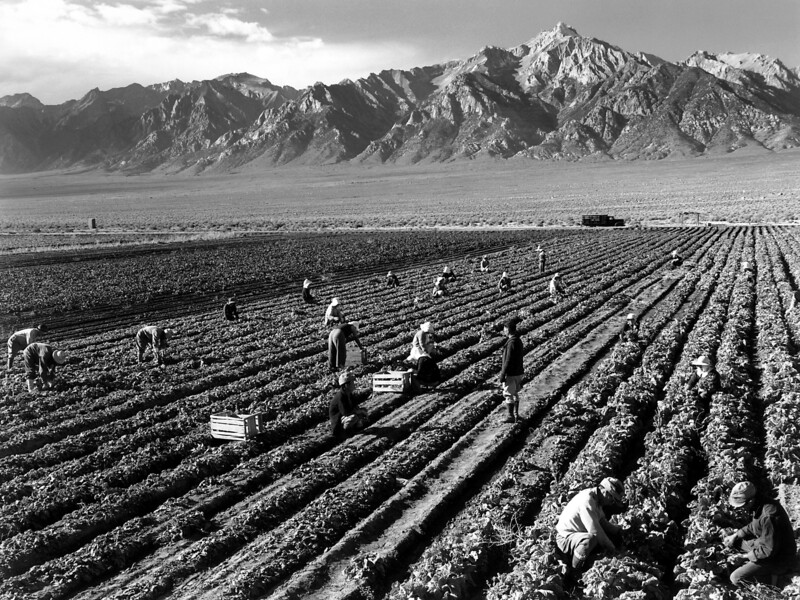
For Japanese Americans, the camera became evidence of disloyalty by definition. Under the incarceration ordered in 1942, cameras were classified as contraband alongside shortwave radios and firearms, and families were forced to surrender them. Inside the camps, photography by the incarcerated was forbidden. The Los Angeles portrait photographer Toyo Miyatake refused to accept that. He smuggled a camera lens and a film holder into the Manzanar camp, built a wooden camera body around them, and secretly documented life behind the barbed wire, at first in defiance of the rules and later with grudging official permission. His photographs are now among the most important visual records of the entire episode.
Soldiers faced their own version of the ban. Ordinary troops were generally not supposed to carry personal cameras into the field, yet enforcing that was hopeless. The snapshots that survived, taken on cheap folding cameras and box Brownies, form a huge and irreplaceable archive of the war as fighting men actually saw it. In one much-repeated case, a British soldier had his wife mail him his Kodak Brownie inside a food parcel, tucked between a ham and a fruit cake. The official rules said no. The human impulse to record what you are living through said otherwise, and it usually won.
The Bans That Never Left
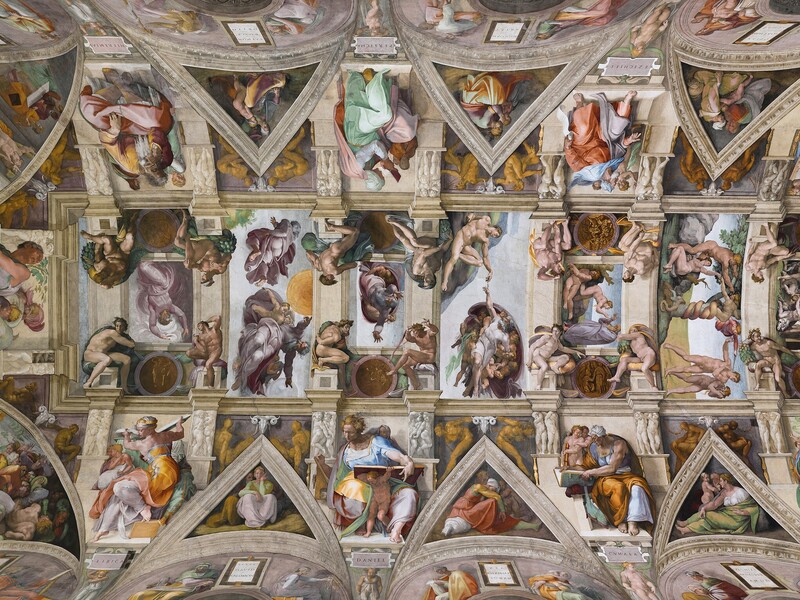
Plenty of camera bans are still with us, and their reasons run from the noble to the frankly commercial. The most famous of them hangs over the Sistine Chapel. Photography there is prohibited, and the reason begins with money. When the Vatican decided in 1980 to undertake a full restoration of Michelangelo's frescoes, the cost was enormous, so it accepted funding from the Nippon Television Network Corporation of Japan in exchange for exclusive rights to photograph and film the restored ceiling. For years, any authorized reproduction had to go through the Japanese broadcaster. Those exclusive rights have long since expired, yet the ban stayed. The Vatican now points to a more practical concern, the cumulative effect of countless camera flashes and the need to keep enormous crowds moving through a small, sacred room.
Copyright drives the newest bans too. Recording a film in a movie theater was once a matter of getting thrown out by an usher. Since 2005, in the United States, it is a federal crime. The Family Entertainment and Copyright Act, signed that April, made it a felony to knowingly use a camera to record a movie during a theatrical screening, punishable by years in prison, and it is why theater staff can now legally treat a raised phone as a potential offense rather than a nuisance.
Some modern bans got proposed and beaten back, which is its own kind of history, though the New York subway belongs in the earlier part of this story too. Filming and picture-taking underground had been prohibited since the 1930s, and that rule survived until 1994. Ten years after it was repealed, at the request of the police, New York's transit authority proposed banning photography across the system again, on the theory that pictures could help terrorists plan attacks. Photographers organized, civil liberties groups objected, and roughly a hundred people staged protest shoots in the stations. The proposal was raised, reconsidered, and finally dropped by 2005. Photography in the New York subway remains legal to this day, with tripods and professional lighting the only real restrictions. The argument was the same one made about the beach in 1890, that a camera in a public place is a threat, and this time the camera won.
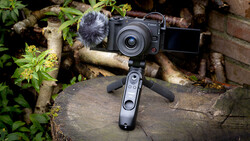
Look at the whole arc and a pattern emerges. Every time a new camera makes it easier to capture people without their cooperation, society flinches, reaches for a ban, and then slowly makes its peace once the technology becomes too common to fight. The vest camera provoked vigilance committees. The Kodak provoked beach notices and helped provoke a new theory of privacy law. Now the smartphone in every pocket is a Kodak fiend that never runs out of film, and the anxieties have simply moved to facial recognition, drones, and the question of who owns the image once it leaves your hands. Even the hardware rhymes with the past. A pocketable modern rangefinder-style camera like the Fujifilm X100VI is popular in part because it looks and feels like the discreet street cameras that scandalized the 1890s. The tool that people once tried to outlaw on the sand is now the one you carry everywhere, point at everything, and rarely stop to think about at all.
Lead image: an original Kodak roll-film box camera, the leather-covered box that turned snapshot photography into a mass hobby. Photo by Bronger, CC0. Source.
.jpg)

.jpg)


Join the Fstoppers community for free
-
Post comments and join in the discussions
-
Browse the site ad-free
-
Share your work and get featured in the community
-
Compete in the photo contests for fun and prizes
No comments yet