A modern camera can handle extreme dynamic range at sunset, but the camera alone will not build the image. In a place like Fjordland National Park, light moves fast, and composition decisions matter more than gear.
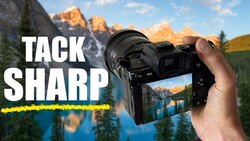
Coming to you from William Patino, this thoughtful video follows Patino as he heads into the mountains with the Sony a7R V. He plans for a wide scene from the start. Big sky, layered mountains, river, forest. That sounds simple until the wind ruins the reflections and the “perfect” foreground falls flat. You watch him walk away from a decent view because the water sits in that awkward middle ground, not still, not dynamic. That small decision is the point. You do not need to shoot every promising scene. You need one that works.
Patino talks about the anxiety that creeps in when the sky starts lighting up. Heart rate rises. You rush. You force frames. He pushes back on that instinct. One strong image beats 20 average ones. He narrows the scene to a single mountain peak rather than an entire ridgeline. That peak becomes the anchor. From there, he builds layers with intention. Ferns in the foreground. A river that curves from wide to narrow. Twin peaks and a hanging valley waterfall in the distance. The 10mm lens exaggerates depth, but only if you place elements carefully. Wide angle is not point and shoot. It is placement, inches at a time.
Settings matter, but not in the way many think. He shoots at f/11 to hold depth from the close ferns to the mountains. Shutter speed hovers around 1/5 to 1/3 of a second to add slight motion to the river. ISO moves to 200 as light drops. What he protects are the highlights. He lets the histogram push close to the right without clipping. Shadows can lift later. Bright clouds cannot be recovered once blown. You see the raw file compared to the processed version, and the dynamic range holds together because of that exposure choice. The frame feels luminous without looking brittle.
There is also a shift in direction that changes everything. Early on, he plans to face north. The cloud drifts. Color disappears. Instead of stubbornly sticking to the original idea, he turns toward the active sky. Subject and light must align. Great clouds over a weak subject do nothing. A strong mountain under flat sky does little. He combines both. He also adjusts the horizon placement with the ultra wide lens. If you center the horizon at 10mm, mountains shrink and recede. A slight downward tilt stretches them upward and restores presence. Subtle move. Big difference.
Later, he reviews horizontal and vertical frames. He admits vertical compositions are harder. With a horizontal frame, he balances ridges on both sides and lets the river taper inward. In one version, ferns fill the lower edge. In another, he leaves breathing room for the water. He even tries lupin flowers in the foreground, then questions whether they belong. He steps away from the files to let them sit before making a final choice. That pause keeps emotion from deciding too quickly. Check out the video above for the full rundown from Patino.
Join the Fstoppers community for free
-
Post comments and join in the discussions
-
Browse the site ad-free
-
Share your work and get featured in the community
-
Compete in the photo contests for fun and prizes
3 Comments
Yes a 10mm is wide almost like doing a panorama but with the top and bottom, BUT what you get is far away things are far away in the image. Here it works due to high mountains and appear close and is great photography like capturing in a city with very tall buildings keeping the camera level and things look like you are there.
The key in getting a natural panorama is the MM length used. to make it work a long lens or telephoto but in portrait view to get the high and low stuff. A low priced on Amazon Panorama rig just $100 or so with a degree selector on its base for the merge of images.
A little advice of using ultra wide lenses doing Astro Milky Ways and that is the capture of the trail in the stars will be horizonal straight across the image like using a 10mm or even a 12mm or even 14mm. Why use them? They are great when doing a panorama in portrait view for say a July or even August pano the top of the arch will be over your head and a little beyond some. In portrait view you get higher with more stars above the arch and in post editing merging all images you will get almost a 3x2 image vs a pano narrow image. The same goes for daytime images.
For us in the US ever go to Horse Shoe Canyon you will see photographers doing multi row panoramas standing on the very edge with tripod and in wind. But using that 10mm lens in just one capture you get the river below as well as the clouds above and sharpness all the way to the mountains on the horizon. I did it with the Voigtlander HELIAR-HYPER WIDE 10mm F5.6 in 2017 in one capture on the A7RM2
Also a visit to the Florida Caverns State Park using Voigtlander HELIAR-HYPER WIDE 10mm F5.6 on the A7SM1 you get more than any postcard.
Also for indoors at Antelope Canyon the then New FE 12-24mm F/4 G on the A7RM2 you also get in one capture more in a image.
And also at the Grand Canyon even at night all the way down to the Angel Trail to the stars above all in one capture again on the A7RM2 + FE 12-24mm F4 OSS
A little info about the A7RM2 on the top dial there a panorama selection and you can use any MM lens and you can do a panorama in camera just learn the speed you move the camera.
A little more help like the new Laowa 10mm f/2.8 Zero-D FF there is a very small and smaller E 10- 18mm (15-27mm in 35mm) F4 OSS with threads for filters up front that can be used at 12-18mm in Full Frame Mode if you want to have a small lens in your pocket on a hike vs a big FE 12-24mm with extra filter holder and big glass filters.
It is a good reminder that the camera is only part of the process. Patino showing the patience to walk away from an almost decent scene says a lot about knowing what will actually work. In places like Fjordland the light changes so quickly that every choice matters. I feel the same when working on projects at https://www.britishbookdesign.co.uk because not every idea or draft should be used. The right one always stands out when you slow down and choose with intention.