Layered ridgelines, each one a shade paler than the one in front of it, are among the most sought-after images in mountain landscape work, and they depend on haze, cloud, and low-angle light that no one can schedule. Getting them usually means showing up at the same summit again and again, often before dawn, with no promise that the sky will cooperate.
After two weeks of predawn hikes across northern Washington, Adrian Vila of aows sets an alarm for 3:30 a.m. and heads for a fire lookout that might finally produce that stacked-ridge shot. The route is a 5.5-mile round trip with roughly 2,300 feet of climbing, nearly all of it walked by flashlight. Near the top, the trail turns into a boulder field you have to scramble over to reach the lookout. Hiking solo in the dark, Vila plays a podcast out loud so animals hear someone coming and don't get surprised. The other habit is keeping your eyes fixed on the trail ahead, because a flashlight beam throws moving shadows that take the shape of whatever you're already nervous about.
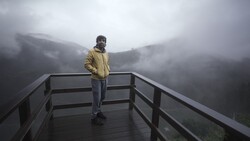
At the summit, the forecast gamble shows up as a thick bank of low clouds parked exactly where the North Cascades peaks should be. Packing up would be the obvious move. Instead, Vila recalls a sunset at Sahale Glacier the week before, where heavy cloud produced stronger photos than the clear morning that followed. So the cameras come out, and the clouds start rolling over the ridges, opening and closing scenes every few seconds. Hours pass, and hundreds of frames pile up on the cards. The sunrise itself never gets colorful, though the light still does plenty of work.
The look Vila is chasing comes from atmospheric perspective. Moisture, dust, and haze scatter light, so each ridge farther from you loses contrast and drifts toward the color of the sky. Leonardo da Vinci wrote about the effect, and landscape painters leaned on it for centuries to fake depth on a flat canvas. In a camera, you can push it further by shooting toward the light or with it raking from the side, and by using a longer focal length so the ridges compress and stack tightly in the frame. Cloud forecasting has also gotten far more useful for this kind of work. Apps like Windy break cloud cover into low, medium, and high layers, which gives you a rough sense of whether a bank will sit below your viewpoint, above it, or right at your elevation. Cloud below a summit can give you a sea of mist with peaks poking through, while cloud at summit level usually means standing inside fog. None of it guarantees a result, so returning to a spot you already know lets you spend your energy on reading the conditions instead of finding the trail.
This was the second visit to the lookout, and the first came only a couple of days earlier, on a crowded Sunday morning with a clear sky and a late start. The video shows only a short clip from that day, but it holds the exact image the whole two weeks had been building toward. He comes away convinced that it's always worth going back to the same locations.
The descent is its own test. The last 3 miles are steep and rocky, the shoes turn out to be a bit too small, and every downhill step jams the toes, even with hiking poles. Daylight finally reveals the forest that was invisible on the way up, and lower down, the trail drops straight into the cloud layer, wrapping the trees in fog. Finding images there means stopping completely to look around, since the slippery rock leaves no room for scanning the scenery while walking.
The image Vila spent two weeks chasing is in the video above.
Join the Fstoppers community for free
-
Post comments and join in the discussions
-
Browse the site ad-free
-
Share your work and get featured in the community
-
Compete in the photo contests for fun and prizes
No comments yet