
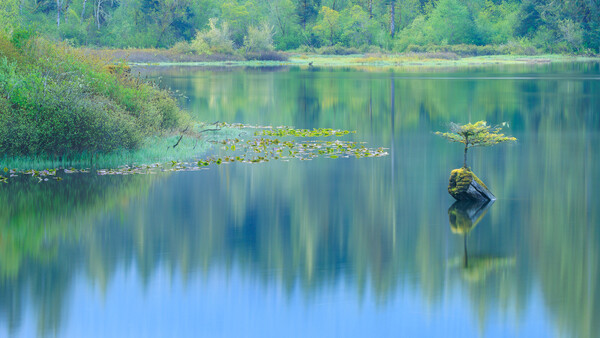
Are we making photos to be seen or to be felt? Today, photographers navigate between creating content for attention and creating meaning for expression—a choice that shapes not just our work, but how we experience it.
Photography has always had different disciplines and intentions: documentary, photojournalism, commercial, and fine art, to name a few. Each comes with its own standards, audiences, and purposes. Many have subgenres and can be approached with myriad styles. What feels newer is a growing divide between making photographs as “content” and making them as “meaning.” Where you sit on that spectrum shapes not only the images you create but also how you feel about them.
Working Definitions
I’m sure we each have our own nuanced understanding of these terms. But for the sake of this discussion, I’ll share my own definition that I use here.
Creating content means producing images primarily to share, usually on social media. It’s typically less about the subject itself and more about its shareability, its potential to catch attention, and its fit with current trends.
Creating meaning means crafting images to explore or express ideas, concepts, or emotions. Here, the work doesn’t depend on how many likes it earns but on whether it resonates with you (and maybe a smaller, more attentive audience).
Creating Content
Scroll through Instagram or TikTok, and you’ll see plenty of content-driven photography: overhead drone shots of similar compositions, portraits in trending styles, certain locations in certain conditions, or clever “before-and-after” edits meant to go viral. The goal is impact—measured in reach, likes, and follows.
Content-driven photography is built on extrinsic rewards. Engagement provides that quick dopamine hit, a visible scorecard of how well you’re “winning.” But the flip side is that this mode can make photography feel like a constant competition—and a never-ending one at that. Trends shift, algorithms change, and you’re always trying to keep up. The work itself can start to feel shallow, and it’s harder for both you and your viewers to form deep emotional bonds with the images.
That said, the upsides are real. A larger audience can open doors to sponsorships, commissions, or visibility. It can provide you with customers for other work, such as photobooks or zines. And the game itself can be thrilling when you’re on the winning side. For some photographers, this chase is energizing, motivating them to get out with their camera.
Creating Meaning
On the other side, meaning-based photography isn’t about the algorithm—it’s about the idea behind the image. Approached in a more traditionally artistic sense, this type of creation is an opportunity to study the world, yourself, and the plethora of relationships that fill it. You might take on a personal project documenting your neighborhood, an abstract exploration of light and shape, or a quiet landscape you return to year after year. The underpinning purpose is expression, discovery, or even catharsis.
This approach is driven by intrinsic rewards. The satisfaction comes from the act of making and the insights it gives you, not from how many people double-tap on a post. Instead of a win/lose game, it’s an open-ended process of experimentation and exploration.
The upsides here are powerful—freedom to create what resonates, opportunities to communicate your worldview, and the joy of following your curiosity wherever it leads. But there’s a cost: this work requires vulnerability. When someone dismisses a photograph that carries personal meaning, it can feel like a rejection of you, not just the image. And because there isn’t an algorithm or trend nudging you forward, you alone must decide what’s worth pursuing.
Why Does This Even Matter?
Much of today’s self-teaching content in photography—YouTube tutorials, reels, even many ebooks—is geared toward content creation. It’s built for visibility, and the style it encourages often prioritizes what looks striking in a feed. For beginners, it’s easy to confuse popularity with quality. These influences can waste your time early in your journey, point you down an unrewarding path, or, even worse, lead you to abandon photography altogether if your images don’t rack up engagement.
For those more drawn to meaning, this landscape can feel disheartening. Swimming against the current of content culture often means less feedback and less recognition. It can lead photographers to question the value or validity of their work. Understanding the distinction helps you wade through the noise, choose the right learning path, and stay motivated by the kind of success that actually matters to you.
Recognizing which mode drives your photography isn’t just a theoretical exercise—knowing whether you’re chasing extrinsic or intrinsic rewards gives you clarity. It shapes how you approach your work, which skills you prioritize, and how you define success. It empowers you to wade through the noise to choose the right learning path for your own journey. Knowing whether you’re creating for attention or for expression can prevent frustration and help you focus on projects that truly resonate. Even a small awareness of your intent allows you to make more deliberate choices in subject, style, and process, keeping your photography aligned with what matters to you most.
Is One Way of Creating Better?
Unsurprisingly, neither is universally better. It depends on what you want from your photography. Some thrive on the extrinsic rewards of creating content; others prefer the slower, intrinsic rewards of creating meaning. Many find themselves somewhere in between.
There are many ways to straddle both paths. You might shoot trendy content for your job while pursuing meaningful projects as a personal outlet. Or you might weave a meaningful subject into a popular trend, giving it both resonance and reach. Professional work often blurs these lines further: a brand might hire you to make content, but they still want that content to meaningfully represent their identity.
The key is recognizing which mode you’re in at any given time. That awareness helps you optimize your decisions, whether you’re playing the algorithm’s game or following your own explorations.
Closing Thought
Whether you’re creating content, meaning, or both, being intentional about which hat you’re wearing matters. Each path offers rewards and risks. The important thing is to know why you’re creating in a given moment—and to let that guide your next click of the shutter.
Have you ever felt torn between chasing engagement and creating work that feels meaningful to you? How do you navigate that balance?





Join the Fstoppers community for free
-
Post comments and join in the discussions
-
Browse the site ad-free
-
Share your work and get featured in the community
-
Compete in the photo contests for fun and prizes
21 Comments
No internal conflict here... I'm not particularly concerned with either shareability or concepts. I create images of subjects that are visually interesting to me. No more complicated than that. Might be different depending on the mood. Some days it's a flower or vegetable at home; other days I feel like shooting landscapes. I suppose my images are rooted in my own emotional response to the subject and hope that someone will buy one of my prints, but I have no expectations that the same emotional response will be shared by the viewer.
This is one thing that you and I see exactly the same way. I could have written what you wrote word for word, and it would be 100% true for me. Except the flower of vegetable at home part .... lol
Try it... it makes a trip to the grocery store a lot more fun for me.
Oh ... when you said "vegetable at home" I assumed you meant something that you grew yourself.
Ditto with "flower" ..... to me, flowers at home doesn't mean something that you get somewhere and bring home, rather, that phrase means flowers that grow in your yard.
So thanks for replying, because now I understand that you meant something very different than what I thought you had meant.
We do have some flowers and vegetables we grow at home, but since I shoot a lot of that type work, I search high and low for those subjects. Kind of like your wildlife, but no so far. Generally around town is sufficient. I never bring my camera into the grocery store though. Even if I don't like the food, I'll buy it, bring it home and shoot with proper lighting. Sometimes I feel a little weird standing around in the store looking at peppers for several minutes.
Very reasonable Deleted User and Tom Reichner -- photography doesn't have to be some highbrow or arcane pursuit. To me though, photographing what appeals to you is creating "meaning" in your images based on that emotion. It might not be meaning in pursuit of some philosophical concept or larger expression, and is just "this is what catches my attention right now." It's primarily how I photograph as well...although like Tom I might skip vegetables and most flowers 😆
Beautifully written.
For me, the real divide isn’t between content and meaning, but between giving answers and asking questions. “Touching” images that we scroll through offer quick emotional closure; meaningful work slows us down and leaves space for reflection.
Both belong to creative practice, and both stand apart from the purely technical. The difference is in what they do: one moves, the other holds. That’s the balance I try to keep — to create work that holds, not just moves.
How does the difference between "move" and "hold" as a response to your images direct or influence your approach to making a picture in the first place? What gives you a clue that someone might stick around long enough to ponder the questions raised by one of your images? Just curious what goes through your mind in anticipation of clicking the shutter.
Thank you, Ed — that’s a great question. What goes through my mind before pressing the shutter is mostly analysis, not inspiration. I look for a scene that can survive movement: where lines, light, or depth will hold even when everything else begins to dissolve. If the frame can’t keep a structure, the abstraction turns into chaos, and that’s never interesting to me.
So I’m not looking for subjects, but for resistance, for something that won’t fall apart completely when I move the camera. If the image works, the viewer stops for a moment to reassemble it, and that’s when it starts to function as intended.
I don't understand what you mean when you use the phrases "hold even when everything else begins to dissolve" and "keep a structure".
Could you please explain what you mean, but in plain direct literal words that are devoid of metaphor?
That’s absolutely fair, not understanding is perfectly normal. What I mean by those phrases is described more precisely in my writings, because it’s quite specific to how I work. In short, I’m trying to find scenes where motion doesn’t destroy the image completely. If you’re curious, I’ve written about it in more detail on my website or in my Medium essays. (Link in my profile).
Oh, you're talking about intentional camera movement "blur" shots. Now those phrases make sense. But without that context, it was rather impossible to know what you were saying. If we have no idea what genre of photography you do, then it is understandable that some of us would be confused by those phrases. Context is everything.
Yes, of course, you’re right. I was replying to Ed, who knows the context; we had discussed it earlier.
I particularly like the way you frame your images. You obviously pay close attention to the edges of the frame and are intentional about exactly where the objects in the frame get cut off.
You are also intentional about how much negative space exists between the edge of the frame and an eye-catching object, such as the red chair in image #1. If there were any less space between the edge of the frame and that chair, there would be a nervous tension, and tension in a composition is indeed a BAD thing, no matter what some misguided goofballs might tell you.
Thanks, Tom. I appreciate your observations. Those are precisely the thoughts going through my mind while composing the photo, as well as in the post-processing stage for what details I may have missed during the shoot. Probably comes from my background in printing and graphic design where margins, spacing and overall balance are critical. I've stared at a picture for a long time before finally deciding to crop a seemingly insignificant half-inch on one side. It's all in the details, despite the idea proposed by many people that story and messaging is really all that matters at the expense of technicalities.
Thanks Alvin Greis ! Very interesting perspective about moving and holding, through asking or answering questions. It feels related although different from producing content or actual meaning. I could see a documentarian answering questions through meaningful work, while someone else at the same event (a street photographer maybe?) creating meaning by asking questions.
Do you think that answering questions in meaningful work leads to that same "touching" or moving in the audience? Or is it different than providing answers in something generated more as content?
That’s an excellent question, and honestly, I’m still looking for the answer myself.
But I believe it not only can, it should. Not as a fixed goal, but as a direction, a form of striving. Photography, I think, can create its own kind of question, not verbal, not direct, but visual.
To me, among street photographers, Bruce Gilden comes close in a different way: his images don’t leave the viewer indifferent, they unsettle. They don’t ask politely, they confront, and by doing so, they provoke questions. But everyone has their own path.
I think it’s great when a photograph has two layers: one content-oriented that grabs attention on the surface, and another where meaning unfolds or the author leaves a subtle hint.
That's a great point, Alvin. There really isn't anything that says that you can't generate content from a deeper, more meaningful place. Although personally I find it easier to keep the distinction, it does add another layer of engagement to a photo!
Adam Matthews wrote:
"For beginners, it’s easy to confuse popularity with quality."
So true! Not only beginners make this mistake, but even seasoned photographers.
A friend was here at my house a couple years ago, and we were looking through my photos on the computer. He saw one of a Whitetail buck in snow and had quite a reaction to it. He kept saying, "Why haven't you put this on Instagram? It would get a thousand likes!"
I shrugged and said that there were a few things about that image that bothered me; I wasn't fully satisfied with the aesthetics, so I didn't want to put it there because it isn't representative of what I am all about, from an aesthetic standpoint. The background is too messy for me.
Over the following weeks he kept texting "when you gonna put that shot up on your Instagram?"
So I finally put it there. Yeah, it got lots of likes, but there wasn't any inner satisfaction from that. "Likes" just don't do it for me. Do I regret putting that photo up on Insta? No. It made people happy to see it, and it made my friend happy. So it's all good.
That pic just recently sold on my Fine Art America site. So yeah it is a "successful" image. But it doesn't give me that deep inner fulfillment that I get from so many of my other photos, because I don't like the way it looks. Yet those photos that give me so much real satisfaction would not get many likes, or sell very well.
But I will keep shooting for myself and what makes me feel satisfied, and not change the way I shoot just to get likes and followers (which I don't care about anyway). Every now and then, what I like will happen to be the same as the masses like, so when that happens I may post the pic. Or not.
Cluttered and distracting backgrounds are a total deal-breaker for me when considering a subject to photograph. Most amateurs don't even see what's in the background. Most of the general public is solely focused on the subject as well. But after 20 years of photography, if I don't know what makes for a superior photograph, regardless of public opinion, I should probably quit trying to be a photographer. Trust your own instincts.
Very interesting story Tom Reichner ! I do think it can be had for non-photographers to understand why we might not be happy with a photo that they would be thrilled to have taken. As someone with extremely basic wildlife photography skills, your image of the Whitetail buck does look great. That's a pretty typical background around here, so whenever I see (less impressive) deer it's with that background....so it being busy doesn't bother me at all, especially since it's somewhat out of focus.
It's a great example of how personal photography is, though!