
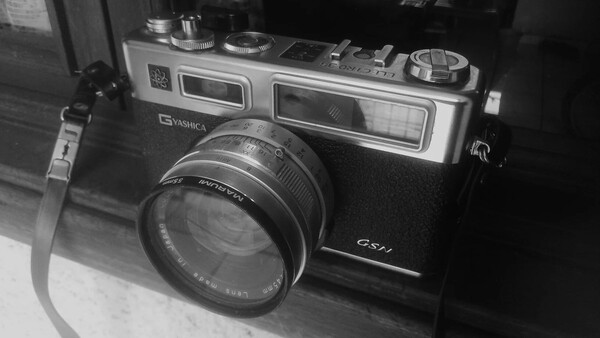
There's a camera on my shelf that changed how I look at the world: a Yashica Electro 35 GSN. Heavy. Honest. A rangefinder that asked nothing of me except to slow down and pay attention. The 45mm lens acts as a "normal" or standard field of view on the camera's 35mm full frame format, allowing you to make everything from street photography to portraits. That camera is part of why I photograph the way I do today. The company that made it doesn't exist anymore.
What wears its name now is something else. A Hong Kong-based trademark holder, MF Jebsen Group, bought the rights in 2008, and the name's owners have spent the years since renting out nostalgia to people who never got the memo. And what they've been selling under that borrowed name is, frankly, an insult to everyone who ever loaded a roll of film into a real Yashica.
Let's talk about the Y35.
In 2017, "Yashica" launched a Kickstarter for a digital camera dressed up as a film camera. A winding lever that winds nothing. Cartridges, plastic, fake, "digiFilm," that you insert to change the look of your JPEGs. No film inside. No chemistry. No risk, no cost, no ritual. Just software, pretending. Pretending to give me (us) the idea of shooting with a film camera, through the comfort of digital.
People bought it anyway. Over a million dollars in pledges. Thousands of backers who wanted the feeling of film without any of the discipline film demands. And when the cameras shipped, the reviews were brutal: cheap builds, disappointing images, backers who felt catfished. It was a toy pretending to be a tool. A gesture pretending to be a process. A joke.
Here's the part that should make every photographer uncomfortable: it worked. It worked because there's real hunger out there for something analog gave us—presence, patience, weight—and this company figured out you could fake the feeling and sell it back at a markup. You don't need film. You just need a lever that clicks.
Fast forward. The name resurfaces again with the FX-D, styled after the old FX-3 SLR, another crowdfunding smash, another fake advance lever that "glides ahead, guiding your mind into focus," according to the marketing copy, as if turning a plastic stick were a substitute for actually understanding exposure, light, timing. Six built-in "film simulation" filters. Software cosplaying as chemistry.
None of this is about hating digital. You know that I'm not a purist waving a flag for silver halide. Digital cameras are tools, and good tools deserve respect. What I can't respect is this: taking a name that meant craft, meant mechanical honesty, meant a real relationship between a photographer and their machine, and hollowing it out to sell a fidget spinner with a lens cap. Ask yourself what you're actually buying when you back one of these campaigns. Not a camera. Not film. Not even, really, nostalgia, because nostalgia requires memory, and most of the people funding these things never touched an original Yashica in their lives. What you're buying is a costume. A performance of analog, built for people who want the aesthetic of slowing down without ever having to slow down.
Honestly, my Electro 35 GSN never asked me to feel anything. It asked me to load film, meter the light, get close, and commit, because I only had 36 frames and no delete button. That's what taught me to see. Not a lever. Not a filter. The stakes. You can't manufacture stakes. You can only fake the lever that used to represent them.
Yashica, whatever's left of the glorious name, should know that. Instead, it keeps cashing checks from people who don't. I am sorry, Yashica, but until you change your business strategy, I am not buying it.




Join the Fstoppers community for free
-
Post comments and join in the discussions
-
Browse the site ad-free
-
Share your work and get featured in the community
-
Compete in the photo contests for fun and prizes
11 Comments
Couldn't agree more. Add to that slapping the name on the terribly built compact cameras using 10 year old mediocre (even then) smartphone sensors and adding software upscaling to sell it to people because there's a bigger number on the box!
I have feelings about Fujifilm doing this with their X-half too. Given the DxO One had an excellent lens in a much more pocketable body than the X-Half there's no excuse for that lens being as big and having only an f2.8 lens as it is. Cash grab and nothing more!
Which is a crying shame because it had the potential to make it more. Fine it's digital, but they could have added raw support for those using the film mode as an option. Compacts have such terrible processing normally that you'd probably want to reprocess it later if you got a really good one. But given it's their app, they could at least voluntarily restrict the editing you could do 'developing' a photo based on the film you selected for that run of images. I love shooting with the ME Super, but I can't really justify it often so I'd have paid for a bit of that experience if they hadn't hobbled it so much and wanted flagship money for it.
Totally agree, Ed. The X-Half is the perfect example of what you're describing. A fixed f2.8 lens on a camera that size, in 2026, is not a hardware limitation: it's a choice. Fujifilm knows exactly how to build small and fast, they've been doing it for a decade with the X100 line. So when the "half frame revival" camera ships with mediocre glass and a price tag that assumes nostalgia will cover the gap, that's not a design compromise. That's a business decision. To be clear: I was ambassador (Fujifilm X Photographer) for 6 years until they removed me in 2021 from their program because of my political ideas, yes, not joking. I reveal this because I know some internal strategies and I can confirm you are right. I can see that I was ambassador for them in their best period, and I can see now how at Fujifilm they lost their direction a bit.
Well that's killed my lust for the X/GFX series a bit 😅 though realistically I'm sure they've all got their less positive practices... They weren't going to make much out of me anyway. I like buying bargain bin and second hand for experiencing everything too much!
Appreciate the honesty though Alex.
I agree. The first 35mm film camera I used was mom's Yashica rangefinder. Yashica exists in old cameras. Otherwise, it is just a name that has been tarnished.
Yes, when I discovered that was a big deception.
I feel the same about my Yashica 6x6. That and my 1974 Olympus OM1 pretty much taught me most of what I needed to learn. Everything since is good, but not that good.
Oh, pretty sure those cameras are a great example how a camera should be made.
I think with the Yashica D taught me more than anything else was how to work within the incredible limits of the camera and instead use the advantages of the large negative. It taught me how to move with the camera instead of depending on a Zoom lens. I still use those techniques today.
Yes, there are cameras that can teach us. Thanks for sharing this.
"YASHICA, Japanese Camera Brand since 1949, with almost 70 years experience in camera and optics development." That's how the KickStarter campaign started. The product photos looked like it was a metal camera body and all the nostalgia came back. I was SOOOO disappointed when it finally came. I used it for about three days and then never again. I collect cameras and it's now in my collection--as an example of "Fool me once..."
Thanks, Steve, for sharing your experience. I know a lot of photographers were fooled by that campaign.