
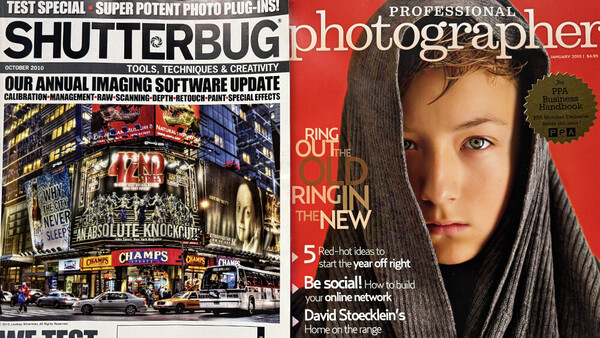
At a thrift shop the other day, I found a couple of relics. No, these weren't the usual camera finds, but rather 16-year-old photography magazines, specifically the now-shuttered Shutterbug and the still-active Professional Photographer. It got me thinking: How expensive has it become to be a photographer these days?
These magazines have a lot of print ads. This was 2010, after all, and a good many older photographers still probably got their information from magazines like these as opposed to the internet. Professional Photographer even had a piece in there about "Why you should care about social networking." How quaint.
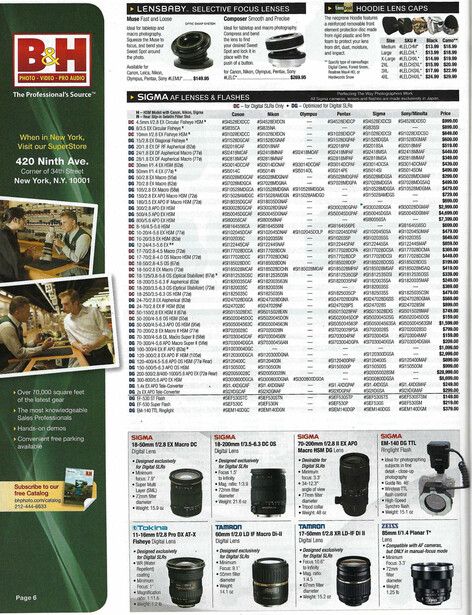
Companies like B&H Photo took out several pages in print publications back then and provided detailed price lists for basically every piece of photo equipment they sold, although they, and all the other authorized retailers, seemed to have some sort of unwritten rule about not showing prices for camera bodies of that era from the major manufacturers.
Still, one can glean a lot of information about pricing from what equivalent lenses cost. For instance, the first (and then-current) version of Canon's standard professional zoom, the EF 24-70mm f/2.8L USM lens, sold for $1,369 at B&H Photo in 2010, or about $2,075 in today's dollars. On a technical level, the current version, the EF 24-70mm f/2.8L II USM, goes for $2,199, which may not seem like a huge increase, but accounting for a new lens mount and therefore a new "current" lens, the RF 24-70mm f/2.8L IS USM, the price is actually $2,399. Tough to swallow, but there is image stabilization now, and in the current market, this wasn't as crazy an increase as I thought it would be.
If we look at something like the Canon EF 100-400mm f/4.5-5.6 IS USM, that lens was $1,610 in 2010 at B&H, or $2,460 today. It's a similar story, with the still-available-new successor, the Canon EF 100-400mm f/4.5-5.6L IS II USM Lens, sitting at $2,699, or the newer RF version, the Canon RF 100-500mm f/4.5-7.1L IS USM, at $2,799, but adding in an extra 100mm of range.
So why does it feel like things cost so much more money these days?
Well, one clue lies in the pages of the ads. There are entire pages dedicated to Sigma, Tamron, and other major third-party players in the lens game. That's a very different landscape from today. Canon has been rather restrictive with third-party lenses, initially not allowing any officially licensed third-party offerings on the RF mount, and only recently allowing APS-C RF-S lenses, and only from a select few manufacturers. Nikon has gone after Viltrox for its lenses on the Z mount. It's a much more hostile environment for cheaper lenses, and so it means buying expensive first-party lenses, and only those lenses, depending on the system you choose.
Another marked difference was that in 2010, software was still something you could buy rather than rent. The Adobe subscription model, the bane of many a photographer's wallet in 2026, was not even implemented until 2013. I know that when I bought the software once, I would often skip two or three versions before upgrading because there was no need. Today, there's still no need to keep upgrading to every version, and Adobe makes you pay anyway, for software that is arguably worse. This just adds another expense onto every photographer's plate just to have basic software to work on. If you want to take more control of your editing regardless of platform, the The Complete Capture One Editing Guide is a solid look at a leading alternative.
Are there other options? It sure felt like there were more that could compete against Adobe in 2010 as opposed to now.
Finally, there's the financials. Across all industries, salaries have not kept pace with the rising costs of living, but beyond that, things that used to be decent income streams for photographers, such as stock photography and print sales, have been completely upended by artificial intelligence and the fact that fewer people are printing their photos these days.
None of this even gets into the cost of accessories such as memory cards and hard drives, now that they've risen to astronomical prices between tariffs and AI needs.
So, if we're looking back at these blasts from the past, is it more expensive to be a photographer these days? Is that new level of expense worth it? Leave your thoughts in the comments below.


Join the Fstoppers community for free
-
Post comments and join in the discussions
-
Browse the site ad-free
-
Share your work and get featured in the community
-
Compete in the photo contests for fun and prizes
2 Comments
in my opinion it's pretty cheap to get into. it's not like you need the most baller bodies and the fanciest lenses out there, you can get by with an old bridge camera from 2010. even a sony a6000 can get as low as like 300€, and with a cheap 16-50mm lens you'll already be taking some nice pictures for under 500€.
Consumer electronics today are a real bargain compared to historical prices. My first digital camera, a 5 megapixel Olympus E1, cost $1,800 for just the body in 2003. Going back to the early days of personal computing, an Apple Macintosh Plus computer with 1 megabyte RAM cost $2,600 in 1986. And an Apple Laserwriter printer cost $7,000 (something like $20,000 in today's dollars). It's easy to see camera gear as expensive because, well, nearly everything else is indeed ridiculously expensive.
The cost of routine household items are absurd. I bought a new Jeep Grand Cherokee in 2003 for $25,000. Today... probably twice that or more. I could afford many such items 20 years ago that I can't today. If it weren't an affordability problem, car dealers wouldn't be offering all kinds of crazy financing options that keep someone in debt for the rest of their life. The median US price of a new home is over $400,000, and that doesn't buy much in a lot of cities. Property taxes and homeowners insurance are outrageous. Health insurance is so expensive that many young people do without and take their chances.
If things seem expensive today, it's because we have an affordability problem. Nearly everywhere, incomes have not risen as fast as inflation. It generally takes two incomes today to buy a house, which was not true when I bought my first in 1978, even with much higher interest rates back then. Incomes in many fields like photography and graphics have been decimated. I was in the printing business and the Internet drove prices to the point it was hard to give stuff away, besides the fact that nobody buys printing much any more. It was so much easier 30 years or more ago to make a good living producing tangible things that people actually needed, like business cards and brochures. Stock photography could make decent money. Nowadays if you're not finding a way to invent something new, and convince the world they need to upgrade or update, you're going nowhere. That's the world Adobe has created.
So it's not so much the idea that cameras seem expensive, but that it's far more difficult making money with them than ever before. Meanwhile so many people struggle to pay rent and groceries making everything feel like it's so expensive... even when a few things like cameras and electronics are relatively cheaper.