
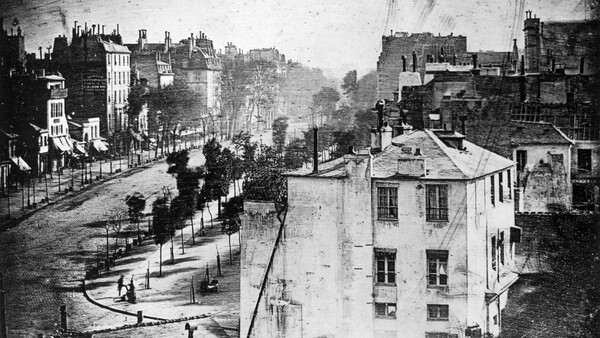
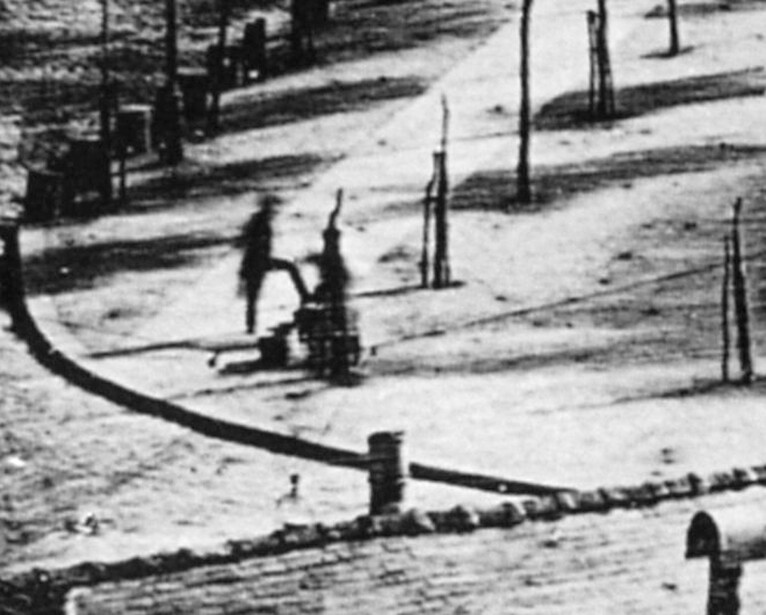
Look at the picture and you see an empty Paris street. Wide sidewalks, a row of trees, tall buildings, and almost no sign of life on what should have been a busy morning. Then your eye catches it: down in the lower left corner, one small figure stands with a foot up on a shoeshine box, and a second figure crouches at his feet. That man is widely considered the earliest identifiable human being in any surviving photograph, and nothing suggests anyone planned his place in history, least of all him.
The image is Louis Daguerre's Boulevard du Temple, made in Paris in 1838 and revealed in stages over the following year, first to private visitors, then to the world. Whether Daguerre meant to catch a person is unknowable now; no record says whether he even noticed the pair before the plate came out of the camera. What is certain is the physics. He pointed his camera out a studio window at a busy boulevard and let the plate soak up light for several minutes. Everything that moved spent too little time in any one spot to build a solid image, so the carriages, the crowds, and the horses faded to, at most, faint traces. The man who stood still long enough, apparently to have his boots shined, stayed put, and so he survived.
It is one of the strangest firsts in the history of the medium. The earliest known surviving photograph to show recognizable people is not a portrait at all. It is a long exposure that washed out an entire city and left two anonymous figures, read from the very beginning as a customer and his bootblack, frozen on a silver plate.
What You Are Actually Looking At
Daguerre made the plate from a window of his studio, which sat beside his famous Diorama theater near what is now the Place de la Republique. He was looking down and across the Boulevard du Temple, a wide, fashionable street lined with cafes and theaters. The view runs at an angle down the boulevard, with the near sidewalk sweeping across the bottom of the frame.
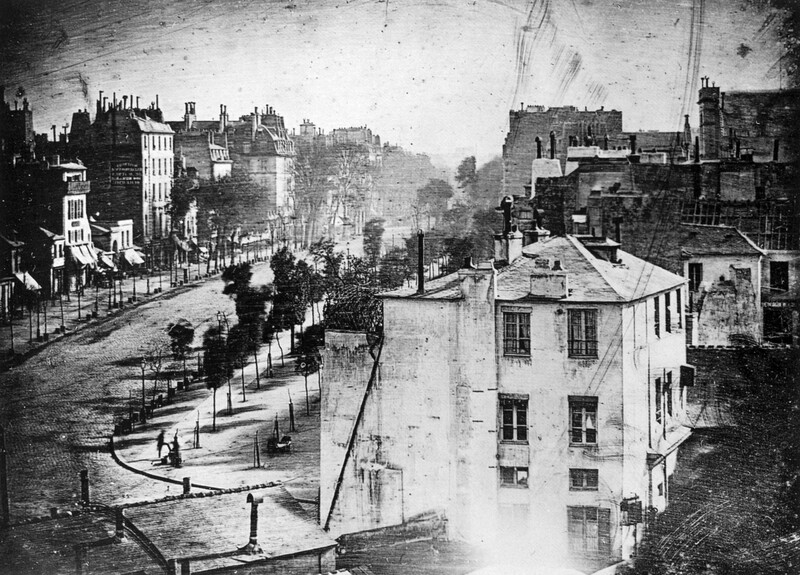
The plate itself is small, roughly 13 by 16 centimeters, a sheet of copper coated with a thin layer of polished silver. That mirror-bright surface is the whole trick of the process, and it is why the picture has the ghostly, engraved quality you see in reproductions. A daguerreotype is not a print you can hold up to the light. It is a one-of-a-kind object that shifts between a positive and a negative depending on how you tilt it, and every one Daguerre made carried the fine detail that later photographers would spend decades trying to match.
Historians place the exposure in the spring of 1838, probably on a morning between late April and early May, at around eight o'clock. Some accounts leave open the possibility of 1837. Either way, it predates the public unveiling of photography itself, which makes the survival of the plate all the more remarkable. And it was not a lone experiment: Daguerre exposed the same view again at midday, on a plate that also survives, and again in the evening, on one that has been lost. He was methodically studying his boulevard through the day, which is worth remembering whenever the morning plate gets told as a story of pure chance.
Why the Street Looks Empty
To understand the empty boulevard, you have to think about how a camera actually gathers light. A photograph is a record of everything that reached the plate during the time the lens was open. If the shutter is open for a thousandth of a second, the plate catches a single instant, and a running horse looks frozen. If the lens stays open for minutes, the plate catches an average of everything that passed, and anything moving smears thin, usually too thin to see.
Daguerre's process was slow. By 1838 he had cut his exposures down dramatically from the eight hours or more that his partner's earlier experiments demanded, but he was still working in minutes, not fractions of a second. Estimates for this particular plate vary. Some sources put it as low as four or five minutes, others stretch it to ten or fifteen, and figures in the range of seven to thirteen minutes get cited often. No exposure log survives, so every number is a reconstruction based on the process and the light. What is not in doubt is the scale: this was a matter of minutes, and minutes are enough to erase a city.
Think about what a busy boulevard looks like over ten minutes. Pedestrians walk the length of the block and are gone. Carriages roll through. Vendors move, horses shift, dogs cross the street. Every one of those moving things spends only a second or two on any given patch of the plate, far too little to build up a strong image against minutes of empty pavement. So they all but disappear, and close readers of the plate believe they can find what little remains: faint possible traces of other people, a horse, maybe a child watching from a window. The street reads as deserted not because it was empty but because it was too alive to photograph.
The man in the corner broke the pattern for what appears to be the most ordinary reason imaginable. Getting your boots shined takes a few minutes, and during those minutes you stand still. He held one position long enough for the light bouncing off him to accumulate on the plate, and the bootblack working at his feet held roughly still too. Two people among that morning's passersby happened to stop, and so two people entered the historical record while everyone else washed out.
The Mirror in the Machine
There is a detail that trips up almost everyone who studies the image closely: it is backward. Like any daguerreotype made without a reversing mirror or prism on the lens, Boulevard du Temple is laterally reversed, a mirror image of the real scene. What appears on the left of the plate was on the right in life, and vice versa. The daguerreotype process recorded the image directly onto the plate without a negative stage to flip it back, so left and right stay swapped.
This matters more than it sounds. For years, people tried to pin down exactly where on the boulevard the shoeshine happened, and the reversed geography sent some of them to the wrong corner. It is also a quiet reminder that these earliest photographs were physical objects with their own rules, not neutral windows onto the past. You are looking at a silvered mirror that happens to hold an image, and the image obeys the mirror.
A small group of researchers has even questioned whether the standing figure is a person at all, suggesting the shape could be a water pump or some other fixed street fixture. The bootblack reading remains by far the most widely accepted, and the crouched second figure is hard to explain as anything but a person at work. Still, the debate is a fair reminder of how much we are asking of a tiny, damaged, minutes-long smudge of silver.
Who Louis Daguerre Was
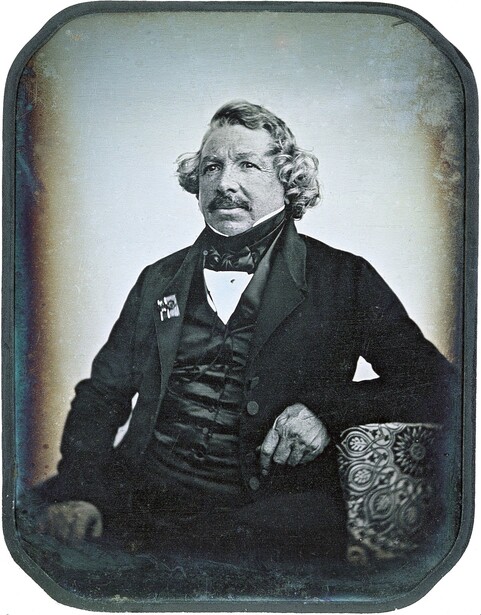
Louis-Jacques-Mande Daguerre was not a scientist by training. He was a showman and a painter, born in 1787, who made his name with the Diorama, a Paris spectacle of enormous painted scenes lit and manipulated so cleverly that audiences felt they were watching real landscapes shift through the hours. He was, in modern terms, a special-effects artist obsessed with illusion and light.
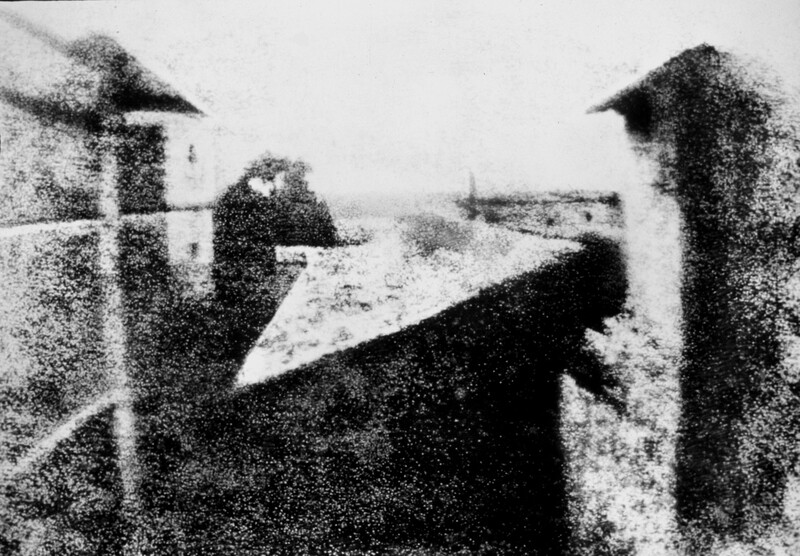
His path to photography ran through Joseph Nicephore Niepce, an inventor who had already managed to fix an image from a camera. Niepce's surviving View from the Window at Le Gras, made in the 1820s, is generally recognized as the earliest surviving photograph of a real scene. It shows rooftops and a courtyard, and it required an exposure so long that the sun appears to light both sides of the buildings, evidence of a duration traditionally put at about eight hours and argued by some modern scholars to have run far longer, perhaps over days. There are no people in it, and at that timescale no ordinary coming or going stood a chance of registering, though the physics never made a person strictly impossible; anyone who stayed planted long enough could have left a trace, exactly as Daguerre's shoeshine customer later did. Daguerre partnered with Niepce in 1829, and after Niepce died in 1833, Daguerre kept refining the chemistry until he had a process fast enough and sharp enough to matter.
That is the leap Boulevard du Temple represents. Niepce proved you could capture a place. Daguerre, cutting the exposure from hours to minutes, proved, whether he meant to or not, that you could capture a person, even one just standing on a corner getting his shoes cleaned.
1839: The Year Photography Went Public
Daguerre kept the exact method secret while he looked for a way to profit from it. The breakthrough came through Francois Arago, an influential astronomer and politician who saw the invention's importance and championed it before the French state. On January 7, 1839, Arago described the daguerreotype to the Academie des Sciences in Paris, announcing that photography existed without yet revealing how it worked.
The full recipe followed on August 19, 1839, when Arago laid out the process step by step before a packed joint session of the Academie des Sciences and the Academie des Beaux-Arts, with the overflow crowd spilling into the courtyard. A few insiders had already seen the results: Daguerre showed Boulevard du Temple to Samuel Morse at his studio that March, and Morse's astonished description ran in the American press within weeks. Rather than issue a French patent, the state struck a different bargain, granting Daguerre and Niepce's son lifetime pensions in exchange for full public disclosure, a gift described at the time as free to all. The gift stopped at the Channel, though. On August 14, five days before the announcement, an agent acting for Daguerre had patented the daguerreotype in England, and because patent rights ran country by country, British photographers still had to buy a license. Within months, photographers across the rest of Europe and the United States were coating their own silver plates and pointing cameras at anything that would hold still.
Boulevard du Temple sat right at that threshold. It was made before the public knew photography was possible, and it survived to become the proof of what the new medium could and could not yet do.
The Plate's Own Strange Afterlife
The original plate had a hard life. In October 1839, Daguerre presented it to King Ludwig I of Bavaria as part of a framed triptych of his work, and it eventually ended up at the Bavarian National Museum in Munich. The plate still exists, but its image barely does. Accounts describe poor storage conditions during the Second World War, and a restoration attempted after the plates were lent to the Munich City Museum in 1970 went so badly that some scholars now describe the original image as effectively destroyed. The version most of us know survives mostly through photographic reproductions made before the worst of the damage, above all the ones the historian Beaumont Newhall made after locating the plates in 1936 or 1937.
So the earliest known surviving photograph to show people is doubly a ghost. The people in it survived a long exposure that swallowed everyone else, and the picture itself survives mostly through pre-damage photographic reproductions. When you look at that man on the corner today, you are looking at a photograph of a ruined original, a stand-in for a smudge of silver that nearly did not make it. That fragility is part of why the image carries the weight it does.
How You Would Erase a Crowd Today
The physics that stranded that lone Parisian on his corner is the same physics you can play with on any modern camera. Point a camera at a busy plaza, set a long enough exposure, and the crowd melts into a soft blur or disappears entirely while the architecture stays razor sharp. Photographers use this on purpose all the time to clear tourists out of a famous landmark or to turn a river of car headlights into ribbons of light.
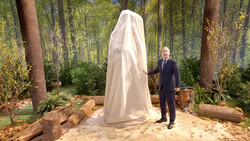
The difference is control. Daguerre was stuck at minutes because his chemistry was slow. You get there on your terms. In daylight you stack a strong neutral density filter in front of the lens to cut the light and stretch a bright-noon exposure out to seconds or minutes, and you lock everything down on a sturdy tripod so the still parts of the scene stay knife-sharp while the moving parts vanish. It is the same effect Daguerre's slow chemistry imposed on him, now brought under deliberate control: he could not avoid erasing the crowd, and you choose to. If you want to build this into a deliberate craft, especially in a dense city setting, the long-exposure and blending techniques in Elia Locardi's cityscape and astrophotography course cover the modern version of the same idea.
None of that changes what happened on the Boulevard du Temple. It just means the constraint became a tool. Every deliberately empty street and every glassy long-exposure seascape is a descendant of one man who stopped, by every early account to have his boots shined, and, without knowing it, became the earliest person a surviving photograph would show.
Lead image - the Boulevard du Temple daguerreotype by Louis Daguerre, 1838; public domain. Source.







Join the Fstoppers community for free
-
Post comments and join in the discussions
-
Browse the site ad-free
-
Share your work and get featured in the community
-
Compete in the photo contests for fun and prizes
4 Comments
Thank you Alex - you've been on a tear lately enlightening all of us with really interesting and well researched articles!
Thank you, Adam! Really enjoying writing them.
I never remember any article on the first human in a photograph being reversed so that readers would see the street scene as if standing there next to Daguerre. Why not?
Very nice article. Funny thing though; a few years ago i visited England and i went to Lacock Abbey. This medieval building was the house of William Henry Fox Talbot. Visiting a exibition on this site i learned that he was the inventor of the photographic negative. They show you the first ever photograph, of a window from the monastry. You can still see this window and stand in the exact spot where the photo was taken. Very exiting. But reading your story i feel something of an argument between the French and the British! Who is right?