

Getty Images image number 53509740 is still on Getty's site today, and the caption still reads: "Two residents wade through chest deep water after finding bread and soda from a local grocery store after Hurricane Katrina came through the area on August 29, 2005 in New Orleans, Louisiana." An Associated Press frame of a young Black man in chest-deep water, carrying what looks like a case of Pepsi under one arm and a full garbage bag, said he was looting. Two decades of argument later, the disputed wording is still there.
The pair became the standard American classroom example of caption bias, and it deserves the status. It also gets used to make an argument the record does not quite support, and the argument it actually supports is more useful to you if you shoot news. Two photographers, working for two agencies, in a drowned city, each typed a verb into a metadata field. One verb accused a stranger of a crime. Once the agencies transmitted them, both verbs went out to millions of screens with nothing downstream touching them again, and that mechanism works the same way today.
What the Two Captions Actually Said
The AP frame was made by Dave Martin, a staff photographer who joined the wire in Montgomery, Alabama, in 1983 and was named AP's regional photo editor for the South in 2004. He shot Katrina, the Deepwater Horizon spill, and the 2011 Alabama tornadoes, and he died of an apparent heart attack on January 1, 2014, at 59, after working the sideline at the Chick-fil-A Bowl. Whatever he thought about the caption, he never wrote it down publicly, and he cannot be asked now.
The other frame was made by Chris Graythen, then a New Orleans photographer and photo editor filing to AFP and Getty. His picture and Martin's were both on Yahoo News by Tuesday, August 30, sitting near each other in the same photo stream, which is how the juxtaposition happened in the first place. Salon described his two subjects as a white man and a light-skinned woman, and that is the contrast readers were reacting to: a Black man captioned looting, two lighter-skinned people captioned finding. Yahoo's public relations manager, Brian Nelson, told Salon flatly, "We don't edit photo captions."
By September 2, Salon had reached both agencies. Jack Stokes, AP's director of media relations, said Martin had watched the scene: "He saw the person go into the shop and take the goods," Stokes said, "and that's why he wrote 'looting' in the caption." Santiago Lyon, AP's director of photography, described the standard behind it. "When we see people go into businesses and come out with goods, we call it 'looting,'" he said. "When we just see them carrying things down the road, we call it 'carrying items.'" Getty's spokeswoman, Bridget Russel, said Graythen had talked the frame through with his editor and that if he had not witnessed looting, he could not say it was looting. Asked how he knew the goods had been found, she was honest: "I wish I could tell you. I haven't been able to talk to Chris."
Graythen had already answered for himself, at 6:10 p.m. on August 31, in a thread on SportsShooter, and it is the least polished and most valuable document in the whole file. He was, at that moment, homeless. He had not seen his wife in five days. His parents and grandparents had lost their houses. He had spent four hours in a boat in his parents' neighborhood photographing and pulling people out of the water, and he was eating his first real meal in three days while typing. He asked people to stop emailing him, and he asked them not to yell at him about his spelling.
Then he explained the caption. There were a million items floating in the water, he wrote, near a grocery store with more than five feet of water in it and no doors, and the stock was drifting away. "These people were not ducking into a store and busting down windows to get electronics. They picked up bread and cokes that were floating in the water. They would have floated away anyhow." He also addressed race directly: "If you don't belive me, you can look on Getty today and see the images I shot of real looting today, and you will see white and black people, and they were DEFINATELY looting. And I put that in the caption."
Where the Popular Version Goes Wrong
The version that circulates says two photographers looked at the same act and chose racially different words for it. That is not what happened. The frames came from two agencies, two photographers, and two scenes, and the same man who wrote "finding" was, by his own account, filing "looting" on white and Black subjects alike that week.
A counter-version has hardened around those facts, and it goes too far in the other direction: the captions had a race-neutral explanation, therefore there is nothing here. Read the record and that does not hold either. Salon's reporter found two more Martin frames from the same scene in the AP database whose captions referred to looters, and neither picture showed an explicit act of looting. So the label attached to images where the act was not visible, on the strength of something the photographer had seen a few minutes earlier and off to one side.

The other caption overreaches in the opposite direction. Graythen saw two people gather floating groceries out of the water, and that is what he described. But the caption he filed says the bread and soda came "from a local grocery store," and he did not see them come out of a store. He inferred the provenance, reasonably, from the flooded shop nearby. Both captions assert something the frame does not show. One assertion is a crime and the other is an exoneration, and neither is checkable by anyone who has only the picture.
The pairing is weak evidence about two men and strong evidence about a format. Whether the wider Katrina coverage was racially skewed is a separate question, and neither photographer's explanation answers it. What these two frames show, precisely, is that a caption field will happily accept a legal characterization of a stranger, and that nothing downstream will stop it.
A Wire Caption Is a Field, Not a Sentence
A news caption is not typed into a page by whoever publishes it. It is filed into a metadata field, in a property the current standard calls Description and the legacy specification numbers 2:120, Caption/Abstract, with a ceiling of 2,000 bytes. It can ride two ways: embedded in the image file itself, and alongside the file as structured metadata in the agency's feed. The feed is what a customer's system reads, and the embedded copy may or may not survive the trip, since some providers strip it deliberately. Where both exist and disagree, IPTC tells receivers the feed's version of a description wins. There is a companion field the standard calls Description Writer, numbered 2:122, Writer/Editor, in the legacy spec, where it held all of 32 bytes, enough for the initials of whoever wrote or edited the sentence. Both ceilings belong to that legacy encoding; the modern XMP properties the same fields map to carry no byte limit.
So the caption travels with the picture, and it arrives already written. Nelson's "We don't edit photo captions" was not Yahoo being lazy in 2005; it is how aggregation works, and it still is. The plumbing has changed less than it looks: the sentence on a news page is now usually rendered from a database field the publisher's system filled straight from the agency feed, and the copy embedded in the JPEG is often stripped somewhere between the wire and the browser. The characterization written by a person standing in floodwater becomes the characterization everywhere the picture lands, because the alternative is a human rewriting captions on a stream of thousands of frames a day, which no aggregator does at scale.
Lyon's account of AP practice makes the pressure clear. Captions are vetted by editors and are the product of a back-and-forth between editor and photographer, and each photographer describes only what he or she actually sees. That is a good rule. It is also a rule that operates on a photographer who has been in contaminated water all day and has a filing deadline measured in minutes, and it asks that person to sort what they saw from what they concluded, in the past tense, in one clause.
What the Rulebooks Say Now
Two decades on, the rulebooks have moved, though not where you would guess. AP's news values now open the images section with a two-part rule: accuracy first, and then a warning against generic photos that could be mistaken for imagery shot for the story at hand, "or that could unfairly link people in the images to illicit activity." The version AP posted on November 29, 2005, three months after the two frames moved and the earliest one publicly archived, said only that "AP pictures must always tell the truth. We do not alter or manipulate the content of a photograph in any way." The new line is a genuine addition, and it is aimed at file and stock imagery rather than at verb choice.
Search the current statement for a rule governing what a caption may assert about a person's conduct and you will not find one. There are rules on correcting captions, on labeling a retransmission a correction, on disclosing a posed portrait. There is also a general attribution rule, which was not in the 2005 document and has been added since: "Anything in the AP news report that could reasonably be disputed should be attributed." A claim that a stranger was looting is exactly that. The statement names photographs as part of the news report, in the line forbidding fabrication of "words, photos, graphics, sound or video," but it never says a caption is part of the news report and never addresses what a caption may allege. And there is a standing fairness clause that has survived every revision since November 2005: "We must be fair. Whenever we portray someone in a negative light, we must make a real effort to obtain a response from that person." "Looting" portrays someone in a negative light. No response was sought, because in chest-deep water no response can be sought, and no exception is written for that case.
And it's a particularly egregious misstep in this case. This was not a local flash flood or heavy thunderstorm. Thousands of people had died and were actively dying, and the response had been infamously terrible. People were truly fending for themselves in a life or death situation. If ever there was a time for context to inform a bit of professional judgment in word choice, it was now. Calling a man carrying food through chest-deep water a “looter” may have satisfied a narrow description of what the photographer believed he had witnessed, but it ignored what that word would imply in the circumstances. At minimum, that is a failure of judgment. Bias, including unconscious bias, remains a plausible explanation.

The word discipline lives in the AP Stylebook instead, and the general form of it was already sitting there in 2005. That year's edition told writers to "specify the source of an allegation" and, in a criminal case, to make that source "an arrest record, an indictment or the statement of a public official connected with the case," and to phrase things so that "an unproved action is not being treated as fact." The accused entry was blunter: do not write accused slayer John Jones, write John Jones, accused of the slaying. The media law briefing in the same volume said flatly that "Pictures and captions must be as accurate and objective as news stories" and that "Pictures and their captions can also give rise to a claim of libel." Every one of those rules was in the book on the desk of every AP employee in August 2005. What arrived in 2020, driven by protest coverage rather than disaster coverage, was the specific word. The stylebook added a looting, looters entry directing that the word looters be applied carefully and specifically to those who engage in looting, and warning against labeling or stigmatizing larger communities, groups, or all protesters. A companion entry on riot, unrest, protest, demonstration, uprising, and revolt tells writers to use care in deciding which term best applies. The race-related coverage guidance, expanded the same year, contains a sentence any caption writer should have taped to a monitor: "Consider carefully when deciding whether to identify people by race. Often, it is an irrelevant factor and drawing unnecessary attention to someone's race or ethnicity can be interpreted as bigotry."
Getty's published editorial policy holds photographs to the same standard of accountability as written journalism and requires captions to meet its accuracy standards, with prompt correction when they do not. World Press Photo states the cleanest version of the rule in its contest requirements: describe the subjects and the activities visible in the frame, and attribute anything you did not witness, the way you would attribute a police casualty count. That is the rule in one line, and it would have kept both 2005 captions inside what the two men actually saw.
Caption Discipline
A photographer on that same SportsShooter thread got there first. At 10:48 a.m. on August 31, hours before Graythen posted, Dick Van Nostrand wrote: "It might be better to write a caption saying a person 'leaves' a grocery with a side of beef and allow the authorities to determine if he/she is a looter. We photograph people in court and refer to 'alleged' crimes until the person's trial is over." Nobody has improved on that in the two decades since.
Build the caption in two pieces. The main clause holds only what the frame shows: a man wades through chest-deep water carrying a case of soda. Everything you concluded, saw earlier, or were told goes in a separate, attributed sentence, and wire style already has the construction for it. An Associated Press photographer saw the man leave a flooded grocery store with the case. That sentence is checkable, it names who is vouching for it, and it does not put a crime in the grammatical position reserved for facts.
Then work the rest of the field like it matters, because it is the only part of the picture you control after you file. Get the name; an unnamed young man and "two residents" are the deepest failure in both 2005 captions, and asking takes four seconds. Reach for the neutral verb whenever you did not see the action begin, which is what Lyon's "carrying items" fallback was for. Reread your whole take before you transmit and check whether the verb changes with who is in the frame, because if it does, the verb is describing you rather than the scene. Put your initials in the Description Writer field so the sentence has an owner. And when you learn more an hour later, send the corrected caption and label it a correction, which AP's own values require and which most of us never bother to do.

Graythen's frame is still online, the caption still standing, and the two people in it are still "two residents." The man in the AP frame was never named at all. The next flood arrives with the same box, bigger now but no smarter, and whatever the photographer types into it will outlive their memory of the afternoon.
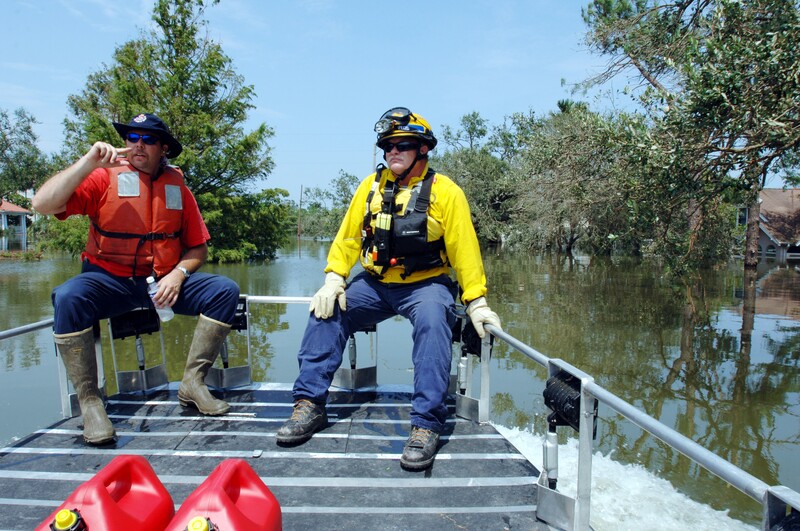
Lead image by NOAA, public domain. Source.







Join the Fstoppers community for free
-
Post comments and join in the discussions
-
Browse the site ad-free
-
Share your work and get featured in the community
-
Compete in the photo contests for fun and prizes
No comments yet