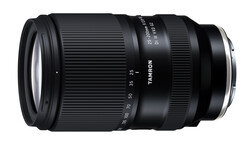
An all-in-one zoom that actually feels like a serious lens can change how you pack and how you shoot. If you use a camera and want one lens that handles portraits, travel, details, and casual video without filling the bag, this new 25-200mm option demands attention.
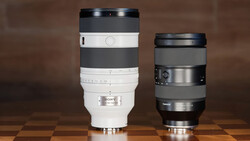
Coming to you from Jay P. Morgan of The Slanted Lens, this practical video puts the new Tamron 25-200mm f/2.8-5.6 Di III VXD G2 lens through a full day of shooting at a ranch, mixing portraits of riders, horses, and close-up details. You see it used as a true walkaround lens, jumping from 25mm environmental frames to tight 200mm portraits without swapping glass. The video also compares this second-generation design to the earlier 28-200mm version, so you get a sense of how much closer it focuses and how the extra width at 25mm affects real scenes. Close focus is a big part of the story here, with half-macro capability at the wide end that lets you fill the frame with things like rings, hands, and small details while still working fast in the field. You get enough sample images on-screen to judge whether that mix of reach and near-macro suits the way you like to shoot.
Autofocus and handling are another clear focus of the walkthrough. Morgan leans hard on the VXD linear motor, showing how it tracks riders and horses at speed while firing bursts, and how quiet it stays when switching over to video clips. There is also a look at how Tamron Lens Utility lets you reassign the side function button, tweak focus behavior, and use the USB-C port to tailor the lens to either stills or video work without diving through camera menus. For lighting, the portraits are built around the Westcott FJ400 II 400Ws Touchscreen Strobe paired with a Westcott round Octabox, so you see how the zoom plays with off-camera flash as well as natural light at different focal lengths. The mix of strobed and ambient setups gives a good feel for how the variable f/2.8 to f/5.6 aperture behaves in real shooting rather than on a spec sheet.
Key Specs
-
Focal length: 25 to 200mm
-
Maximum aperture: f/2.8 to f/5.6 (variable)
-
Minimum aperture: f/16 to f/32
-
Mount: Sony E
-
Format coverage: full frame
-
Minimum focus distance: 6.3 in / 16 cm at the wide end, 2.6 ft / 80 cm at the telephoto end
-
Maximum magnification: 0.53x (1:1.9 macro reproduction ratio)
-
Optical design: 18 elements in 14 groups
-
Aperture blades: 9, rounded
-
Focus type: autofocus
-
Image stabilization: none in the lens
-
Filter size: 67 mm front thread
-
Dimensions: approximately 3 x 4.8 in (76.2 x 121.5 mm)
-
Weight: 1.3 lbs / 575 g
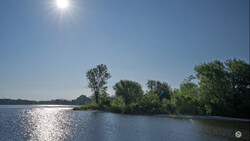
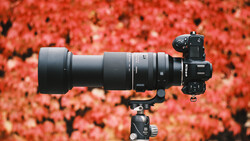
The video does not stop at numbers, though. You see how that compact 4.8 in length and 1.3 lb weight feel on an actual Sony body, especially when the host is moving constantly around the arena. Ergonomics get some attention: the zoom ring travel is shown in real time, the grip texture is discussed while zooming and pulling focus, and the three distinct control zones make it easy to switch from framing to manual focus by touch. The 67mm front thread means the lens drops straight into existing Tamron kits built around that filter size, which matters if you rely on polarizers or neutral density filters and want to travel with one set. There is also a look at the BBAR G2 coating in harsh light, with direct sun and bright reflections challenging the lens so you can see how much flare and ghosting actually show up.
Later in the video, you get a taste of how the lens behaves at 200mm during sunset portraits, with background blur at f/5.6 and off-camera flash shaping the riders against the sky. The video hints at how the bokeh looks in busier backgrounds and how the lens balances between subject sharpness and smooth blur at longer focal lengths, but leaves you to judge the finer points. You also see the lens used as a travel-style zoom in a looser way, walking and grabbing quick frames rather than working from a locked-off spot, which says a lot about how natural it feels to live at 25-200mm all day. There is more in the full review about how the lens compares to carrying a pair of faster primes, how that variable aperture plays with strobes at different distances, and where the previous 28-200mm still has a place if you already own it. Check out the video above for the full rundown from Morgan.


Join the Fstoppers community for free
-
Post comments and join in the discussions
-
Browse the site ad-free
-
Share your work and get featured in the community
-
Compete in the photo contests for fun and prizes
1 Comment
Alex asked:
"Is This Tamron 25-200mm G2 Zoom Lens All You Need on a Trip?"
For most of my photography trips, no way. I typically need at least 600mm to get pleasing images.
BUT .....
For herp photography trips (reptiles and amphibians) this lens actually would fill all of my needs.
Why?
Because of this spec:
Maximum magnification: 0.53x
That's enough to sufficiently fill the frame with smaller herps such as geckos and toads. To do so at just 25mm is impressive, because it will allow one to get close enough to have a tiny subject be fairly large in the frame, while also capturing a big slice of the critter's habitat, which yields a rather dramatic looking environmental portrait.
EDIT: This is assuming that it is used with a "full frame" sensor. On a crop sensor, 25mm is not nearly wide enough to produce dramatic looking environmental portraits of very small subjects. So if I was on a herp photography trip with a crop sensor camera, I would need this lens plus my Laowa 15mm f4 shift macro lens.