
Not so long ago, a 40mm prime lens was an uncommon sight. When selecting a standard focal length prime lens, the choice was 35mm or 50mm. So why are we seeing so many 40mm primes now? And more importantly, why would we need one?
35mm and 50mm primes have always been the default everyday lenses for decades, perfect for walking around with if you have a full frame digital camera. They were actually the two top choices back in film days too. Most of us only had one of these focal lengths—usually a 50mm, as they were the most affordable.
A 40mm lens was popular on compact fixed-lens cameras in the 1960s and 1970s because they could be made so small and were a good compromise between a 35mm and 50mm. Leica introduced a 40mm f/2 Summicron in the early 1970s for their interchangeable-lens CL cameras and, in theory, it could be used on their more popular M cameras, although the 50mm frame lines had to be used. So after a few years, they stopped making the lens, and now only make 35mm and 50mm primes. For general interchangeable-lens SLRs from the 1980s onward, a 40mm was a rare sight. Voigtländer started making them in the early 2000s, but the main camera brands didn’t join the party until fairly recently.
35mm and 50mm Primes
A 35mm focal length has always been a great choice for environmental portraits, travel, and street photography. I call it the “storytelling lens,” as it gives us compositions with context.
The 50mm prime offers more of a natural field of view and is great for portraits and general photography. It allows us to isolate objects more than a 35mm.
A 35mm lens often means you need to immerse yourself into the scene because you need to be closer to the action, while a 50mm means you can keep a little further back. A better option for those who have less confidence to get in on the action perhaps. Or for those who want to get close and capture more detail. So that 15mm difference distills down to context versus intimacy.
So Why 40mm?
I can only speculate here, but maybe it has something to do with photographers looking for smaller, lighter cameras and wanting to carry less gear. I know this to be the case personally, as someone who loves street and travel photography. I usually only want to go out with a camera strapped around my neck with one small lens, and no other gear.
A 40mm can be made very small, and replaces a 35mm and 50mm for those who only want one lens to do everything. So, in a nutshell, a 40mm is a compromise for those only wanting to have just one small prime lens.
This seems to be the thinking with camera brands making increasingly popular compact cameras. Ricoh’s GR IIIx has a 40mm full frame equivalent fixed lens. Fujifilm has a very popular compact XF 27mm f/2.8 pancake lens (40mm full frame equivalent) aimed at their X Series users. Leica introduced the Leica Q3 43, a 43mm fixed-lens version of their Q series, in 2024.
Manufacturers making full frame cameras are watching this trend to go small and minimal, and are making them too. Sony and Nikon now make light, small 40mm lenses. This means we’re now faced with a choice of 35mm, 40mm, and 50mm. How do we decide?
There are a host of third-party lens manufacturers all producing 40mm too. They seem to be everywhere. I wonder, is it because many photographers also want to be filmmakers, and they’ve found out many great movies are shot with a 40mm focal length? These guys will do anything to make “cinematic” content, so it wouldn’t surprise me! A 40mm cinema lens gives cinematographers a natural perspective and minimal distortion. Perfect for shooting people.
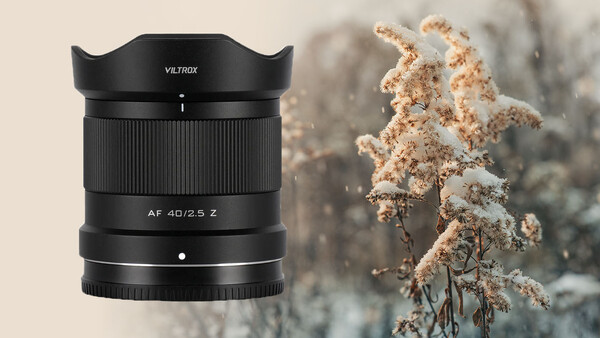
One of those third-party lens manufacturers offering 35mm, 40mm, and 50mm lenses is Viltrox. They have an autofocus 40mm f/2.5 Z-mount lens, and I got my hands on it to pop onto my Nikon Z6III. We should take this chit-chat beyond words and theory, and see what all the fuss is about, right?
Viltrox AF 40/2.5 Air Full Frame
Viltrox makes 35mm, 40mm, and 50mm primes. Among them:
- The Z-mount Viltrox AF 40mm f/2.5 Air weighs 180 g.
- Their Viltrox AF 50mm f/2 Air weighs 220 g and is slightly bigger.
- Viltrox’s current Viltrox 35mm f/1.8 is made of metal and is much heavier and larger.
So we’re not comparing apples with apples here, but the 40mm wins on the size and weight front anyway. Maybe there’s a lighter version of the 35mm in the works.
My default everyday lens happens to be the Viltrox 35mm f/1.8. Most of the time for the past couple of years that’s all I’ve used on my Z6 and Z6III—I consider it to be the perfect travel lens. I love it, and couldn’t live without it. Or could I? The second lens in my bag—should I decide to take a bag out with me—is either a 50mm or 85mm.
The first thing to note is my 35mm and 50mm are both f/1.8, compared to the 40mm’s f/2.5. Not a huge deal really. That’s a good wide aperture for the focal length, and should give me good separation.
I took the Viltrox AF 40mm f/2.5 to my local conservation area in a snowstorm. Can the 40mm allow me to shoot wide landscape scenes like a 35mm allows, and more intimate scenes like the 50mm allows? And with so much wet snow falling, will the Viltrox lens even survive the outing, as it’s not weather-sealed?
When I found some distant compositions, I found myself needing to walk closer or back away a little. No big deal. When I came across intimate scenes like a leaf with snow blanketing it, with the decent minimum focus distance of just over one foot, and a decent wide aperture of f/2.5 to help isolate my subject, the results were excellent.







Conclusion
I’m not usually a fan of plastic lenses. I prefer holding a metal lens, because plastic lenses tend to feel like holding a child’s toy, and don’t instill confidence. However, this Viltrox 40mm is so small, light, and incredibly affordable at just $168, you can’t help but like it. Viltrox makes wonderful metal lenses, but obviously the point of this model is the weight.
It has:
- A very reasonable minimum focus distance of 1.3 ft
- A standard 52 mm filter thread
- A little plastic hood and cloth pouch included
This is a basic lens, but so is Nikon’s version, which unlike the Viltrox, has a plastic mount. Yup, plastic, and that one costs $297!
The Viltrox AF 40mm f/2.5 Air is a very sharp lens, and overall very impressive for travel and everyday use. Would I choose the Viltrox 40mm f/2.5? For a smaller full frame camera, and if I wanted to stay as small and light as possible, then yes. To be honest though, there would be occasions when I would prefer the Voigtlander NOKTON 40mm f/1.2. It’s metal, manual focus, and can take a beating. I prefer manual focus photography for street and urban work and like to zone focus, and the Voigtlander has distance markings on the barrel. But for travel and general photography when autofocus is needed, the Viltrox 40mm f/2.5 Air is hard to beat.
Now on to the main point of this article. Why 40mm? Is 40mm a good focal length, or too much of a compromise?
I would say I still prefer a 35mm lens when traveling—to tell a story with context—and bring a 50mm or 85mm for when I want to isolate subjects. But—a big but—if you go on a trip where you can only take one lens, I would most certainly say grab a 40mm. I can see a 40mm working best for trips where I might be shooting a lot of people.
The Viltrox AF 40mm f/2.5 Air is available for Sony E mount, and Nikon Z mount.


Join the Fstoppers community for free
-
Post comments and join in the discussions
-
Browse the site ad-free
-
Share your work and get featured in the community
-
Compete in the photo contests for fun and prizes
1 Comment
Really, not a replacement just an interesting length for half length environmental portraits.