A single lens that can handle landscape, travel, portraits, casual macro, and video without weighing you down changes how you plan every shoot. The Sigma 20-200mm f/3.5-6.3 DG Contemporary lens aims to be that kind of tool, especially if you hike, travel, or just prefer to keep things light.
Coming to you from Luca Petralia Photography, this insightful video takes a close look at how the Sigma 20-200mm f/3.5-6.3 DG Contemporary lens behaves as a true one-lens kit on a high-resolution body. Petralia builds the case around real hiking and travel use, where carrying a bag of primes or multiple zooms is not realistic. The extra width at 20mm is a big part of the story, since it lets you leave the separate wide angle at home in situations where a 28-200 option would feel cramped at the wide end. You see how often that starting focal length changes compositions compared to something like the Tamron 28-200mm f/2.8-5.6 Di III RXD, especially for tight spaces and dramatic foregrounds. Petralia leans on real scenes rather than charts, so you watch the lens being used the way you actually would.
Beyond the range, Petralia highlights the close-up performance, which is where this lens quietly becomes more than a travel zoom. The 1:2 magnification is available in the mid-range, around 28 to 85mm, so you can fill the frame with details without standing on top of your subject. That distance helps with flowers, small objects, and anything that would be scared or shaded if you had to be inches away. On a 61 MP body like the Sony a7R V, the files hold up well in the center even wide open, which matters if you rely on crops instead of swapping to a dedicated macro. Petralia also points out that while the extreme corners at wider focal lengths need some stopping down, the tradeoff is acceptable in the kind of real world shooting this lens encourages.
Key Specs
-
Focal length: 20 to 200mm
-
Maximum aperture: f/3.5 to 6.3
-
Minimum aperture: f/22 to 40
-
Mount options: Sony E and Leica L
-
Format coverage: full frame
-
Minimum focus distance: 9.8" / 25 cm (wide) to 25.6" / 65 cm (tele)
-
Maximum magnification: 1:2 (0.5x) in the 28 to 85mm range
-
Optical design: 18 elements in 14 groups
-
Aperture blades: 9, rounded
-
Focus type: autofocus with Sigma’s HLA motor
-
Image stabilization: none
-
Filter thread: 72mm
-
Dimensions: approx. 3 x 4.5" / 77.2 x 115.5 mm
-
Weight: 1.2 lb / 550 g
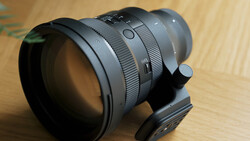
Size and handling get a lot of attention in the video, and that will matter to you if you walk all day with a camera. The lens is shorter and lighter than many older super zooms, so it balances well on a body like the a7R V instead of feeling front heavy. Petralia shows the zoom lock that prevents lens creep but still releases if you twist the zoom ring firmly, which keeps you moving instead of fiddling with switches. Weather-sealing against dust and splashes gives you more confidence outdoors, especially paired with modern mirrorless bodies that are built the same way. There is also some time spent on how the zoom ring feel is not perfectly linear, something you notice more when you work quickly.
Video users are not ignored, and this is where you might be surprised by how flexible the lens becomes. Petralia vlogs at 20mm handheld, using in-body stabilization to keep things steady without a grip or gimbal. The range then lets you jump from talking to camera to picking off compressed details in the scene, which suits travel and documentary work. There are compromises, like focus shift when zooming and a bit of focus breathing at the wide end, so smooth zoom moves while recording are not the strength here. You also see how the lack of optical stabilization is less of an issue on modern bodies with strong in-body stabilization, especially if you stay on the wider half of the range. Check out the video above for the full rundown from Petralia.




Join the Fstoppers community for free
-
Post comments and join in the discussions
-
Browse the site ad-free
-
Share your work and get featured in the community
-
Compete in the photo contests for fun and prizes
1 Comment
If I'd start a Sony FF kit that would be one of my first lenses.