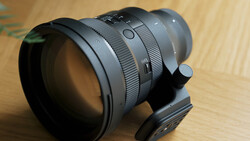
The OM System M.Zuiko Digital ED 50-200mm f/2.8 IS PRO lens is built for versatility. Wildlife, macro, and long hikes through uneven terrain all push your gear in different ways, and this lens manages to handle them without feeling like a burden in the bag.
Coming to you from Courtney Victoria, this detailed video explores the OM SYSTEM M.Zuiko Digital ED 50-200mm f/2.8 IS PRO lens. Victoria puts it through woodland tests with scenes ranging from towering trees to deer slipping through the undergrowth. The lens’ image stabilization gets special focus. With seven stops of stabilization, handheld shooting at slower shutter speeds becomes realistic, letting you capture stationary subjects without dragging a tripod along. Victoria pushes it as far as one-eighth of a second, discovering just how forgiving the stabilization can be when shooting still subjects like trees.
The flexibility doesn’t stop there. Adding a 2x teleconverter expands the reach to an 800mm full frame equivalent, all without the need for a dedicated super-telephoto lens. Macro shooting also comes into play. By stacking the converter, magnification moves into true macro territory, letting you capture close details without changing lenses. It won’t outperform a dedicated macro lens in sharpness or handling at ground level, but the ability to switch between wildlife and macro work in the same outing adds convenience.
Key Specs
-
Focal Length: 50 to 200mm (35mm Equivalent: 100 to 400mm)
-
Maximum Aperture: f/2.8
-
Minimum Aperture: f/22
-
Lens Mount: Micro Four Thirds
-
Minimum Focus Distance: 2.6' / 78 cm
-
Magnification: 0.08 to 0.25x (1:4 Macro)
-
Optical Design: 21 Elements in 13 Groups
-
Aperture Blades: 9, Rounded
-
Image Stabilization: Yes, 7 stops
-
Tripod Mount: Removable and Rotating Collar with 1/4"-20 Thread
-
Filter Size: 77mm
-
Dimensions: 3.6 x 8.9" / 91.4 x 225.8 mm
-
Weight: 2.8 lbs / 1,250 g
Another strength is comfort. Victoria points out that carrying the lens over long hikes doesn’t feel punishing. Compared to larger 800mm equivalents in other systems, the size and weight are relatively modest. While it isn’t as compact as some may expect, its balance of reach and aperture puts it in pro territory, particularly paired with the OM-1 Mark II. Even in tough weather conditions, the lens holds up, keeping its usability intact. Check out the video above for the full rundown from Victoria.





Join the Fstoppers community for free
-
Post comments and join in the discussions
-
Browse the site ad-free
-
Share your work and get featured in the community
-
Compete in the photo contests for fun and prizes
2 Comments
This lens is strikingly similar to a 100-400mm f5.6 according to just about any metric.
I think it's great that OM has a lens that truly replicates what a 100-400mm f5.6 can do, and it achieves this by having that f2,8 aperture, which means that the depth of field will be pretty much equivalent to what you get from a 100-400 f5.6 on a full frame sensor.
Good point. I was just going to post something similar noting the the equivalent F5.6. Instead I will go with my second thouht; My first NEW car cost $2600.