
In 1858, a French balloonist who called himself Nadar leaned over the edge of a wicker basket tethered above the village of Petit-Bicêtre, just outside Paris, and made the first photograph ever taken from the air. You cannot see it. That plate, and every other aerial photograph Nadar made in those first years, is gone.
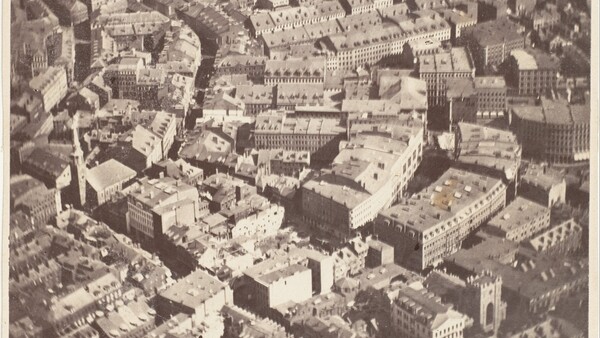
What survives instead is Boston. On October 13, 1860, an American photographer named James Wallace Black went up over Boston Common in a gas balloon and came back down with a hazy silver view of the city's rooftops, wharves, and church spires. It became known as "Boston, as the Eagle and the Wild Goose See It," and it is generally recognized as the oldest surviving aerial photograph you can still put your eyes on, and the earliest surviving aerial view of a city.
Those two facts sit side by side in every honest history of the medium. The first aerial photograph and the first surviving one are not the same picture, and they were made two years and an ocean apart. This is the story of both, and of how hard it once was to point a camera down instead of out.
The Showman Who Wanted to Photograph the Earth From Above
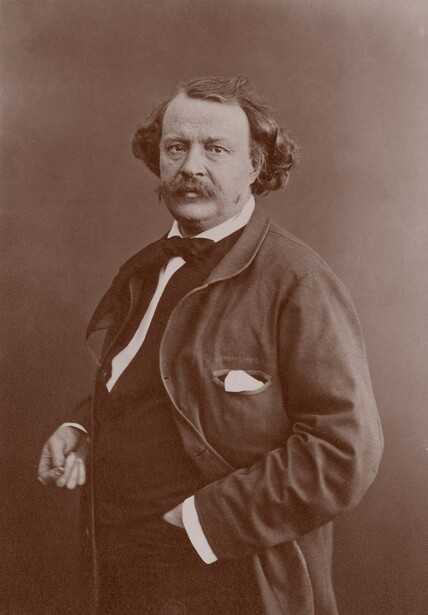
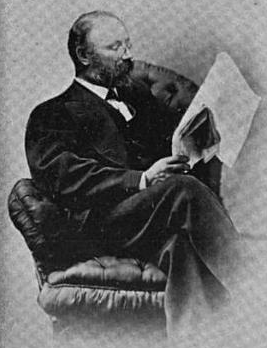
Nadar was born Gaspard-Félix Tournachon in Paris in 1820, and by the 1850s he was one of the most famous men in the city. He was a caricaturist, a journalist, a novelist, and eventually the portrait photographer of choice for half of literary and artistic France. Baudelaire, Victor Hugo, Sarah Bernhardt, Delacroix, and Liszt all sat for him. The nickname came from a bohemian joke about adding "dar" to the ends of words, and it stuck so completely that most people never learned his real name.
He was also obsessed with flight. On October 23, 1858, the same year he finally got a usable picture, Tournachon patented the idea of using aerial photographs for mapmaking and surveying, a "système de photographie aérostatique." His pitch was practical and slightly delusional at the same time: tether a balloon over a series of stations, photograph the ground from directly overhead, and produce maps more faithful than anything a surveyor could draw by hand. He was convinced the scheme could make him rich. It never did, but the ambition drove him up into the sky again and again until the pictures finally came.
Why the First Aerial Photograph Was So Hard to Make
To understand why the first aerial photograph is lost, you have to understand what taking any photograph meant in 1858. Nadar worked in wet collodion, the dominant process of the era. A glass plate had to be coated with syrupy collodion, sensitized in a bath of silver nitrate, exposed while still wet, and developed within roughly ten to fifteen minutes, before the emulsion dried and went dead. There was no loading a film cartridge and firing away. Every exposure was a small chemistry experiment that had to be finished on the spot.
Now do all of that in a swaying balloon basket. Nadar carried a portable darkroom aloft with him, a tent rigged inside the gondola, and mixed his chemistry in the air. His early attempts kept coming back mysteriously blackened and fogged. He eventually worked out the cause: sulfurous impurities in the illuminating gas, chiefly the hydrogen sulfide vented through the balloon's valve, were fogging the silver on his sensitive plates and ruining them before he could develop anything. His fix was to shield the work rather than the balloon, enclosing the basket and its portable darkroom so the escaping gas could not reach his chemistry.
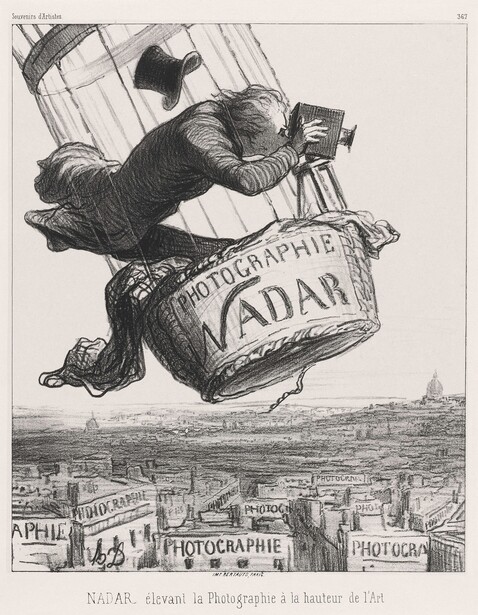
With the leak solved, the pictures came. Sometime in 1858, from a captive balloon tethered roughly 80 meters, about 262 feet, over Petit-Bicêtre, Nadar exposed a plate looking down at the fields and buildings below and developed it successfully in the basket. It was the first time anyone had ever photographed the world from above. Honoré Daumier caught the absurd grandeur of it a few years later, in an 1862 lithograph, drawing Nadar hunched over a camera in a runaway balloon, top hat flying off, the rooftops of Paris labeled "Photographie" beneath him. The caricature was a joke about photography's pretensions to art. It was also, accidentally, a monument.
The Picture That Vanished
None of it survives. Not the Petit-Bicêtre plate, not any of the aerial images Nadar made in those first experiments. The originals are simply gone, lost the way an enormous amount of early photography was lost, to breakage, chemical decay, and time. What we have is the record that they happened, not the pictures themselves.
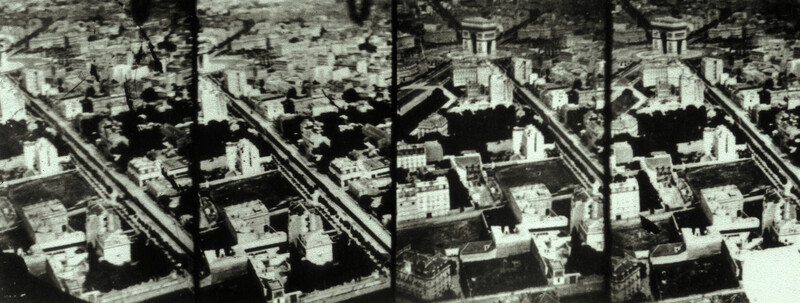
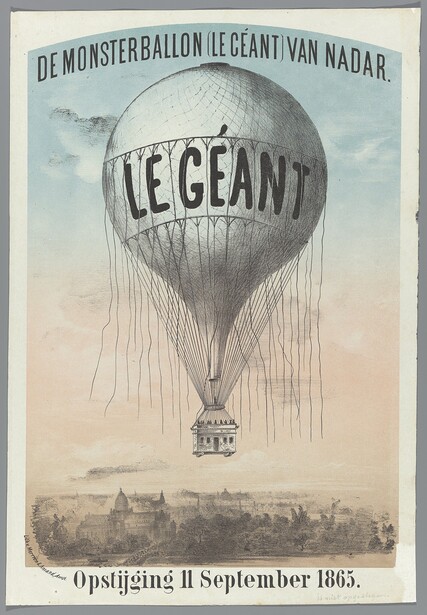
This is where the history gets slippery, and where a lot of confident writing goes wrong. The Bibliothèque nationale de France holds a Nadar aerial print carrying the caption "First Result of Aerostatic Photography," with a note that the negative was obtained at an altitude of 520 meters by Nadar in 1858. It looks like proof that the first aerial photograph survived after all. It is not. Scholars have shown that the image is mislabeled and was actually made over Paris about a decade later, around 1868. Nadar's earliest genuinely surviving aerial photographs of Paris date to the mid-to-late 1860s, including crisp views of the Arc de Triomphe and the Place de l'Étoile. By then he had graduated to spectacle. In 1863 he commissioned the Godard brothers to build Le Géant, an enormous craft roughly 45 meters tall that could carry more than a dozen passengers, complete with cold chicken and wine served aloft. It crashed hard on an early flight and nearly killed him and his wife, but it made him a legend and helped inspire Jules Verne.
Boston, as the Eagle and the Wild Goose See It
So the oldest aerial photograph you can actually see is not French. It is American, and it is Boston. James Wallace Black was a Boston photographer, born in New Hampshire in 1825, who had partnered with the inventor John Adams Whipple and built a reputation for technical daring. A contemporary newspaper account suggests Black and the aeronaut Samuel Archer King may have attempted aerial photography over Providence, Rhode Island, on August 16, 1860, two months earlier, though the status and survival of any images from that flight remain disputed. On October 13, 1860, two years after Nadar's first success, Black went up with King again in his gas balloon, the Queen of the Air. The balloon was held captive over Boston Common by a rope running to a windlass on the ground, which steadied it at about 1,200 feet, roughly 365 meters, while Black worked.
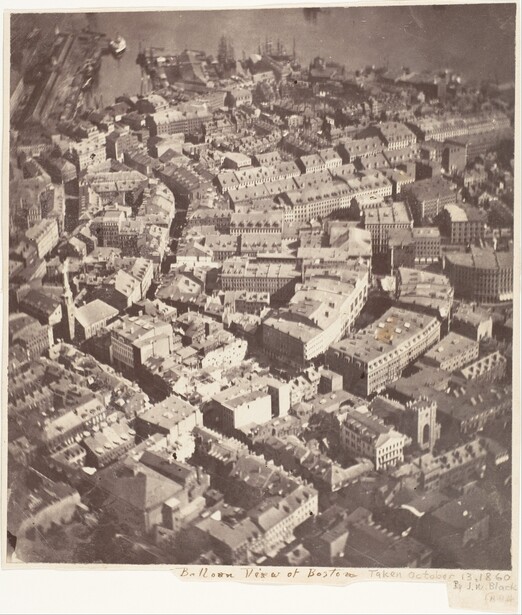
He exposed eight glass plates, each a little over ten inches on the long side. Most were useless. When King let the balloon rise freely to try for more altitude, the same enemy Nadar had fought reappeared: expanding gas from the envelope seeped into the camera and neutralized the plates. King's own account describes the gas expanding as the balloon climbed. Only one plate from the whole ascent came back clean, a single good print showing Boston's harbor, its wharves, and the dense grid of downtown rooftops seen at a steep oblique angle.
The poet and physician Oliver Wendell Holmes, who was fascinated by photography, wrote about the picture in The Atlantic Monthly in 1863, and the phrase by which it became known came from that essay. "Boston, as the eagle and the wild goose see it, is a very different object from the same place as the solid citizen looks up at its eaves and chimneys," he observed. That sentence became the title. The surviving print is now held by the Metropolitan Museum of Art, with related material at the Boston Public Library, which is why you can pull it up on a screen today while Nadar's first plate exists only as a story. The Met also attributes an 1860 photograph titled "Aerial View, North Weymouth, Massachusetts" to Black, though its precise circumstances are less clearly documented. Either way, the Boston plate is the one history remembers, and the one usually named the oldest.
What Nadar's Balloon Set in Motion
The early aerial photographers were solving a problem nobody had asked them to solve, and the uses came fast once the pictures existed. Within a few years, both armies in the American Civil War were sending observers aloft in balloons for reconnaissance. That was balloon observation, not balloon photography, and the two get conflated constantly. Despite claims still repeated in some museum captions and popular histories that Union crews photographed from the air, there is no authenticated aerial photograph made during the fighting. Photographers who could not afford balloons found other lift. The British meteorologist E.D. Archibald sent cameras up on kites in the 1880s, Arthur Batut refined kite photography in France later that decade, and by the First World War aerial reconnaissance had become a precise, industrialized craft, with cameras built specifically to be aimed straight down from aircraft.
Everything that followed runs back to those two tethered balloons. The drone hovering over a wedding or a coastline, the satellite view you scroll past without thinking, the sweeping opening shot of a landscape film, all of it is the descendant of a caricaturist mixing chemistry in a swaying basket and an American waiting for a rope-steadied balloon to hold still. Nadar wanted to map the world from above and thought it would make him a fortune. He got the view and missed the fortune, and he lost the proof. If you want to make the kind of sweeping aerial landscape he could only imagine, Elia Locardi's landscape photography course is a far gentler introduction than a leaking gas balloon.
The honest way to hold the story is to keep the two pictures separate. Nadar was first, in 1858, and his work does not survive. Black was second, in 1860, and the clean plate from his Boston ascent is generally recognized as the oldest surviving aerial photograph anyone can still actually look at. The record of a beginning and the beginning you can still look at are two different things, and the history is richer for refusing to blur them.
Lead image: "Boston, as the Eagle and the Wild Goose See It," James Wallace Black, 1860, public domain. Source.


_van_Nadar._Opstijging_11_September_1865,_RP-P-OB-88.837-2.jpg)
Join the Fstoppers community for free
-
Post comments and join in the discussions
-
Browse the site ad-free
-
Share your work and get featured in the community
-
Compete in the photo contests for fun and prizes
No comments yet