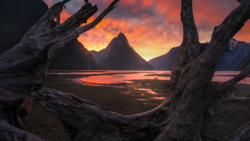
A wide angle lens pointed at a mountain range can make the peaks look small and far away, which is the opposite of what most people expect when they carry one into big terrain. Getting around that problem by getting close to something in front of you and building the frame back toward the peak is what turns a flat record of a view into an image that pulls the eye through it.
After a couple of months of barely touching his camera and doubting he could still make a good photograph, William Patino heads into the backcountry of New Zealand's South Island with friends to see if one trip can shake him loose. The valley has nearly everything a landscape shooter could want: snowcapped peaks, waterfalls, a reflective lake, and rainforest. It also has a low cloud base that threatens to shut down the light all afternoon. Patino starts every composition with the mountain as the end point, then works out which foreground and midground will carry the eye there. He steers away from patchy snow, which he finds much harder to use than full coverage, and frames around it. When the sky stays gray, his fallback is to wait until close to blue hour and lean into a moodier image, or to pull something vibrant into the foreground so the whole frame doesn't go dull.
The clouds eventually break, and he gets roughly an hour of golden light with color in every direction. Standing over a reflection, he points out the common instinct to zoom in tight on the mirrored peak. That shot is pretty, but it reads as flat and two-dimensional. Stepping back and placing something near the lens gives the scene layers that move toward the viewer. Later, from a small knoll, he punches in to around 20mm or 21mm and shoots through an opening, keeping the valley walls balanced on either side. Reflective scenes rely on symmetry, and he warns against overcompensating on one side when you try to even out the weight.
The size relationship between a foreground rock and a distant peak comes from where the camera sits. Focal length only decides how much of the scene fits in the frame. Put a boulder 1 meter from the lens with a mountain 5 kilometers behind it, then move to half a meter away. The boulder roughly doubles in apparent size, and the mountain barely changes at all. That distance ratio is the main lever you have with a wide angle lens, and it explains why a few steps forward can change a composition more than swapping lenses. In practice, keep moving toward your foreground until it feels almost too close, then check the corners for anything that pulls attention away. Working that close also stretches the depth of field past what one frame can hold at most apertures. Focus stacking has become a routine part of landscape work, and many current mirrorless bodies from Nikon, Canon, Fujifilm, and OM System include automatic focus bracketing to make it quicker in the field. The same thinking carries over to wildlife in the landscape: a subject close to the lens with the scene behind it follows the same near-far logic as a rock and a peak.
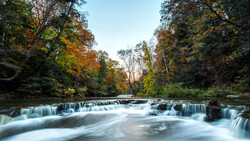
Patino puts that to work when a group of kea, the world's only alpine parrot, starts watching the group from nearby. He raises the ISO and focus stacks a young bird eating berries, with the bird in the foreground and the landscape behind it, aiming for an environmental wildlife frame he calls one of the harder images to pull off. The kea's curiosity turns into trouble after dark, when they go after tents and gear and make for a long, frozen night. By morning, there's a brief window of color on the range before packing up takes over. The last stop is a rainforest waterfall with a big S-curve and a blue pool at its base. The area in front of it is wide open. His first instinct is to build depth from the greens on the left before something on the other side of the scene draws him away.
You can see how Patino finally frames that waterfall, along with the kea encounter, in the video above.
Join the Fstoppers community for free
-
Post comments and join in the discussions
-
Browse the site ad-free
-
Share your work and get featured in the community
-
Compete in the photo contests for fun and prizes
No comments yet