Comet PanSTARRS had a narrow visibility window, and Brent Hall had roughly 12 hours to pull together a shot. What followed was a scramble of location scouting, dead batteries, cactus needles in the leg, and a hard lesson about light pollution direction.
Coming to you from Brent Hall, this candid video follows Hall as he scouts a hillside in his small mountain town in southern New Mexico the evening before the comet's last visible morning. His original plan was City of Rocks, a dark-sky-friendly location, but it was fully booked. So he pivots to a ridge above a historic 1800s church called La Capilla, using the Sun Surveyor app to pin down the comet's expected azimuth of 73° and an altitude of 4 to 6° at 4:47 a.m. He finds a cholla cactus with a natural V-shaped opening that frames the horizon, and locks in his composition. He's shooting with an Canon EOS R6 Mark II paired with a Canon RF 24-70mm f/2.8L IS USM, and decides to shoot at 35mm so Andromeda can fit in the frame alongside the comet.
Back out at 4:15 a.m., Hall hikes to the spot with knee braces on, sets up at f/2.8, ISO 16,000, and a 2-second test exposure to check framing and light pollution. He also brings the Dwarf II smart telescope as a second rig, planning 10-second exposures in alt-az mode. The problem becomes clear fast: he's shooting northeast, directly through his town's light pollution. The comet, which is significantly dimmer than NEOWISE or the 2023 comet he photographed from nearly the same spot, doesn't cut through. He ends up with what he openly calls a one-star image, a wide shot where the comet is a faint dot, and a slightly tighter 70mm version that he generously calls a two-star.
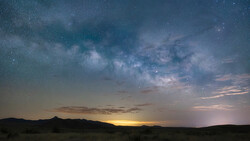
What makes the video worth watching isn't the comet shot. Hall is unusually honest about the chain of decisions that led to the failure, including why he convinced himself he could pull it off despite knowing the conditions were against him. He'd successfully photographed a comet from that same trail before, but that comet was to the west, away from the town's glow. PanSTARRS rose to the northeast, straight into the light dome. That distinction didn't register until after the fact. And after the comet session wrapped, he turned his Canon EOS R5 Mark II with a Canon RF 16-35mm f/4L IS USM south toward the Milky Way, stacked 47 frames using Sequator and Siril, and finished the edit in Luminar and Photoshop. That image, shot from a light-polluted town, is the actual highlight of the session, and Hall breaks down the four-app workflow that produced it. Check out the video above for the full rundown from Hall.



Join the Fstoppers community for free
-
Post comments and join in the discussions
-
Browse the site ad-free
-
Share your work and get featured in the community
-
Compete in the photo contests for fun and prizes
No comments yet