The Sigma 100-400mm f/5-6.3 DG OS HSM Contemporary sits in an awkward middle ground that most people dismiss without thinking too hard about it. Street shooters call it too big. Wildlife photographers call it too short. Row thinks they're both wrong.
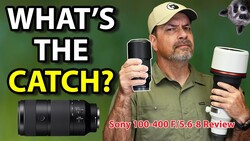
Coming to you from Jason Row of Rowtography, this thorough real-world video makes a surprisingly strong case for the 100-400mm focal length as one of the most useful ranges you can own. Row picked up this Sigma copy secondhand for £600 in mint condition, a fraction of what Sony's equivalent costs. The lens packs focus range limiters, two-stage image stabilization, a panning mode for tracking moving subjects, and a standard stabilization mode for general handheld shooting. It runs f/5 to f/6.3, which sounds limiting on paper, but Row points out that modern noise reduction tools have changed how much fast glass actually matters day to day.
The sharpness testing was done at St. Mary's Lighthouse under backlit conditions, loaded into DXO PhotoLab 9 for a closer look. From f/5 through f/11, the lens holds up well across the frame with no meaningful chromatic aberration visible. At f/22, there's the expected diffraction softening, and one 400mm shot at f/11 showed some softness Row attributes to camera movement rather than the lens itself. The results from wider apertures through the mid-range are sharp enough that the image quality gap between this and the Sony version probably doesn't justify the price difference for most use cases.
What makes the video worth watching is how Row builds the versatility argument with real images rather than just claims. He pulls in shots from the Scottish Highlands taken on this exact lens, city scenes from London and Paris showing compressed backgrounds and isolated subjects, negative space compositions at 100mm on an APS-C body, and even a 16-shot HDR bracket of the lighthouse that came in just under a gigabyte merged in Lightroom. He also spends real time on the 100-400mm range as a video focal length, pointing out that so much footage today defaults to wide angle because long heavy lenses don't work on gimbals. That gap in the visual landscape is exactly where this focal length earns its place. He also addresses using the Sony a7R V's APS-C crop mode to effectively extend reach without sacrificing too much resolution, which changes the math on whether 400mm is actually the ceiling. Check out the video above for the full breakdown and sample images from Row.

Join the Fstoppers community for free
-
Post comments and join in the discussions
-
Browse the site ad-free
-
Share your work and get featured in the community
-
Compete in the photo contests for fun and prizes
1 Comment
I must ask everyone to please stop saying "cheap" it is low cost or inexpensive!
Now before Sony came out with the 200-600mm there was the150-600mm F5-6.3 DG OS HSM | Contemporary 015 that to be used on the a Sony camera was a need of an adapter and yes you could use a 1.4X or 2X Teleconverter. Using it in APS-C here on the A7M3 in 2019 Shows sharpness and great tracking. Yes today used $ is worth it.
Sigma has always had great glass and before major brands came out and even at lower prices.
Just some info for those getting used lenses and using on a Canon or Nikon. This lens helped me see the difference between a Sony and a Canon as far as using a Teleconverter on either, on a Canon the thing about just going over f/8 when combined messes with the AF where as on a Sony Mirrorless only tracking when above f/11. But todays Canon Mirrorless do not have the problem. Info to help be aware of not to be confused with a lens problem for it is the Camera DSLR.
Lastly yes i cut my teeth on Sigma lenses not knowing Sony in a year would have one like one.