

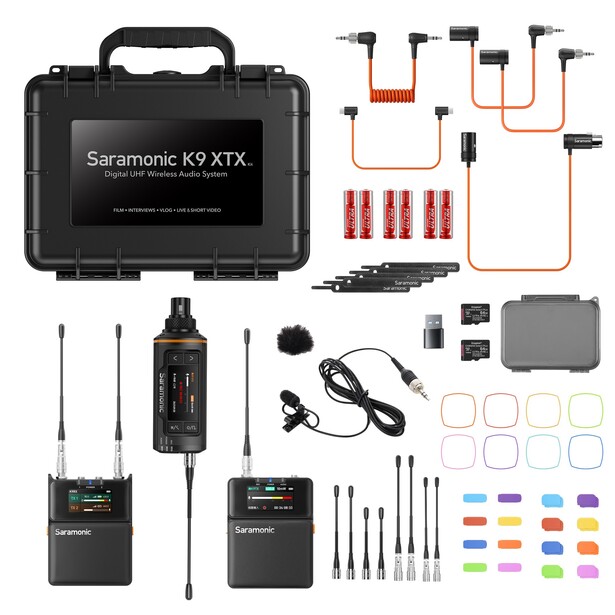
The microphone you already trust is almost never the problem on a small shoot. The cable running out of it usually is. A shotgun on a boom, a reporter's handheld, a hypercardioid on a stand in a conference room: each one works beautifully until you have to get its signal back to the camera, and then you are taping XLR down a hallway and hoping nobody walks through it. Saramonic's K9 XTX is a plug-on transmitter built for exactly that gap. It screws onto the bottom of an XLR microphone and sends the signal digitally over UHF, so the microphone stays the same and the cable disappears.
What a Plug-On Transmitter Actually Solves
Plug-on transmitters are an old idea that small crews have historically skipped, because the good ones lived in the same price bracket as the rest of a professional wireless package. The category exists because of a specific problem: lavalier systems put a bodypack on a person, but plenty of the audio you record is not on a person. It is on a boom over an interview, on a stand in front of a panel, or on a handheld a reporter is passing back and forth. Those microphones are almost always XLR, and XLR means a cable.
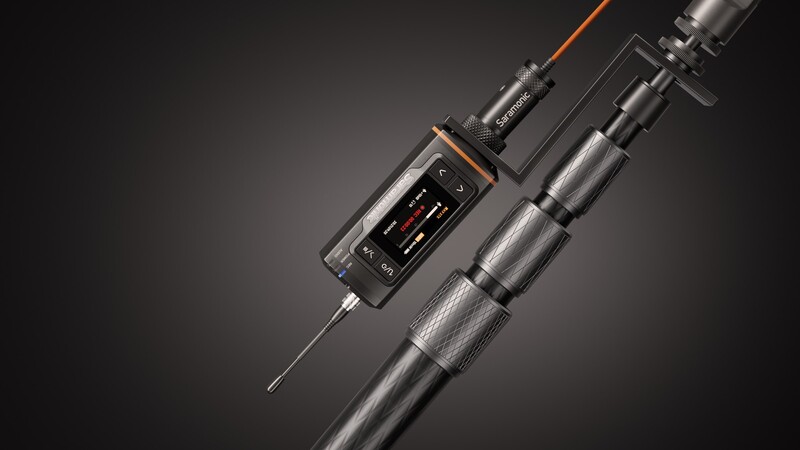
A plug-on transmitter attaches directly to the microphone's own connector and turns that microphone into a wireless unit for as long as you need it. When the shoot is over, you unscrew it, and the microphone goes back to being a wired microphone. Nothing about the sound you chose changes. You are not swapping your shotgun for whatever capsule came bundled with a wireless kit.
The practical difference on set is mobility. A boom operator who is not tethered can follow a subject through a doorway. A second camera can sit across a room without a cable crossing the shot. Two people can set up an interview in the time it used to take to run and tape a single line. On a crew of one or two, that time is the whole budget.
Phantom Power Is the Spec That Decides Compatibility
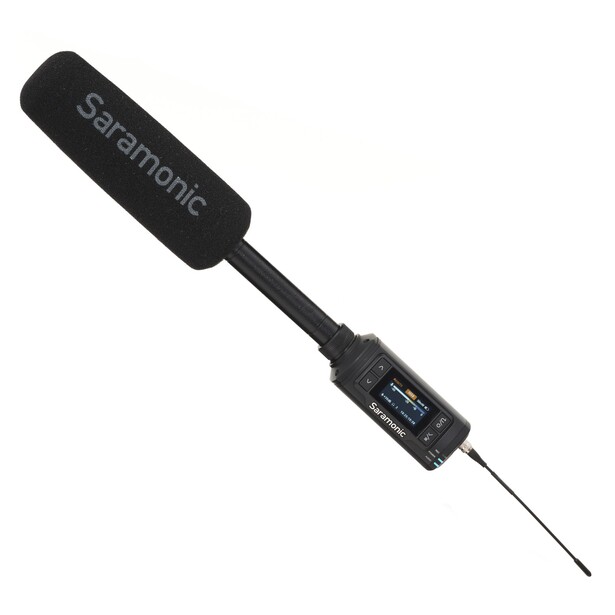
The K9 XTX takes selectable phantom power at 3V, 5V, 12V, 24V, and 48V. Most condenser shotguns and studio microphones expect a full 48V. Some compact and older condensers are designed around 12V or 24V. Dynamic microphones, including most reporter handhelds, want no phantom power at all and can be damaged by it in certain wiring situations.
Phantom power can also be switched off entirely, and there is a separate line-level setting for feeding the transmitter from a mixer output. A transmitter that only offers 48V or nothing forces you to check every microphone against it before a shoot. One that steps through the common voltages lets you move the same unit between a shotgun in the morning and a dynamic handheld in the afternoon without keeping a mental compatibility chart. Saramonic also includes a locking XLR connector, which is the sort of detail that goes unnoticed until a transmitter works itself loose on a moving boom.
A Convenient Built-in Safety Net
Saramonic builds 32-bit float recording into the transmitter itself, with 64 GB of onboard storage. Those are two different protections.
The 32-bit float part addresses level. In a conventional 24-bit recording, setting your gain too high means clipping, and clipping is permanent. A 32-bit float file has enough headroom that a signal recorded far too hot can be pulled back down in post without the distortion that would have been baked into a fixed-point file. For unrepeatable audio, a wedding vow, a one-take interview, a subject who suddenly raises their voice, that is meaningful insurance.
The onboard recording part addresses transmission. Any wireless link can drop, and RF is least predictable in exactly the venues where you cannot ask for a second take. If the transmitter is also writing a local file, a dropout becomes an editing inconvenience rather than lost audio. You are recording at the source, upstream of everything that can go wrong between the microphone and the camera.
This removes two of the failure modes that make people nervous about going wireless in the first place.
One restriction applies only in the United States, where a patent prevents the transmitter from recording internally in 32-bit float and transmitting at the same time. American users choose one or the other for a given take. Everywhere else in the world, the two run simultaneously.
Timecode Is the Part That Pays Off in Post
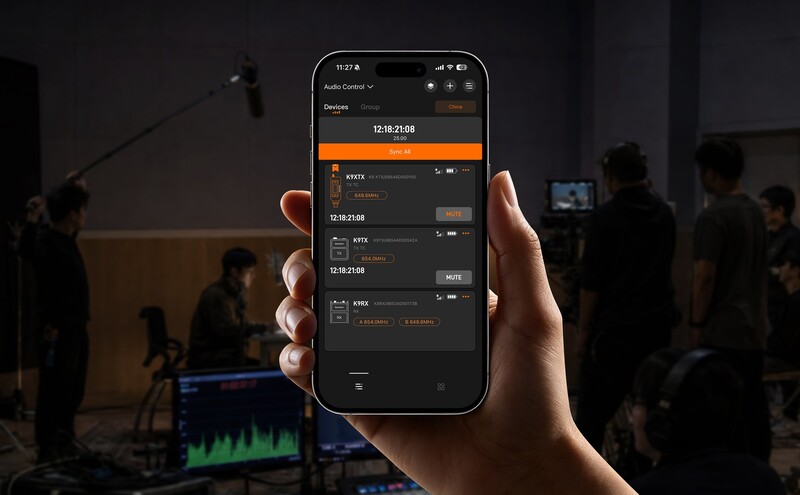
The system generates and reads LTC timecode at the standard frame rates, over a wireless sync or a wired input. If you have never worked with it, timecode is what lets a multicamera edit assemble itself. Every device stamps the same clock onto its files, and the editor lines everything up automatically instead of you scrubbing for a clap or a door slam at the top of every take.
If you're filming a two- or three-camera interview or wedding, it is the difference between an hour of syncing and an instant lock. Crews that adopt timecode rarely go back.
Where It Sits in the Spectrum
Saramonic rates the system for wideband operation from 550 to 960 MHz, with GPS-based regional frequency coordination and RF output switchable between 10, 25, 50, and 100 mW. The company quotes stable transmission up to 150 meters at 50 mW in favorable conditions, and a 130 dB dynamic range.
Most inexpensive wireless microphone systems operate at 2.4 GHz, the same unlicensed band as Wi-Fi and Bluetooth, which means sharing space with every phone, laptop, and venue access point in the room. The K9 XTX sits far lower down. Both ranges are technically UHF, but the sub-gigahertz bands are where professional wireless has always lived, and those longer wavelengths carry better through walls, bodies, and open distance. The tradeoff is that the legal frequencies down there vary by country, which is what the GPS-based coordination is meant to handle when you land somewhere new.
Managing More Than One
The other half of running a wireless system is administration. The Saramonic System App handles up to 48 devices at once, so you can group units, change frequencies, update firmware, and put transmitters to sleep without physically reaching any of them.
If you are running one transmitter and one receiver, app-based fleet management is not why you would buy this. If you are running several on a live event, in a multi-room corporate shoot, or across a documentary crew, walking to each unit to change a setting is a real cost, making this an important and useful feature.
Power and Weather
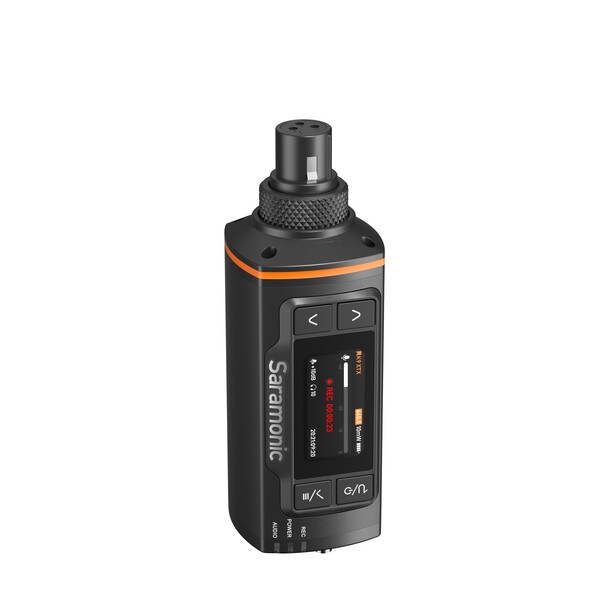
The transmitter runs on replaceable AA batteries for up to 14 hours, and it accepts USB-C external power. AA cells mean a dead unit is a thirty-second fix anywhere in the world, without a proprietary pack or a charging window between setups. USB-C means a locked-off camera position can simply run on a power bank all day.
Saramonic also offers an optional waterproof housing rated IP66, along with a color display for checking levels and status at a glance. Anyone who has shot outdoors knows how much of the job is weather you did not plan for.
Who This Is Built For
The K9 XTX is aimed at people whose microphones are already good and whose bottleneck is everything around them. Documentary crews, event and wedding filmmakers, corporate and commercial video teams, and small production companies moving from one camera to several tend to hit the same wall in the same order: cable runs limit where the microphone can go, then multicamera sync eats the edit, then RF gets unreliable in the one venue that matters.
If you shoot with a single camera and a lavalier system that already works, this is more capability than the job needs. If you own XLR microphones you like and keep working around the cables attached to them, it addresses the actual problem, which is the connection rather than the capsule. Crews that need a bodypack and receiver alongside it can start with the K9 Duo Kit instead.
Availability
In the United States, the K9 XTX transmitter is $300 through Saramonic USA. If you want the whole system rather than the transmitter on its own, the same store carries the K9 Duo Kit at $750, which pairs the plug-on transmitter with a bodypack transmitter and a receiver. Outside the United States, the transmitter and the K9 XTX Kit are sold through the Saramonic store and authorized dealers.



Join the Fstoppers community for free
-
Post comments and join in the discussions
-
Browse the site ad-free
-
Share your work and get featured in the community
-
Compete in the photo contests for fun and prizes
1 Comment
Seems over-engineered, large and clunky and adds 50% to the length of the microphone. In these days of 32bit transceivers from DJI the size of a quarter, I'm sure they could have done much, much better than this oversized beast with a ridiculous protruding antenna. The camera is nearby. What the heck?!