Teleconverters can quietly destroy your keeper rate before you even realize what's happening. Sharpness drops, autofocus consistency gets unreliable, and tracking falls apart — all from one small piece of glass between your lens and body.
Coming to you from Steve Perry, this practical video breaks down 10 specific ways to improve sharpness and autofocus performance when shooting with teleconverters. Perry opens by explaining that the problem isn't one single flaw; it's a combination of factors. A teleconverter reduces the light reaching your AF system, lowers contrast, degrades image quality, and puts more strain on phase detection geometry. None of those issues is catastrophic on its own, but stacked together, they can seriously hurt your results. Perry's first recommendation is straightforward: more light means better AF performance. A 1.4x TC costs you one stop; a 2x costs two. In dim conditions, Perry says he'll often skip the TC entirely and crop instead, because a sharp cropped image beats a soft full frame shot every time.
Perry also makes a strong case for favoring the 1.4x over the 2x whenever you're shooting action. The 2x doesn't just magnify the subject; it magnifies every optical compromise the TC introduces. AF speed drops more, accuracy suffers more, and image quality takes a bigger hit. For birds in flight or fast-moving wildlife, the 1.4x gives you a much better balance of reach and performance. He also covers the "focus refocus" technique for static subjects in tough AF situations: acquire focus, shoot a short burst, deliberately throw focus off, then reacquire before shooting again. In low light with a TC attached, the AF system can settle into a slight miss, and giving it a second chance to lock can make a real difference. Perry is clear that this isn't something you do every time — only when the camera is visibly struggling to commit to a lock.
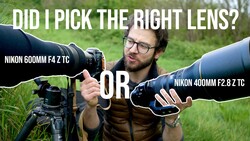
On the lens side, Perry points out that faster primes like a 600mm f/4, 400mm f/2.8, or 300mm f/2.8 pair well with teleconverters because they still feed the AF system plenty of light even after the TC penalty. Slower zooms, particularly anything at f/5.6 or f/6.3, are where he gets cautious, and he avoids the 2x on slower zooms altogether. He also recommends OEM teleconverters over third-party options for better autofocus performance and sharpness consistency. Beyond glass selection, Perry covers shutter speed, AF area size, stopping down slightly for sharpness gains, shooting longer bursts to improve your odds, and one factor that surprises a lot of people: subject distance. Atmospheric distortion and heat haze are already a problem at long range, and a teleconverter magnifies both. Perry's view is that the best use of a TC is to finish filling the frame with a subject that's already reasonably close, not to rescue something that's simply too far away. Check out the video above for the full rundown from Perry.



Join the Fstoppers community for free
-
Post comments and join in the discussions
-
Browse the site ad-free
-
Share your work and get featured in the community
-
Compete in the photo contests for fun and prizes
No comments yet