Polished golf clubs reflect everything around them, so a light that flatters one club can leave the one beside it flat and glaring. Shiny, curved metal is one of the hardest subjects to light, and the decisions that solve it carry over to watches, jewelry, cutlery, and anything else with a chrome finish.
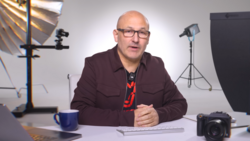
Polished metal behaves like a mirror, and Karl Taylor of Visual Education treats it that way from the first setup. He tapes three clubs in position in front of a black foam board and hangs a huge scrim very close and very low over them. With a distant light source, the camera records far more reflection of the source than actual texture on the product. Pulling the scrim in tight brings those two exposures closer together. Because the clubs are so curved, they pick up light from nearly every direction, so the scrim has to fill almost everything they can see, and one front edge that still reflects part of the studio gets earmarked for a fill panel.
The first test uses a single bare bulb fired through the scrim, and moving it shows how sensitive these surfaces are. Lift the light away from the scrim, and the highlight grows softer and broader. Lower it, and the highlight tightens into something more specular, which Taylor prefers on the top of one club. A position that looks great on two clubs looks terrible on the third, and stray light causes enough flare that the scrim has to go up about a foot. At f/16, the depth of field still doesn't stretch across all three clubs, so he starts planning to handle each one separately, partly for focus and partly because three different materials won't all look their best under one setup. Power adjustments happen in tenths of a stop, since a half-stop increase is already enough to blow out a highlight.
A reflective object shows you an image of whatever it faces, so lighting it means designing what it reflects as much as how bright it is. That's why car studios hang enormous overhead sources and why product shooters lean on scrims, strip lights, and graduated backgrounds. A reflection that fades from bright to dark reads as a rounded surface. A reflection that's evenly lit edge to edge reads as a flat stripe sitting on top of the metal. You can put this into practice with very little gear: before adding another light, look at the product from the camera position and ask what each surface is currently reflecting. Often the fix is to move or reshape the thing being reflected rather than to add power. This approach makes the most sense when you're shooting anything polished in a small space, which describes a lot of people photographing their own products for online stores. A sheet of diffusion fabric, some black foam board, and a few mirrors cover a surprising amount of this work, and none of it requires a large studio.
With two overhead lights in place and a broad base exposure working, Taylor notices a lovely patch of light on the side of the putter and traces it back to light bouncing off the floor. He enhances it with a mirror and gets a smooth gradient running down the shafts with no extra light at all. That gradient gives the clubs real shape and three-dimensionality. A makeup mirror can't throw a bright or specular enough patch to be useful, which leads to the obvious question of whether a small softbox could do the job with more output. He runs a direct test between the mirror and the softbox on the club shafts, with back-to-back frames showing how each source renders the gradient inside the curve of the metal. Meanwhile, the putter face, the background, and the oversized driver are all still waiting to be solved.
Which source Taylor keeps for the shafts, and more, is in the video above.




Join the Fstoppers community for free
-
Post comments and join in the discussions
-
Browse the site ad-free
-
Share your work and get featured in the community
-
Compete in the photo contests for fun and prizes
No comments yet