Every serious hobby eventually turns into a chore, and photography is no different. When you've come home empty-handed four or five outings in a row, the little voice telling you to quit gets loud, and beating it takes more than better planning.
That voice is exactly what James Popsys sets out to quiet in this video, where he shares a trick he uses to stay out shooting even when nothing feels worth photographing. He calls it NPG, or non-photography goals. The idea is simple. Pick a target that has nothing to do with taking pictures, then refuse to go home until you've hit it. His favorite is a step count. Twenty thousand steps, and until you've walked them, you're stuck outside with a camera in your hand.
Popsys is honest about why this works better than the obvious fixes. He could research locations, plan specific shots, or hike up a mountain for a guaranteed sunset. But a technically nice photo of a subject you don't care about ends up in the same place as a bad one, buried on a dusty hard drive. He also likes the thrill of not knowing what he'll find, which planning tends to kill. The step count sidesteps all of that by removing the decision to leave. You keep moving, and moving keeps you in the game long enough to actually see something.
There's a wider principle here that applies far beyond a pedometer. Popsys makes the case that photography is only worthwhile because it's hard, that good photos are supposed to be rare, and that if every shot landed, the whole thing would go stale fast. He compares it to golf. Being so good the ball goes exactly where you aim every time would be fun for a day, then tedious. Reframing difficulty as a feature rather than a flaw changes how you handle a bad day. Instead of reading an empty memory card as proof you're wasting your time, you read it as the normal cost of doing something with any value. That mental shift is what keeps you out on outing number six, which is the only place the next good frame can come from.
Popsys walks through several variations. The step count has a weakness he admits to. When it's cold or he's hungry, he'll convince himself nothing is happening and start walking just to keep the number climbing, which pulls him away from a spot that might have paid off. So he uses other structures instead. One is picking a route from A to B and back, chosen partly because his car is parked at A. Another is committing a fixed block of time to one place, like the ninety minutes he spends in Rhosneigr while his car sits in for a service. Each version does the same job of taking the decision to leave out of your hands, but they suit different moods and different days.
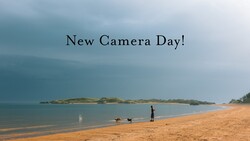
What makes his approach land is that he doesn't oversell it. He openly says he didn't come home with a standout shot after either 20,000-step walk, and that most of the frames he did get came inside the first 3,000 steps. That's the point, though. The goal isn't to manufacture a masterpiece on demand. It's to buy yourself enough time outside that a real opportunity has a chance to appear. He does spot a few he likes along the way, including dog walkers drifting closer as the tide comes in and the light finally breaks through a lone cloud parked, as he puts it, exactly over the sun.
His best advice arrives almost as an aside near the end. The ideal, he says, is to find something outdoors that makes you forget about photography entirely until a shot presents itself. Mountain biking, sitting on a bench with a friend, walking with a podcast. When your brain isn't grinding on whether the light is good enough, you notice more of what's actually in front of you. The non-photography goal is the backup plan for when that natural absorption won't come. If you can't lose yourself in the walk, at least give yourself a number that forces you to keep taking it.
If the well of motivation has run dry and you've caught yourself thinking about packing it in, watch the full video above to see how Popsys puts each of these goals into practice on real outings.


Join the Fstoppers community for free
-
Post comments and join in the discussions
-
Browse the site ad-free
-
Share your work and get featured in the community
-
Compete in the photo contests for fun and prizes
2 Comments
Mr. Popsys' statement about golf shots misses the most important point -- if you're a professional golfer at a tournament, you want the ball to go exactly where it is supposed to go because that's how you win and make money.
Likewise, a professional photographer wants every shot to land (even though they don't of course) because that's how you eat.
As an amateur, I promise Mr. Popsys that if every, or almost every, one of my shots landed (golf or photography), it would not go stale for a long, long time.
You must be a Pro for you go out hunting for an image, the worst thing a photographer can do! Why you ask? Over my many decades of capture of light and times it is about the eye and it being trained to see what others do not! Or you can study and plan a location for the best times but that also is what you dream of a good capture in your mind but yes again you are out and about and as the saying goes " You have to be out thereto get that capture".
In todays world we are on wheels or floating for we are very mobile everyday even when home inside we walk about not really seeing just going about life. The thing is a photographer is capturing light of a certain time and place never to happen again, and that is the prize- the unique image that is only yours with the story you heard as you pushed down the shutter button not ever and never to be captured again. But the image has to have something say to who ever sees it not just you.
Another key thing is when out and about are you ready with that tool in your bag and its attachments and have you read the 600+ book that tells you all the different tricks it can do no matter the light night or day and to day how to today do video, yes a lot of info for a little brain but when you see a capture in one mind the has that story your ready.
Instead of counting steps and what not are you enjoying the time or as you put it is it like work? We drive to and fro everyday/night how many times do you stop when you see it the combo of things. How many time will you stop or will you just keep going and say another day have to get somewhere.
What do you carry and how do you carry and how handy is it. Like do you really need that 1.8 lens Prime or better to have a telephoto (that has OSS/IS).
I have two tear drop bags one for day and one for night and when on trip say a long drive I am ready for nightly hotel stay but look at all my apps and just go out and see not look but see.
An example I got into Milky Ways back in 2015 but had to learn when and where. all the YouTubers have everyone going out to the west at dark sky places and wearing sneaker with all the snakes and what not. But I can see it even under lit condition just look at the stars and mostly using an app like PhotoPills. The point here is I have images that are unique and no one not even pros have thought of mainly knowing how to also capture at night with light only a camera can see. I even learned, by just trying, I could bracket 5 at +/- 2EV hand held meaning even in the blue hour i can capture what my eyes see and no need to haul around a tripod everywhere.
Bottom get out and enjoy seeing stories no one else notice but study your camera's tricks just to be ready!
1. Hand held blue hour
2. Yes under sodium orange lights with dark sky over the Atlantic ocean
3. This was after I did some Milky Way's and found this group night fishing using a 16-35mm f/4 and the A7SM1 they sat still for 30s using no flash, but I captured what wedding photographers (4 to 5 weddings every week end)never think of.
4 Have camera will travel to a place and time of stories never to be duplicated!