You shot 36,000 photos in your first year and kept maybe 10. That's not failure, and treating it as failure is the thing quietly holding you back.
The reframe comes from Cody Mitchell, who argues that we inherited a broken definition of what a photographer is. Most of us judge ourselves by output. Good photos mean you're a photographer, bad photos mean you're a fraud. Mitchell points out that you never actually chose that standard, you just absorbed it, and then you punish yourself for not living up to it. His alternative is blunt: a photographer is someone who consistently engages in the process of shooting with the goal of improving that process. No mention of quality anywhere in the definition.
That shift runs on the difference between output goals and input goals. An output goal sounds like "I want a photo good enough to hang in a gallery" or "I want to win an award." Fine ambitions, but they depend on conditions, luck, and the world cooperating, none of which sit under your control. An input goal, like "I'll shoot 100 photos every day," lives entirely in your hands. Nothing in that promise requires the photos to be good. Mitchell walks through the arc of a beginner shooting 100 frames where 99 are bad, then an amateur where 80 are bad, then an expert where only 20 are, and the only variable that changed was showing up.
The reason this works has real backing. Mitchell tells the story of a photography class run by Jerry Uelsmann, who split his students into two groups. One group was graded on producing a single best possible image by the end of the term. The other was graded purely on quantity. The best photos at the end all came from the quantity group. I'll let the video explain why the perfectionist group stalled, but the takeaway lands hard: intensity and consistency beat trying to know everything before you press the shutter.
If you want a framework here, it's the same one deliberate-practice research keeps circling back to. Volume alone doesn't make you better, feedback does. Mitchell's version is a closed daily loop. Shoot your 100 frames, pull the three you like most and ask what they share, then pull the three worst and ask what they share. Feed that back into tomorrow's 100. This maps almost exactly onto how athletes and musicians train, small corrections repeated at high frequency, and it's why the 1% daily improvement idea he floats isn't just a motivational line. Compounding is real, and skill compounds the same way money does. If 100 sounds like too much, drop it to 10 or five and hold the number steady. The specific count matters less than closing the loop every single day.
There's a quiet permission in all of this. Ansel Adams, arguably the most famous photographer in history, considered his year a success if he walked away with one good image. That was a working professional at the top of the field. Nobody is producing keeper after keeper, and the polished portfolio you admire is sitting on top of a mountain of frames nobody will ever see. Mitchell says he has hundreds of thousands of photos that will never surface. Once you expect 99 bad shots for every good one, you've already won before you start, because you stopped scolding yourself for the outcome you built into the plan.
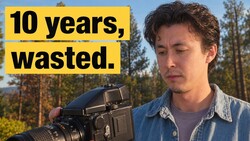
Mitchell lays out the full daily system and the reasoning behind the classroom result in the video above, so give it a watch before your next shoot.




Join the Fstoppers community for free
-
Post comments and join in the discussions
-
Browse the site ad-free
-
Share your work and get featured in the community
-
Compete in the photo contests for fun and prizes
1 Comment
Serendipity is the missing variable. My best shots have more to do with being in the right place at the right time than deliberate planning.