
There is a moment I've become very familiar with over the years. It usually happens on the drive home, just after I've packed the camera away and the light has long since faded.
It's that quiet realization that nothing from the day will make it into a final image.
No keeper. No portfolio shot. Nothing to process.
For a long time, I treated those days as failures. I would mentally replay decisions I made in the field, question timing, and sometimes even question whether I had missed something obvious. It felt like the effort should have guaranteed a result.
Over time, though, that way of thinking changed completely. Not because I started getting better images more often, but because I started to understand what hit rate actually means in landscape photography, and more importantly, what it doesn't mean.
Expectation vs. Reality in the Field
There is a natural assumption in photography that effort should lead to outcome.
You plan the location.
You check weather systems.
You time your arrival for light.
You commit the energy to being there when conditions align.
On paper, that sounds like a controlled process. A system where preparation leads to predictable results.
But landscape photography doesn't operate on effort alone.
When I'm out in the field, I'm constantly shown that I'm working with a set of variables that sit completely outside of my control. Light direction shifts minute by minute. Cloud structure builds or collapses in ways that don't always match forecasts. Atmospheric clarity changes with wind direction, humidity, and timing. Even tide and seasonal position can shift the entire character of a scene.
I can do everything correctly and still walk away with nothing. That is not a rare scenario. It is the norm.
And for a long time, that mismatch between expectation and reality was the main source of frustration in my work.
The Problem With Outcome-Based Thinking
When I first started photographing landscapes seriously, I evaluated every shoot in a very simple way. Did I get an image or not? If I came home with something strong, the shoot was successful. If I didn't, it wasn't. That way of thinking feels logical at first. It creates a clear measure of success. But over time, it can become restrictive.
Because it ignores almost everything that actually happens in the field.
The waiting.
The observing.
The repositioning.
The decision making under changing conditions.
The constant reassessment of light and composition.
All of that gets discounted if there is no final image.
What I began to realize is that this mindset was not only limiting how I evaluated my work, but it was also changing how I behaved in the field. It created pressure to force outcomes from situations that were never aligned to produce them.
Instead of working with conditions, I started working against them, and didn't treat it as a learning experience.
The Ansel Adams Perspective
There is a perspective often attributed to Ansel Adams that suggests producing around a dozen strong images in a year would be considered a very good output.
Not a dozen shoots. A dozen images. Across an entire year.
Whether that number is exact or not almost becomes irrelevant. What matters is what it represents.
At a high level of landscape photography, even for someone operating at a very experienced standard, the ratio of time spent in the field versus strong finished work is extremely low.
That idea helped change my understanding of hit rate entirely.
Because it removed the expectation that every outing should produce something usable.
What Hit Rate Actually Means
Hit rate is simply how often a shoot results in a strong image.
When I look at my own work honestly, the number is low. Much lower than most people would assume from looking at finished images or social media output.
But the key shift for me was understanding that hit rate is not just about luck or conditions. It is about exposure and decision-making over time.
It is not a measure of how often things go right. It is a reflection of how often you are in position to respond when things do go right.
And those two things are very different.
Why Low Hit Rate Is Not a Problem
One of the biggest misunderstandings I had early on was that a low hit rate meant I was doing something wrong.
I now see it differently.
A low hit rate is not a flaw in the process. It is a natural result of working in an environment that is unstable by design. Landscape photography is built around change. Nothing is fixed. Nothing is repeatable in exactly the same way. Even returning to the same location produces different outcomes depending on light, tide, weather, and season.
That unpredictability is not a complication to remove. It is the foundation of the shoot. And it also explains why strong images feel better when they do happen. If every shoot produced a strong image, none of them would carry the same weight.
What Actually Improves Over Time
When I stepped back from outcome-based thinking, I started to see progress in a different way. Not in how often I came home with images, but in how I made decisions in the field.
The real improvements looked like this:
I became better at reading weather systems and understanding how they might evolve over time.
I started to understand how certain locations respond under different conditions rather than relying on them to behave the same way each visit.
My composition choices became more deliberate, especially when light was changing quickly.
And my patience increased, particularly in situations where waiting mattered more than moving.
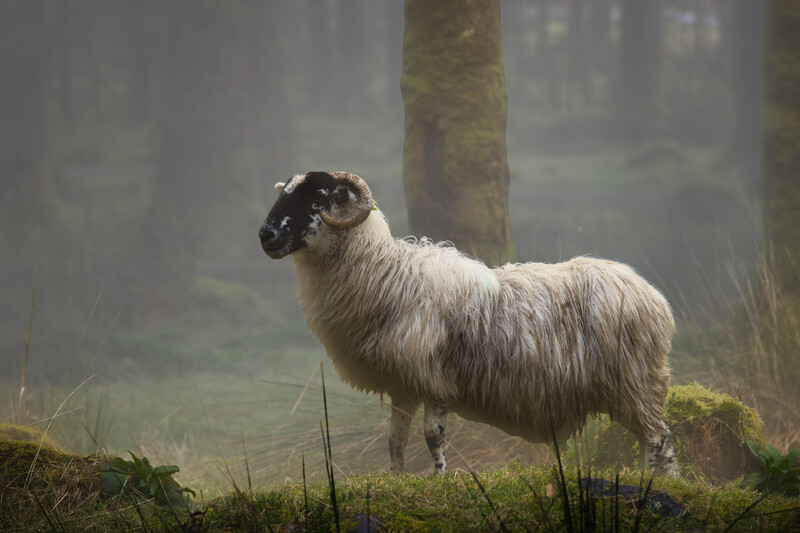
None of these improvements guarantees a successful image on any given day. But they increase the probability of recognizing opportunities when they appear. That distinction is important. Take the image of the sheep below. The conditions weren't ideal, so I shifted my approach, and just as I did, this guy walked close by, so of course I had to take a photo of him. The result? An image I like from conditions that weren't as I had originally hoped.
The Role of Repetition and Familiarity
A large part of improvement in landscape photography comes from repetition. Not repetition of success, but repetition of experience.
The more time I spend in the field, the more familiar I become with how conditions behave. Patterns begin to emerge. Light quality at certain times becomes more predictable. Weather systems start to feel more readable. Locations reveal different characteristics depending on conditions. This familiarity does not remove uncertainty. It simply reduces the amount of time needed to interpret it. And that has a direct impact on my decision making.
Because in landscape photography, timing is often the difference between an image working or not working.
Managing Expectations
One of the most useful shifts I made was changing how I evaluate a shoot in real time. Instead of asking whether I got a strong image, I started asking whether I made good decisions based on the conditions available. That might include choosing the right composition, waiting in the right location, recognizing when conditions were not going to develop in a useful way, or even deciding when to call it a day and not feel bad that I did.
This removed a lot of unnecessary pressure. It also meant that a day in the field could still feel productive, even if nothing ended up being processed afterward. Because value was no longer tied solely to outcome.
My Personal Perspective
Looking back, I can see that some of the most important parts of my development did not come from successful shoots.
They came from the sessions that didn't produce anything.
The mornings where light never arrived.
The evenings where conditions collapsed.
The days where nothing aligned despite planning.
At the time, those moments felt like missed opportunities. But they were actually building familiarity with how unpredictable the process really is. They also taught me something else that has stayed consistent in my approach. If I remove expectation from the equation, I see more. I notice more. I react less and observe more. The pressure is gone.
And that changes how I work completely.
Final Thoughts
Hit rate in landscape photography is low.
It always will be.
The conditions we work with are too variable, too dynamic, and too dependent on timing to expect consistent outcomes.
But that is not a limitation of the craft. It is part of what defines it.
Over time, I have stopped measuring my work by how many images I bring home from a shoot. Instead, I look at how I behaved in the field, how I responded to conditions, and whether I made decisions that align with what I've learned. And even more so, the fact that I was outdoors and not sitting at home.
That shift has made the entire process more sustainable. And more importantly, it has made the successful moments feel more rewarding when they do arrive.
What are your thoughts on this topic? Let's continue the conversation below.


Join the Fstoppers community for free
-
Post comments and join in the discussions
-
Browse the site ad-free
-
Share your work and get featured in the community
-
Compete in the photo contests for fun and prizes
8 Comments
What I've done probably over the last two or three years is take less photos most of my landscape adventures now I probably take a set of 15 maybe 20 photos in total but work on keepers and quality. Think about what I'm doing slowing down...... and just going through a more methodical process
Exactly the approach we have to use when using film. Film is at $5.00 a sheet for my camera format. That demands being very selective and accurate. If I do 10 images a day that is a long hard days work.
Take a macro lens along on your next "landscape" photography shoot, and you can pretty well guarantee that you'll come home with a keeper, regardless of whether light and drama of the grand landscape photo cooperates or not. If looking up at your intended subject framed by a boring sunny sky isn't working, look down at your feet.
If hit rate is measured by how often a shoot results in a strong image, challenges lie with that idea. What is a strong image? My first criteria is how I respond emotionally to the image. It may break all the rules of composition but if I like it, I keep it. I probably find a lot of keepers from an outing that other people might have tossed in the trash.
Nice writing, and very true. I've seen it so often. People go to the exact location some well known artist has worked thinking they'll get the same immortal image - they won't. Your statement in the article that great images are often the result of putting yourself in the place where the light, composition, cloud structure and all the other factors will be right. I try to set aside time for a few days spring, fall and winter to "go to the woods" and work, not just a day or when I am driving somewhere, but to be there on purpose. The other thing for me is that often an image needs to age before it actually comes to maturity for me. Most often if I rush back, get in the darkroom and hastily print my negatives I end up with only a very shallow rendering that doesn't make my heart sing. Most often the images have to sit, and I have to recognize that making an image takes time. In the words of Georgia O'Keefe; "“Nobody sees a flower - really - it is so small it takes time - we haven't time - and to see takes time, like to have a friend takes time.” It takes time and attention to build an image. Creating art isn't a commercial endeavor. I am used to working on a tight schedule in my commercial work. Deadlines are nothing new, and we are not creating works of personal expression. We are photographing silver ware and buildings that are someone else's creation. Occasionally those do transform into works of art. But the usual flow is that creating art works takes time. And in the words of the great American philosopher and rock and roll singer Ricky Nelson... "you can't please everyone so you might as well please yourself". Nice article. And BTW, the reason Adams said that a good photographer working very hard might be able to produce 12 good photographs a year was partly because the cameras he used were very slow and very deliberate. Just go and work with an 8x10 view camera, old fashioned lenses and bulky film holders and you'll understand. If he had our modern tools he would probably had a completely different statement to make.
A thing I have often said, "working in a new location is like making a new girlfriend. A lady will not give you all her secrets on a first date. It takes time to learn who she is, and as time passes and more time is spent together, more secrets will be learned". Making a landscape photograph is a lot the same. A location will not tell you its secrets on your first expedition. You visit, and revisit a location many times over many years, and your images will become more and more intimate about that place. More of its secrets will be told. Only time and intimacy with a location will allow you to make truly telling images. It has nothing to do with equipment, the toys you own or the tools you use. It has only to do with what I call "Moments of Perfection". In fact I have an artists statement based on that phrase and have made several gallery showings with that as the title. If you aren't there in that moment, you'll never get the image. As Weegee the Famous once said of his news photography; "F-8 and be there".
A Great share of information! One point not mentioned, software gets better as time goes by even decades later or better yet going back to film days for there are ways to bring those to life! Back in 2015 I started doing Milky Way's and at the time I fell for all the fast class and many had no chip for metadata info and lens correction were no where in post all meaning many waisted nights under the stars. A look back some 10 years later Lrc had LC's for unchipped lenses and a program that let you add metadata. Also tools to help correct bad decisions like doing bracketed captures with long exposes when not knowing camera NR is auto turned off after a 1 sec. exposure, example just doing a 3 at +/- 1EV gave noise but also dead and hot pixels. Two things in Lrc got way better and that is noise reduction to each image and then a modern HDR selection. All of just this brought back a hole night of images.
I suggest a trip back in time to those images that were thought not good enough and play with in newer SW. Something to always remember, first the images are mostly RAW, second you can edit an image one day and a week later editing again the two will never be the same even better try the same image with different editors (if you have) again all will be different so a no hit will turn into a hit maybe.
This image captured in 2015 and a 3 at +/- 1EV with a unchipped lens and staying at a near by hotel I traveled 100 miles just for this one night.
I have a simple way of judging my own images: does the photograph enhance the story or narrative I am telling or not? If it does, it stays, if not, it is excluded. As it is my story, my decisions do not depend on popularity or 'clicks', only what I think important. I greatly enjoyed your lead image of what I termed "Batman Rocks" on the Dingle Peninsula. Brings back good memories.
That’s a very good approach Steve! You’ll like my ego article so too I think
those are the devils horns but perhaps I’ll call them Batman from
now on too 😁
yeah Dingle is a stunning area for sure