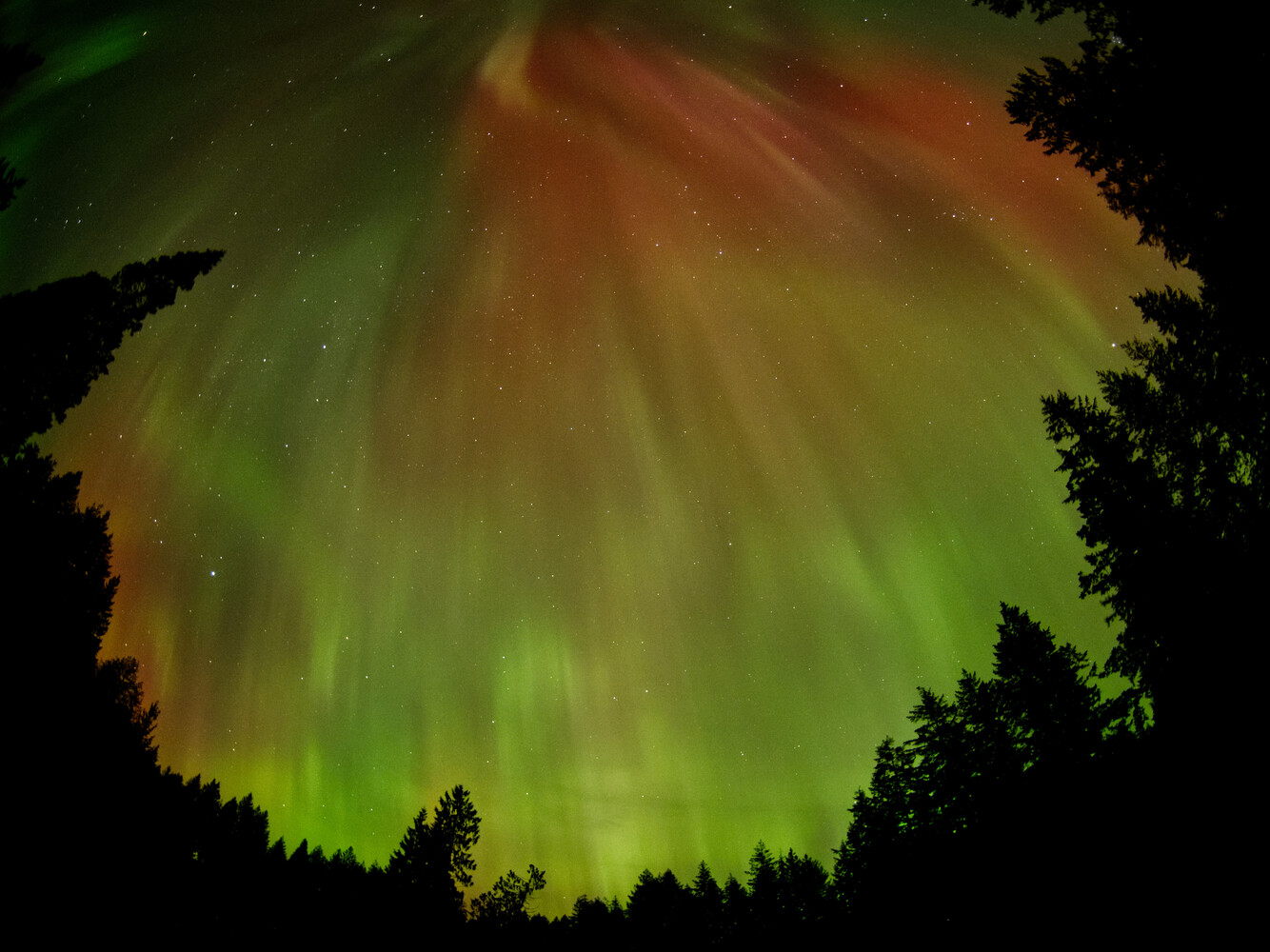

I'd seen auroras before. At a distance. At the horizon. But this was the first time it was immersive, from horizon to horizon, in all directions!
I went out and took photos for three hours! And then, at about 3AM, I went to bed, but could not sleep, because THEY WERE STILL OUT THERE!
Foolishly, I first went out with my brightest and widest rectilinear lens, the Laowa 6mm ƒ/2 C&D Dreamer. This is an awesome lens that I love when there is enough light for manual focus, but I just couldn't get the stars sharp, and I was constantly bumping the focus ring, taking a bunch of blurry photos.
So I went back and got my rarely-used 8mm ƒ/1.8 Olympus M.Zuiko Digital ED PRO Fisheye. At first, I was distracted by the fisheye effect, but I really love the way it makes the trees wrap around the sky, and it is sharper in the corners than any super-wide rectilinear can get.
I used the Olympus OM-1's "Starry Sky" focus mode, which yielded perfectly sharp stars without effort. And this would have been much more difficult without Olympus's superb IBIS.
The OM-1 has a brilliant viewfinder IBIS aide, with a little box bouncing around from camera motion within a bigger box. As long as you keep the little box inside the big box, IBIS has your back. If it strays outside the box, delete the shot and try again.
With this IBIS aide, I'm convinced I can hand-hold an exposure longer than it takes for my arms to cramp up or for my bladder to complain! This was five seconds at ƒ/1.8, ISO 2,000. My longest shots were tack-sharp at twelve seconds.
I'm blessed with Bortle-1 skies in my rural location 20 kilometres east of Powell River, British Columbia, Canada. The closest yard light is about a kilometre away.











No comments yet