Slowing down and making a single print from start to finish is one of the hardest things to do when you shoot a lot. Most people never get there, not because they lack the skill, but because the habit of moving on to the next shot is almost impossible to break.
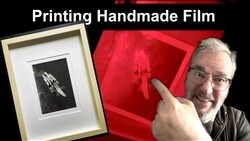
Coming to you from Ari Jaaksi - I Shoot On Film, this thoughtful video follows Jaaksi through the entire process of taking one photograph, a lakeside image he shot a few months prior, and turning it into a finished, framed print. He starts with paper selection, choosing between Ilford Multigrade RC 300 and Foma Fomabrom 112, two fiber-based papers with very different characters. He lands on the Ilford, partly because of its texture and slight golden hue, which shapes almost every decision that follows, including the color of the window mount. That golden cast rules out a white mount entirely; it would make the print look dirty rather than warm.
The darkroom work alone takes four to six hours. Jaaksi makes trial print after trial print, adjusting contrast, dodging, and burning until the image starts to match what he actually wants, not just what he imagined when he took the shot. He's direct about the fact that fresh chemicals are non-negotiable at this stage. Using tired chemistry to save time is how you waste a full day on mediocre results. Once he has prints he likes, he washes them in a print washer that circulates water automatically, flattens them under a stack of books for a few days, and then begins spotting out the dust marks left by the negative with black and gray paint. It's slow, exacting work, and he clearly enjoys it.
The framing decisions are just as deliberate. Jaaksi orders custom window mounts from a local frame shop rather than cutting them himself, and in this case he stacks two mounts on top of each other to give the final piece a subtle three-dimensional quality. He reaches for a dark walnut frame, inexpensive but well-suited to the warm tones of the paper and the mount, and uses an antistatic record cleaner to pull dust off the glass before assembling everything. The whole package, from negative to framed print, takes six to eight hours. The result is a single photograph he describes as one of the best things he's ever made, with no exhibition, no wall space, and no buyer lined up. He made it because it deserved the attention.
That framing is worth sitting with. Jaaksi isn't arguing that everyone should print less or work slower as a philosophy. He's showing what happens when you actually do it, concretely, with one specific image, and what the process demands at each step. The video doesn't romanticize darkroom work; it just documents it honestly, including the trial prints that don't work and the hardware workarounds for flattening fiber-based paper without a dedicated print dryer. Check out the video above for the full framing and assembly process from Jaaksi.

Join the Fstoppers community for free
-
Post comments and join in the discussions
-
Browse the site ad-free
-
Share your work and get featured in the community
-
Compete in the photo contests for fun and prizes
9 Comments
"Slowing down and making a single print from start to finish is one of the hardest things to do when you shoot a lot. Most people never get there, not because they lack the skill, but because the habit of moving on to the next shot is almost impossible to break."
Indeed. This is where submitting photos to a contest, building a website, or putting together a printed portfolio is helpful. It's an occasion to sift through your work and make conscious decisions about which images are best and which work best together, and then to perfect them for an audience.
I've often heard that film photography forces you to slow down and think more about what you're doing. I wouldn't know... I was never a serious film photographer, nor do I have any desire to become one. The digital equivalent though is printing your own work. I like his speaking about making several trial prints. In today's world of sophisticated software, the promise is that a calibrated monitor and appropriate paper profile will produce a perfect print the first time. I don't buy it. Prints and monitors are two entirely different things. And, besides, I rather enjoy the process of printing the same picture two, three, or four times before determining it to be finished.
Printing is more than just an unavoidable step for getting an image on to a wall with as little pain and cost as possible. I never even think about a frame, so wall art is not the way I prefer to view my prints. I prefer something I can hold in my hands. Printing is as much of a creative element in photography as composition and camera settings... best served by not rushing through the process.
More film myths perpetuated by people who never worked under creative deadlines or budgets. Film and chemical processing doesn't magically slow you down. Working deliberately is a conscious choice you make whether you're using a digital camera or a paintbrush.
What I like most about this video is that the print making process as described doesn't have to fit into a creative deadline or budget. I understand how those things constrain the approach to a job. I had a business for 40 years. But photography for me is most enjoyable when I can take as long as I want, and make as many reprints as I want. Digital or darkroom doesn't matter... one is not inherently better than the other. It's the enjoyment and immersion in the process that gives photography life and meaning.
Snide derision misses the point.
What method are you using to scan the negatives?
Using a record play cleaner to get rid of dust. Great idea. I have printed in a darkroom for MANY years and have literally thousands of hours, in fact cumulatively months and probably years printing in a darkroom. The thing I like best about working in a darkroom is that successive printing of an image, over a long span of time, causes the image to evolve where an image that is printed now in 2026 will be radically different from one that I printed from the same negative 20+ years ago. My vision of the scene will have evolved, my technique will have improved - at least I hope it has. Maybe I am just slower than Ari Jaksi, but I don't recall ever having a completed image in just six hours in the darkroom. I do believe that the darkroom print is still the absolute King of Photographic Art. The downside of that is that the cost of materials, film and darkroom paper has absolutely skyrocketed in the last 5 years to the point that a sheet of 16x20 paper is now almost $10.00 a sheet, and frankly, unless I am preparing for a gallery show where it will make a difference I just cannot justify that expense. So, inkjet is what I am doing now.
Piezography is a special carbon ink that you can use in Epson printers for making black and white prints, that some people believe compares well to darkroom prints.
piezography. Haha. My preferred pie is a tart cherry! Seriously though, I need to investigate to see if those cartridges are available. Hadn't thought of that process in years.