

Fujifilm occupies a unique position in the camera market. While Canon, Nikon, and Sony battle for full frame dominance, Fujifilm has charted its own course: a mature APS-C system beloved by enthusiasts and professionals alike, plus a medium format lineup that brings large sensor photography to a broader audience than ever before. For photographers entering Fujifilm's world in 2026, the lens ecosystem can seem deceptively simple at first glance, but there's more nuance hiding beneath the surface than you might expect. Understanding the difference between XF and XC, decoding all those suffix letters, and knowing how the X-mount and G-mount systems relate to each other will help you make smarter buying decisions and build a kit that truly serves your needs.
The Foundation: Two Completely Separate Systems
Unlike some manufacturers who offer lenses that work across multiple camera lines, Fujifilm maintains two entirely distinct ecosystems. They share naming conventions and design philosophy, but the lenses themselves are not cross-compatible in any way.
The X-mount launched in 2012 with the X-Pro1 and remains Fujifilm's APS-C mirrorless system. With a sensor measuring 23.6mm x 15.6mm and a 1.5x crop factor, the X-mount has grown into one of the most comprehensive APS-C lens lineups available from any manufacturer. Fujifilm's commitment to APS-C as a primary format (rather than treating it as a stepping stone to full frame) means the X-mount lens library is purpose-built rather than adapted from larger formats. This results in more compact designs optimized specifically for the sensor size, with excellent optical performance even on the higher resolution bodies like the 40-megapixel X-T5. Note that while all XF and XC lenses work on high-resolution bodies, Fujifilm publishes a list of lenses optimized to fully resolve these sensors. Standouts from that list include the updated f/1.4 prime trio (XF 18mm, 23mm, and 33mm f/1.4 R LM WR), the XF 56mm f/1.2 R WR, the XF 90mm f/2 R LM WR, and the Red Badge zooms including the new XF 16-55mm f/2.8 R LM WR II. The complete roster is considerably longer, so check Fujifilm's official X-mount lens page for the full compatibility breakdown. Older lenses like the original XF 35mm f/1.4 R still produce beautiful images but may not extract every last bit of detail from 40-megapixel files.
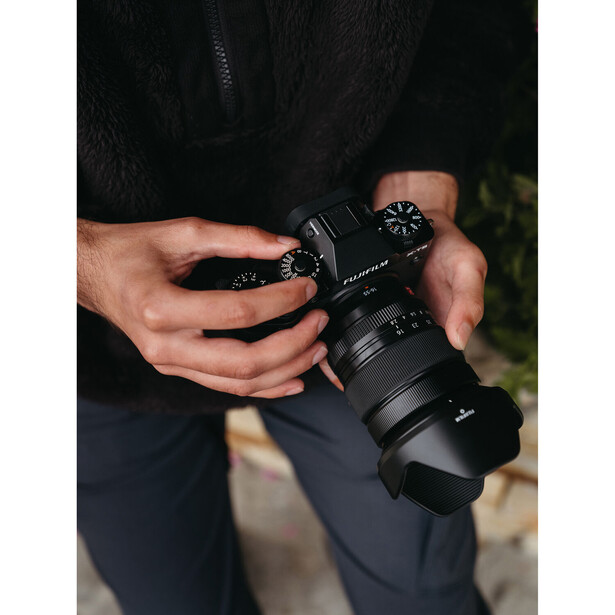
The X-Mount Alphabet: XF Versus XC
Within the X-mount system, Fujifilm divides its lens lineup into two distinct tiers. Understanding this division is essential for building a kit that matches your needs and budget.
XF Lenses: The Premium Line
XF lenses represent Fujifilm's higher quality offerings and constitute the majority of the X-mount catalog. These lenses share several characteristics that distinguish them from their XC siblings. The construction uses metal barrel housings and metal lens mounts, providing durability and a premium feel in hand. Most XF lenses include a physical aperture ring, allowing direct manual control of exposure in the classic manner that Fujifilm cameras are designed around. Optical designs typically incorporate specialized elements like ED (Extra-low Dispersion) glass and aspherical elements for superior image quality and aberration control.
The XF lineup spans everything from ultra-wide primes to super-telephoto zooms, with particularly strong coverage in the fast prime category. Within the XF line, Fujifilm informally distinguishes their top-tier professional lenses with a red badge on the lens barrel, similar to Canon's "L" series or Sony's "G Master" designation. This "Red Badge" designation commonly refers to the constant-aperture f/2.8 zooms (XF 8-16mm, XF 16-55mm, XF 50-140mm), but also encompasses high-end telephoto glass like the XF 100-400mm f/4.5-5.6, XF 150-600mm f/5.6-8, and the XF 200mm f/2. The price premium over standard XF zooms reflects this professional positioning, though Fujifilm doesn't publish an official "Red Badge" roster.
Lenses like the XF 23mm f/1.4 R LM WR, XF 35mm f/1.4 R, and XF 56mm f/1.2 R WR have earned devoted followings for their rendering characteristics and build quality. For photographers who value the tactile experience of traditional camera controls combined with modern optical performance, the XF line delivers.
XC Lenses: Budget-Friendly Options
XC lenses target entry-level and budget-conscious photographers. The construction switches to plastic barrels and plastic lens mounts, reducing both weight and cost. Crucially, XC lenses lack the aperture ring found on most XF optics. Instead, aperture must be controlled through the camera body's command dials. This isn't necessarily a dealbreaker for photographers who prefer that workflow anyway, but it does change the shooting experience on Fujifilm bodies designed around lens-based aperture control.
Currently, five XC lenses exist: the XC 15-45mm f/3.5-5.6 OIS PZ (a collapsible power zoom often bundled with entry-level bodies), the XC 16-50mm f/3.5-5.6 OIS II, the newer XC 13-33mm f/3.5-6.3 OIS (the current kit lens for the X-T30 III), the XC 50-230mm f/4.5-6.7 OIS II, and the XC 35mm f/2. Despite the budget positioning, these lenses still deliver good optical quality. The XC 35mm f/2 in particular offers an affordable entry point to prime lens photography with image quality that punches above its price point.
Decoding the Suffix Soup: What All Those Letters Mean
Fujifilm uses a standardized system of suffix codes to indicate lens features. Once you learn these, you can decode any lens name at a glance.
- R (Ring): The lens includes a physical aperture ring for direct aperture control. Most XF lenses carry this designation, while no XC lenses do. On Fujifilm cameras, the aperture ring sends electronic signals to the camera rather than mechanically controlling the diaphragm, but the tactile experience remains similar to classic manual focus lenses.
- WR (Weather Resistant): The lens includes seals at critical points to resist dust and moisture intrusion. Weather resistance is particularly common on Fujifilm's professional-grade zooms and newer prime designs. Pairing a WR lens with a weather-sealed body like the X-T5 or X-H2 provides confidence when shooting in challenging conditions.
- OIS (Optical Image Stabilization): The lens contains a stabilization system that physically shifts optical elements to compensate for camera shake. This is especially valuable for telephoto lenses and when shooting video. Note that some newer Fujifilm bodies include in-body image stabilization (IBIS), which works with any lens, but combining IBIS with OIS lenses can provide even greater stabilization performance.
- LM (Linear Motor): The lens uses a linear motor autofocus system for fast, quiet focus acquisition. Linear motors excel at the smooth, silent focusing required for video work and also improve tracking performance for moving subjects. Most newer XF lenses include LM designation.
- PZ (Power Zoom): The lens includes motorized zoom control rather than manual zoom ring operation. Currently found on the XC 15-45mm kit lens and the XF 18-120mm f/4 LM PZ WR. Power zoom is particularly useful for video shooters who want smooth, consistent zoom speeds.
- APD (Apodization): An extremely specialized designation used only on the XF 56mm f/1.2 R APD. This lens includes an apodization filter element that produces exceptionally smooth bokeh by gradually transitioning out-of-focus areas. The tradeoff is approximately one stop of light loss (the lens transmits at roughly T/1.7 while maintaining f/1.2 depth of field characteristics).
A note on autofocus motors: Lenses marked "LM" use fast, quiet linear motors. Non-LM lenses use other autofocus drive systems and are often slower and more audible during focusing. If your XF lens (like the XF 27mm f/2.8 R WR or the original XF 35mm f/1.4 R) lacks "LM" in the name and makes noticeable noise while focusing, this is normal behavior for that design generation.
High-speed shooting and lens limitations: Bodies like the X-H2S and X-T5 can achieve burst rates of 15-40 fps, but many older lenses cannot move their focus elements fast enough to maintain continuous autofocus at these speeds. Photographers shooting sports or wildlife who want to maximize burst performance and tracking accuracy should prioritize Linear Motor (LM) lenses. Pairing a high-speed body with an older lens like the original XF 56mm f/1.2 R or XF 35mm f/1.4 R may result in disappointing keeper rates during action sequences.
Macro: Indicates the lens is designed for close-up photography. Fujifilm's macro lenses vary in their magnification ratios. The XF 30mm f/2.8 R LM WR Macro is the newest and most compact option with true 1:1 magnification. The XF 80mm f/2.8 R LM OIS WR Macro also offers 1:1 magnification with greater working distance, while the older XF 60mm f/2.4 R Macro provides 1:2 (half life-size) magnification.
Teleconverter compatibility (critical warning): Fujifilm's XF 1.4x TC WR and XF 2.0x TC WR teleconverters have a protruding front element that makes them physically incompatible with most X-mount lenses. Attempting to mount a TC to an unsupported lens can cause glass elements to collide, potentially damaging both pieces of equipment. The compatible lenses are: XF 50-140mm f/2.8, XF 100-400mm f/4.5-5.6, XF 150-600mm f/5.6-8, XF 70-300mm f/4-5.6, XF 500mm f/5.6, and XF 80mm f/2.8 Macro. Note that the XF 200mm f/2 is not compatible with these standard teleconverters and requires its own dedicated XF 1.4x TC F2 WR. Always verify compatibility on Fujifilm's official support pages before purchasing, as this list may expand with future lens releases.
The Medium Format World: GF Lenses and G-Mount
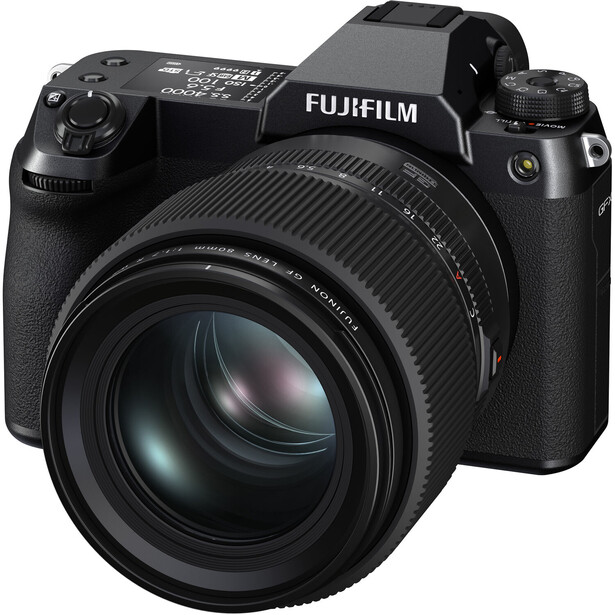
Understanding the GFX Crop Factor
Here's where things get counterintuitive. Because the GFX sensor is larger than full frame (not smaller like APS-C), the "crop factor" works in reverse. The GFX sensor has a 0.79x multiplication factor relative to full frame. A 63mm GF lens provides a field of view equivalent to a 50mm lens on a full frame camera (63mm x 0.79 = approximately 50mm). This also affects depth of field calculations: the larger sensor provides shallower depth of field at equivalent field of view and aperture compared to full frame.
GF Lens Characteristics
GF lenses use the same suffix system as XF lenses (R, WR, LM, OIS), making the naming conventions consistent across Fujifilm's lineup. Nearly all GF lenses include weather resistance, aperture rings, and linear motors as standard features, reflecting their professional positioning. The lineup has expanded steadily since 2017 and now covers focal lengths from the ultra-wide GF 20-35mm f/4 R WR to the super-telephoto GF 500mm f/5.6 R LM OIS WR.
Notable GF lenses include the GF 110mm f/2 R LM WR (an 87mm equivalent portrait lens with legendary rendering) and the compact GF 50mm f/3.5 R LM WR (a 40mm equivalent that keeps the system surprisingly portable).
For architecture and product photographers, the GF tilt-shift lenses (GF 30mm f/5.6 T/S and GF 110mm f/5.6 T/S Macro) represent uniquely capable tools in the medium format mirrorless space and are often the deciding factor for professionals choosing Fujifilm over competing systems.
Flash sync speed consideration: GFX bodies use a focal plane shutter with flash sync speeds of 1/125s on older models and 1/160s on newer bodies like the GFX100 II and GFX100S II. Studio photographers accustomed to higher sync speeds on other systems should be aware of this limitation. To achieve sync speeds up to 1/800s or beyond without resorting to HSS (which significantly reduces flash power), some professionals adapt Hasselblad H-mount lenses with leaf shutters via third-party adapters.
Third-Party Lens Support: A Welcoming Ecosystem
Unlike Canon's historically restrictive approach to RF mount, Fujifilm has embraced third-party lens manufacturers, making X-mount one of the most open APS-C ecosystems available. Multiple manufacturers produce native autofocus lenses for X-mount with full electronic communication.
Sigma offers their popular Contemporary prime trio: the 16mm f/1.4 DC DN, 30mm f/1.4 DC DN, and 56mm f/1.4 DC DN. They've also brought the excellent 18-50mm f/2.8 DC DN to the system. These lenses deliver excellent optical performance at lower prices than equivalent Fujifilm glass, though they lack aperture rings and weather sealing.
Tamron has committed significantly to X-mount with the 17-70mm f/2.8 Di III-A VC RXD, 11-20mm f/2.8 Di III-A RXD, and the superzoom 18-300mm f/3.5-6.3 Di III-A VC VXD. The 17-70mm f/2.8 in particular has earned a reputation as possibly the best all-around lens for Fujifilm shooters who want a single versatile zoom.
Viltrox offers budget-friendly autofocus primes including 13mm, 23mm, 33mm, 56mm, 75mm, and 85mm options at various apertures. Quality has improved dramatically over successive generations, and their f/1.4 primes represent remarkable value for photographers on tight budgets.
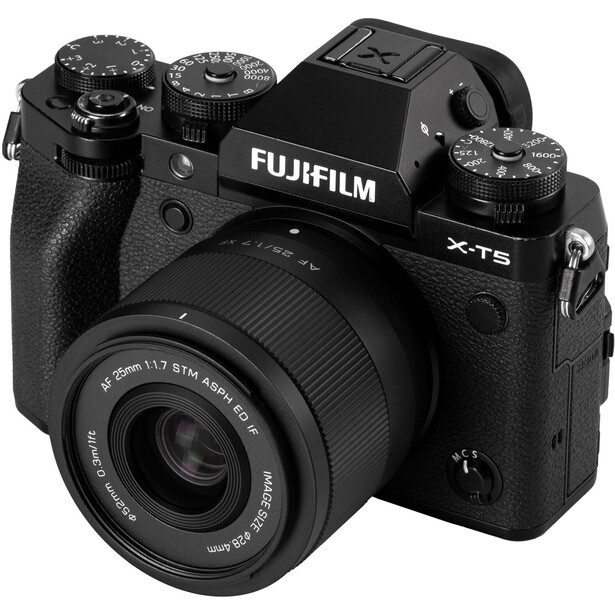
Zeiss made early investments in X-mount with their Touit line (12mm f/2.8, 32mm f/1.8, and 50mm f/2.8 Macro), though these have become somewhat dated compared to newer options.
For GFX medium format, native third-party autofocus options remain limited, though Viltrox has begun entering the space. Smart adapters like the Fringer EF-GFX Pro allow use of Canon EF lenses with autofocus and aperture control, and many GFX shooters have built kits around adapted EF glass. However, AF performance varies considerably by body, lens, and firmware combination, so expectations should be tempered compared to native GF glass. If you need guaranteed, seamless autofocus without caveats, Fujifilm's own GF lenses remain the safest choice.
Specialty Glass: Cine Lenses
For dedicated video work on X-mount, Fujifilm offers the MKX series: the MK18-55mm T2.9 and MK50-135mm T2.9. These are the only native cine lenses for the system, featuring constant T-stop across the zoom range, smooth de-clicked aperture and focus rings, and standardized 85mm front diameters for matte box compatibility. While most photographers will never need these, video-focused shooters should know they exist as an alternative to adapted cine glass or using stills lenses for motion work.
Adapting Legacy Glass
Fujifilm's relatively short flange distance makes X-mount an excellent platform for adapting vintage manual focus lenses. The 17.7mm flange distance allows adapters for virtually any SLR lens mount without requiring optical correction elements.
Popular adaptation options include Canon FD, Nikon F, Pentax K, M42 screw mount, Minolta MD/MC, Contax/Yashica, and Leica M. Simple mechanical adapters provide manual focus and manual aperture control, while some adapters for Canon EF (like the Viltrox EF-FX1 and Fringer EF-FX Pro) include electronic contacts for autofocus and aperture control with varying degrees of success.
For vintage lens enthusiasts, Fujifilm cameras offer an advantage: excellent focus peaking, focus magnification, and a digital split image feature that makes manual focusing remarkably precise. Combined with Fujifilm's renowned color science and film simulations, adapted vintage glass can produce beautiful, characterful images.
Quick Reference: X-Mount Compatibility at a Glance
Lens Type Works on X-Mount Bodies? Aperture Ring? Typical Use Case XF Yes (Native) Yes (most) Enthusiast/Professional XC Yes (Native) No Entry-level/Budget GF No N/A Medium format only Third-party AF (Sigma, Tamron, etc.) Yes Usually No Value/Specialty Adapted Manual Yes (via adapter) Lens-dependent Creative/VintagePractical Guidance for 2026
- For new Fujifilm shooters building an X-mount kit: Start with either the XF 16-50mm f/2.8-4.8 R LM WR kit lens (weather-sealed with an internal zoom mechanism that doesn't extend when zooming, making it ideal for gimbal use since the center of gravity stays constant) or the Tamron 17-70mm f/2.8 if you want constant aperture and stabilization. Add a fast prime based on your preferred focal length: the XF 35mm f/2 R WR offers an affordable 50mm-equivalent with weather sealing, while the Sigma 30mm f/1.4 provides faster aperture at lower cost without weather protection.
- For photographers prioritizing Fujifilm's shooting experience: Invest in XF glass with aperture rings. The tactile experience of adjusting aperture directly on the lens, combined with Fujifilm's physical shutter speed and ISO dials, creates a shooting workflow that many photographers find deeply satisfying. The XF 23mm f/2 R WR, XF 35mm f/2 R WR, and XF 50mm f/2 R WR trio provides a compact, weather-sealed, fast-aperture kit covering the most popular focal lengths.
- For budget-conscious shooters: Third-party glass offers tremendous value. The Sigma Contemporary primes deliver optical quality matching or exceeding their Fujifilm equivalents at significantly lower prices. Viltrox primes have improved dramatically and offer entry into fast-aperture photography for remarkably little money.
- For those considering GFX medium format: Understand that you're entering a more specialized system with higher costs and fewer lens options. The image quality benefits are real (larger sensor, more resolution, different rendering characteristics), but the lens investment is significant. Start with a versatile option like the GF 32-64mm f/4 R LM WR or the compact GF 50mm f/3.5 before expanding.
If you're new to the Fujifilm system and want to develop a strong foundation in camera technique before investing heavily in glass, Photography 101 provides comprehensive training that applies regardless of which lenses you choose.
Looking Forward
Fujifilm continues active development on both X-mount and G-mount systems. The X-mount lens roadmap shows ongoing commitment to APS-C, with recent releases like the XF 16-50mm f/2.8-4.8 R LM WR and XF 16-55mm f/2.8 R LM WR II demonstrating Fujifilm's willingness to update and improve existing designs. The 16-55mm Mark II is particularly notable for introducing a physical aperture de-click switch, allowing photographers to toggle between clicked stops for stills work and smooth, stepless iris control for video. This hybrid-focused design direction signals where Fujifilm is heading with future professional glass. The GFX system has matured impressively, with the GFX100 II bringing professional-grade speed and handling to medium format.
Third-party support continues expanding, with Sigma and Tamron both committing to additional X-mount releases. This openness gives Fujifilm shooters options that Canon RF and Nikon Z users often lack, particularly at the budget end of the market.
For photographers who appreciate thoughtful camera design, excellent color science, and a company genuinely committed to their chosen sensor format, Fujifilm offers a compelling alternative to the full frame mainstream. Understanding how the lens ecosystem works puts you in a position to build exactly the kit you need, whether that's a compact travel setup, a professional portrait system, or a versatile all-around collection.




Join the Fstoppers community for free
-
Post comments and join in the discussions
-
Browse the site ad-free
-
Share your work and get featured in the community
-
Compete in the photo contests for fun and prizes
1 Comment
A full frame XT-5 like design (dial buttons) would be my ideal camera, but unfortunately there is no such thing. That's why i chose Sony a long time ago.