
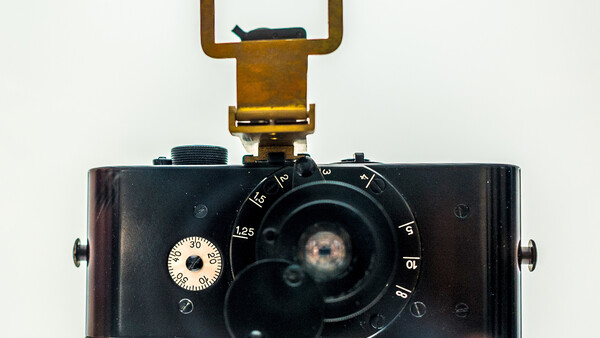
The short side of a full frame sensor is a silent-movie measurement. Cinema's full aperture ran about 24.89mm across the strip, from one row of perforations to the other, and when Oskar Barnack turned that film on its side in a workshop at Ernst Leitz in Wetzlar, that number became the height of a still photograph. The 36mm long side is two movie frames laid end to end with a millimeter or so shaved off.
What Barnack Built, and When
Barnack came to Optische Werke Ernst Leitz in Wetzlar in 1911 from Carl Zeiss in Jena, hired as a precision mechanic in the microscope department's experimental workshop. He was asthmatic, which is part of why the light, small camera mattered to him personally. He was also building motion picture equipment, and that is where the format question started.
Emulsions of the period varied batch to batch, and a badly exposed reel of cine stock was an expensive mistake. The account that traces back to Leitz's own histories has Barnack building a small device that exposed a short piece of a roll so he could develop it, read the result, and set his movie camera for the rest of the reel. The cine stock held up under enlargement better than the plate material he had been using, and the fine grain is what pushed him toward a small-negative still camera. Whether the surviving prototype is that test device or the still camera that grew out of it is where accounts split, and the popular shorthand that "the Leica started life as a light meter" flattens the sequence. The camera in Wetzlar is unambiguously a still camera, with a viewfinder, a focal plane shutter, and a lens on the front.
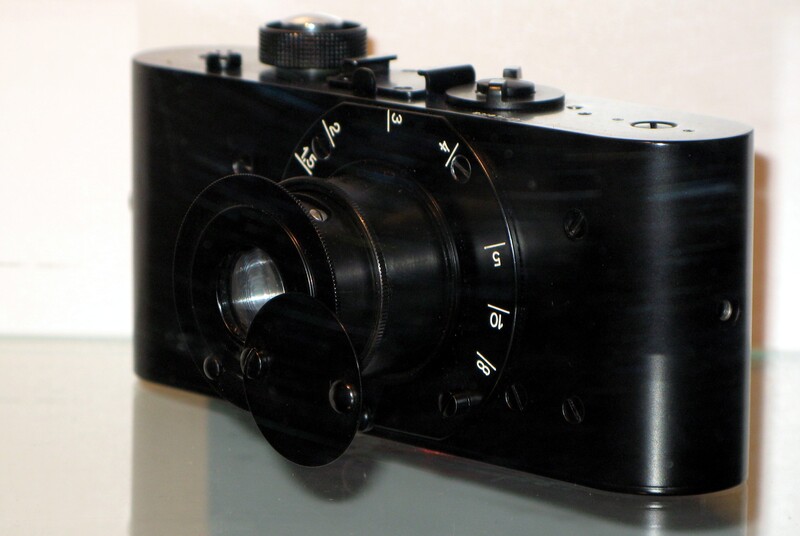
The date is genuinely unsettled. Design work is placed in 1913, and a street photograph of the Eisenmarkt in Wetzlar attributed to Barnack carries that year. The first fully functional model is usually dated to March 1914 at the latest. Leica's own centenary timeline files the Ur-Leica under 1914 while dating Barnack's arrival at Leitz to 1911, so the safest reading is 1913 for the design and 1914 for the working camera.
The prototype's frame size is disputed in the same way. Several histories say the Ur-Leica exposed a 24x38mm negative that was later trimmed to 24x36mm, while others, including Leica's own timeline, describe the 24x36 format as the point of the prototype from the beginning. The 38mm figure is not arbitrary, since eight film perforations measure exactly 38mm and that is how far a 35mm camera advances between shots. The surviving camera is reported to carry a Mikro-Summar 42mm f/4.5 lens, a design originally computed for Leitz microscopes, behind a focal plane shutter with a fixed slit and a speed of roughly 1/40 second, the same exposure time cine cameras of the era ran at.
The Frame Came From the Sprocket Holes
Motion picture film was itself a leftover. At Thomas Edison's lab, William Kennedy Laurie Dickson took 70mm Eastman stock, split it lengthwise into two 35mm strips, and perforated both edges. The silent-era frame that resulted measured 0.980 by 0.735 inch, or 24.89 by 18.67mm, four perforations tall, running vertically through the camera. That is the 18x24mm cine frame that gets quoted in every Leica history, and its proportion is 4:3.
Barnack rotated the film 90 degrees and used two frames' worth of length. The perforation pitch is 0.1870 inch, or 4.750mm, per SMPTE 102, the motion picture standard for that pitch, and 35mm still film inherited the same spacing. A camera advances eight perforations for each shot, which is 38.00mm exactly. Put a 36mm image inside that advance and you get a 2mm gap between negatives, which is what you see on any developed roll. The 24mm dimension is what fits between the two rows of perforations after the film's edges are accounted for.
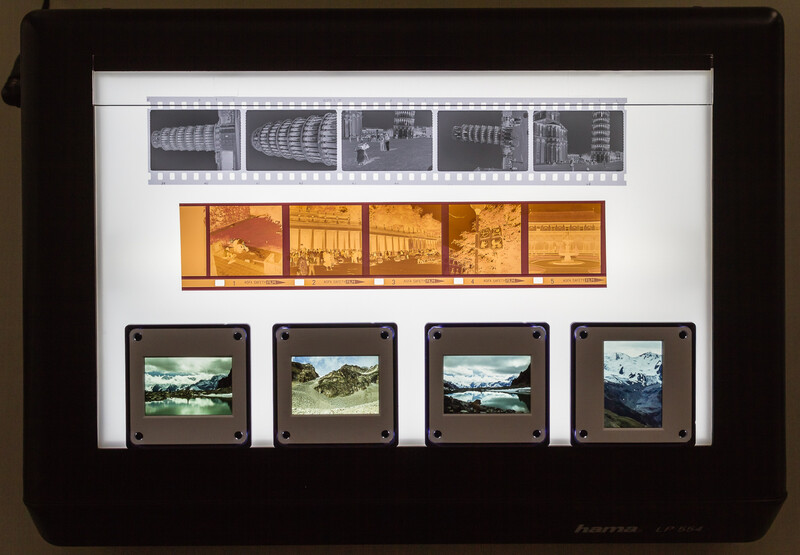
So 24x36mm sits where the machinery let it sit, between the perforations on one axis and across a whole number of sprocket teeth on the other. What the machinery did not settle on its own is the proportion. In the one retrospective account Barnack published, in 1931 or 1932, he says it was his own preference for the 2:3 proportion that led him to turn the 18x24mm cine frame ninety degrees and double it. The film transport made that rectangle cheap to build. A man who liked the shape is the reason it is that shape, and photographers have been composing inside his preference for a hundred years.
The old cine frame never actually went away. Run 18x24mm through a still camera and you have the half frame format, which Olympus built the Pen line around from 1959 and the Pen F system around from 1963, doubling the number of exposures on a roll. Half frame is the movie frame back in its original orientation, renamed by the format that displaced it.
Barnack Was Not the First to 24x36mm
The Leica gets credited with inventing the format, and that credit is too generous. A British patent for a still camera using perforated movie film went to Leo, Audobard, and Baradat in 1908. The Homeos, a stereo camera from Jules Richard, appeared in 1913 on 18x24mm pairs. The American Tourist Multiple, also 1913, sold at $175 and shot half frames. The Simplex, from the Multi-Speed Shutter Company in New York, was advertised in 1914 and is usually credited as the first production camera to make 24x36mm exposures on 35mm film, though only about 27 were built. The French Furet followed in 1923, in a body that looks startlingly modern.
Leitz supplied permanence rather than priority. The Leica I was presented at the Leipzig Spring Fair in 1925, with a 50mm f/3.5 lens sold first as the Anastigmat, then renamed the Elmax, and finally replaced by the four-element Elmar. Around 60,600 cameras were built across the Leica I family, counting the Luxus and Compur variants. Then, in 1934, Kodak introduced the 135 daylight-loading cassette, designed by August Nagel in Stuttgart for the Kodak Retina and usable in Leica and Contax bodies as well. At that point, the rectangle stopped being one manufacturer's choice and became infrastructure.
Deviating from it got expensive quickly. Nikon's first rangefinder, the Nikon I of 1948, exposed a 24x32mm frame inherited from earlier Japanese practice, a shape that squeezed more pictures out of scarce film. American occupation authorities in Tokyo blocked its export to the United States, and the trouble was the film advance rather than the mount. The Nikon I moved seven perforations per exposure, while the automatic color slide cutting machines used in America were built around the Leica format's eight, so a Nikon roll came back cut in the wrong places. Nikon moved the Nikon M to an eight-perforation advance, which cleared the export problem while leaving the frame at a still-nonstandard 24x34mm, and conformed to 24x36mm outright afterward. Inside 35 years, a workshop convenience in Wetzlar had become a trade barrier in Tokyo.
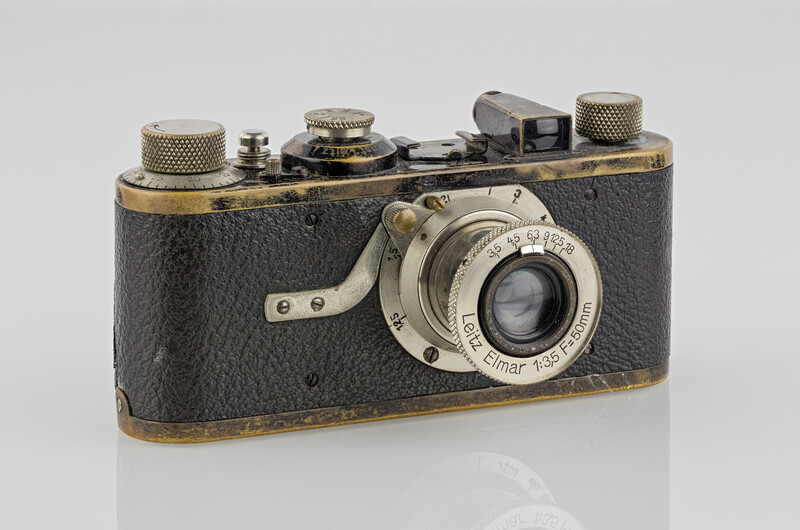
Digital Made "Full Frame" the Standard Term
Film photographers mostly did not call it a full frame camera. The format was 35mm, or Kleinbild in German, or "miniature format" and "small format" in the English literature, all named in relation to the plate and roll film sizes it was smaller than. "Full frame" already meant two other things: the full gate of the movie format in cinematography, which is roughly half the area of the still frame, and the practice of printing an entire negative including the rebate.
The 24x36mm sense was not a digital invention either. It turns up in film-era copy wherever a maker needed to separate a full-size frame from a half frame, and Minox used exactly that wording for the 35 PL, a film camera: "Despite its small dimensions the Minox 35 PL is a full-frame 24 x 36 mm miniature camera." What digital did was make the term unavoidable, and turn a descriptive phrase into a product category. Early digital SLRs used sensors smaller than the film frame, and once cameras appeared that covered the whole 24x36mm area, the industry needed a word for them. The Contax N Digital, shown in 2000 and finally sold in 2002, and the Canon EOS-1Ds of September 2002 are the cameras that made the term necessary. Nikon still markets its version as FX. Everyone else says full frame.
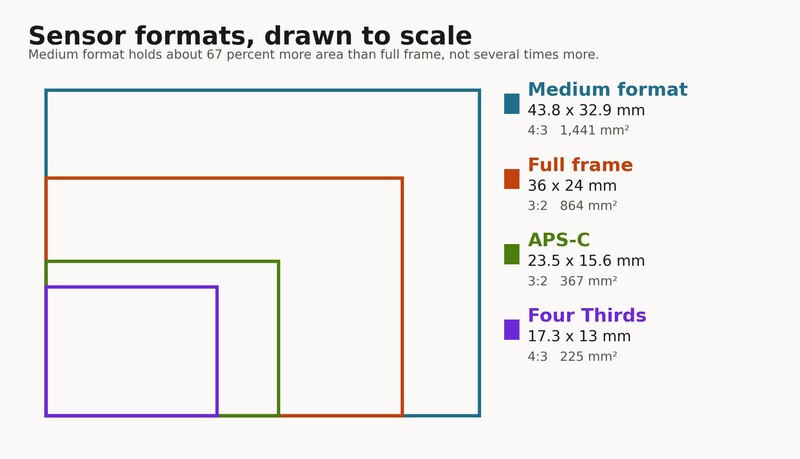
The formats underneath it are named just as accidentally. APS-C takes its name from the Classic print mode of the Advanced Photo System, a 1996 film format whose C frame measured 25.1x16.7mm at 3:2. Today's APS-C sensors measure 22.3x14.9mm at Canon and roughly 23.5x15.6mm at Nikon, Sony, and Fujifilm, and both are 3:2 because the parent rectangle was. Micro Four Thirds is 17.3x13mm, and the name refers both to its 4:3 aspect ratio and to the 4/3 inch sensor size designation, a unit inherited from video camera tube diameters. The one popular interchangeable-lens format that broke away from Barnack's shape is half named after a vacuum tube.
The inheritance runs into how you talk about lenses, too. Crop factor and 35mm equivalent focal length exist because 24x36mm is treated as the origin point, so a 33mm lens on APS-C is sold to you as a 50mm and a 45mm lens on 44x33 is sold to you as a 36mm. Both numbers describe something real, the angle of view, by measuring it against a rectangle one man chose in a Wetzlar workshop.
Price follows the inherited rectangle with remarkable obedience. A Sony a7 IV launched at $2,499 because 24x36mm is the serious tier. An OM System OM-1 Mark II gets described as an enthusiast body partly because its sensor is smaller than a rectangle one asthmatic mechanic settled on before the First World War. The lighting, the seeing, and the client management do not change with sensor area, which is why a broad skills course like The Well-Rounded Photographer transfers cleanly across every format on this list.
Medium Format Is 4:3 for the Same Kind of Reason
Most digital medium format sensors sold today are 43.8x32.9mm, usually written as 44x33, with a handful of larger backs above them. That is 1.33:1, and it is about 67% more area than full frame, not the several-fold jump the name suggests. The proportion is inherited from 645, the 6x4.5cm roll film frame whose actual image area is 56x41.5mm, or about 1.35:1.
Digital backs were built to mount on existing 645 bodies from Hasselblad, Mamiya, and Contax, so the sensor had to sit inside that frame and share its shape. Earlier backs used 48x36mm chips, and Kodak's 39-megapixel KAF-39000 measured 49x36.8mm, both 4:3. The sizes moved around rather than marching in one direction, though. Phase One's own list runs from 44.2x33.1 through 48.9x36.7 and 49.1x36.8 up to 53.9x40.4mm on the P65+ and the IQ180 and IQ280, which the company calls full frame 645, and it includes a 36.9mm square on the P20 and H20. What most of them share is the 4:3 proportion, not one steadily shrinking rectangle. Go back one more step and 645 exists because 120 roll film is about 61mm wide, a width Kodak set in 1901 for the Brownie No. 2, and because 6x4.5cm yields 15 or 16 frames per roll instead of 12. A Fujifilm GFX100S II at about $5,000 is shaped by a 1901 decision about paper backing and a frame count.
What a Sensor Designed From Scratch Would Look Like
A lens projects a circle. The largest-area rectangle you can fit inside a circle is a square, so the shape that wastes the least of what your glass already delivers is square. Full frame's image circle is 43.3mm across the diagonal. A square sensor using that same circle would measure 30.6x30.6mm, giving 936 square millimeters against full frame's 864, roughly 8% more sensor from the identical lens lineup. You would also stop rotating the camera, and you would crop to 4:5 for print, 1:1 for a feed, and 9:16 for a phone from a single capture instead of committing at the shutter.
Manufacturing does push back. Photolithography steppers max out at a field of about 26x33mm, so a 24x36mm sensor already has to be built from stitched exposures, and a 30.6mm square would need the same treatment. That is a real cost, and it is a cost full frame already pays.
Cameras that break the rectangle already exist and always have. Hasselblad's V system shot 56x56mm square for decades. The Robot cameras put a 24x24mm frame on 35mm film. Panasonic has repeatedly shipped a multi-aspect sensor, in the GH1, GH2, LX100 and LX100 II, that is physically larger than the lens image circle and reads a different region for 4:3, 3:2, and 16:9 while holding the diagonal angle of view constant. The 1:1 setting is a further crop and does narrow the field of view. That design shows the aspect ratio of a sensor is a choice a manufacturer makes each time rather than a property of light.
Phone cameras carry no film lineage at all, no sprocket holes, no cassette, no lens mount inherited from 1925, and the main camera in almost every one of them shoots 4:3. Given a clean sheet of paper, the industry did not choose Barnack's rectangle.
Lead image: a replica of the Ur-Leica, Oskar Barnack's prototype, on display at Leitz Park in Wetzlar, Germany. Photo by Aljawad, CC BY-SA 4.0. Source.





Join the Fstoppers community for free
-
Post comments and join in the discussions
-
Browse the site ad-free
-
Share your work and get featured in the community
-
Compete in the photo contests for fun and prizes
4 Comments
Great article. Very interesting.
Alex, I thought you might like these: not the replica ur-Leica, but the real thing, as shown to me in Solms back in 2011. They stopped showing the original soon after, so I was lucky to have seen it in the flesh, so to speak. The hands in the white gloves belong to Stephan Daniels.
Oh my gosh, that's incredible! What a treat to see it in person! Thank you for sharing!
Great article. Thank you.
"Phone cameras carry no film lineage at all, no sprocket holes, no cassette, no lens mount inherited from 1925, and the main camera in almost every one of them shoots 4:3. Given a clean sheet of paper, the industry did not choose Barnack's rectangle."
I'll speculate that phone cameras adopted 4:3 because vertical orientation was preferred by website designers, long before social media was a thing.