
If you’re shooting fast-moving sports or wildlife, or you’re a videographer shooting long takes in a raw format and high resolution, the most essential piece of gear you need is a fast reliable memory card. Choosing one, however, can be a nightmare. So what do you do? I would guess you buy one from a reputable brand, right? That makes sense, but recently I discovered there’s a lot of marketing smoke-and-mirrors going on—and I thought you should know about it.
What I’m seeing from all the chat groups and forums, are conversations about read and write maximum speeds, and cards that over-heat. There’s also an emphasis on capacity, to handle the large memory-intensive files people are shooting. So we’re looking at numbers, to make a buying decision. That seems like a good place to our search for the right card—but it turns out there’s a little more to things than that. Let’s take a look at what’s really important, and what no one is talking about.
What Actually Impacts Performance?
There’s one really important thing that looks insignificant on paper, but it’s the most important consideration for memory cards that can handle a fast sustained and stable recording, even when nearing the card’s full capacity. And this thing comes down to how many bits of memory each cell in the card can store. This is referred to as NAND. There are two types of NAND cell (flash memory chip); TLC and SLC.
Consumer memory cards you might believe to be impressive because of their capacity and speed, are made with a Triple Level Cell (TLC). They contain three bits per cell, with a total of eight voltage states, that needs to be continually measured when recording. This requirement for continual precise voltage tuning stresses the cell over time, wears out, and slows down. There’s a reliance on error correction via firmware tuning.
The other NAND memory is Single State Cell (SLC). These contain just one bit. So there are just two states, one or off. SLC is dramatically faster because the controller only needs to detect two voltage levels instead of eight. SLC writes instantly and keeps going because there’s nothing to continuously carefully measure, whereas TLC slows down as its cache fills.
Because TLC wears out, cards are typically good for 1,000 to 3,000 write cycles. SLC are good for 50,000 to 100,00 write cycles.
It’s all rather technical, so to sum it up:
- TLC is built for affordability and capacity. They are more fragile, but can be very capable for most photo and video projects.
- SLC is built for reliability and sustained performance, and they’re dramatically faster.
It will come as no surprise that SCL memory cards are much more expensive, and are typically used in military, industrial storage, and servers. At this time, there are no consumer memory cards on the market using true SLC chips.
Buyer Beware
I use CFexpress Type B memory cards, and I’ve discovered that a few manufacturers are making memory cards and marketing them in a manner that makes you believe their cards are true SLC, when they’re actually not. The cards are called pSLC, or pseudo-SLC. This means a TLC cell operates in a pseudo one bit mode—it’s pretending to be an SLC with performance enhancement. The firmware is forcing the controller to use only two or the eight voltage levels. Yes, it does perform faster, is more reliable, but it’s still a physical TLC.
It’s important to note, that memory cards using TLC and pSLC chips are perfectly fine for our photography and filmmaking work, but it’s important to understand what we’re actually buying.
Things don’t end here, however.
You need a Type 4.0 version If You Use CFexpress Cards
As cameras are made with increasingly higher raw burst rates, and the capacity to shoot 8k and 12k video, you really need to be looking at a type 4.0 CFexpress memory card.
Why? Type 4.0 cards solve practical limitations that really matter. They can reach multiple gigabytes per second of sustained write speed, whereas older CFexpress cards often start fast and then slow down dramatically once the cache fills.
Type 4.0 is a real upgrade. But, it still doesn’t end here!
Type 4.0 CFexpress Cards Need to Have a 2TB or Higher Capacity
This will come as a surprise to many. Why should you buy a 4.0 card that’s 2TB or larger? CFexpress 4.0 cards are faster by design, but real world speed depends on how much flash memory is inside the card.
Each NAND flash chip has a maximum speed limit. To achieve very high sustained speeds, a card must use many NAND chips working in parallel. Smaller capacity cards simply don’t contain enough NAND chips to fully take advantage of CFexpress 4.0 bandwidth.
When I asked memory card manufacturer Novachips, they told me “Once capacity reaches around 2TB or more, enough NAND chips can be combined to overcome individual speed limits. At that point, CFexpress 4.0 cards can deliver meaningfully higher sustained write speeds than CFexpress 2.0—especially important for long, high-bitrate video recording.”
So in short then, CFexpress 4.0 isn’t just about the interface—it needs enough memory inside the card to unlock its full performance, which typically happens at 2TB+ capacities.
A New 4TB CFexpress 4.0 Memory Card Comes To Market
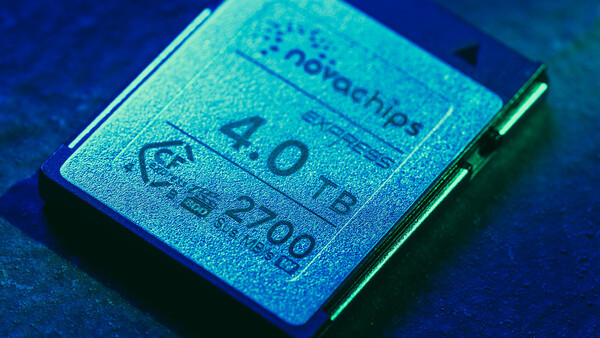
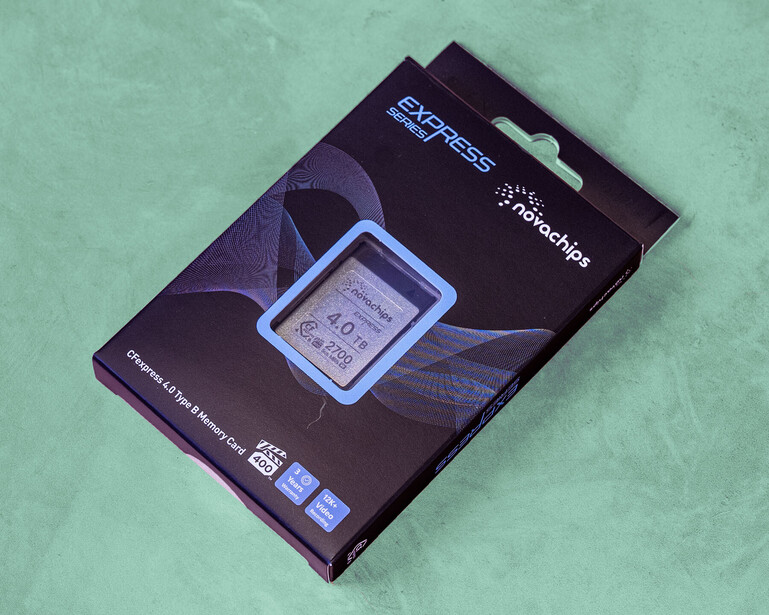
I was recently sent a brand new CFexpress 4.0 Type B memory card to test, designed for the professional photography and videography market. It was created by Novachips, a company that has plenty of experience designing and manufacturing flash storage solutions for large multinational enterprises where reliability is paramount. They’re relatively new to the consumer market, and what they have to offer is proving to be very impressive. Already their cards have been approved by RED and have been rated by the Compact Flash Association, an independent organization that issues a VPG (Video Performance Guarantee).
The card I have is a whopping 4 TB, designed to record video at 12K. Key specs and design details:
- Capacity: 4 TB
- Target use: 12K video recording
- Sustained speed: 2,700 MB/s, with a VPG guaranteed sustained write speed rating of 800MB/s.
- Build: Metal casing, sticker-free for improved heat control
TOP TIP: Always check for an official VPG rating on any cards you’re looking at. For a complete list of VPG-certified consumer memory cards, click HERE.
One of the design features that make this card so good, is the casing. It’s metal, and there are no plastic stickers on it like you see on so many. Their absence has proven to provide better heat control.
Novachips tell me the things they focus on are a reliable sustained write speed, heat control during long shoots, and stability when nearing full capacity. Using a metal case addresses these issues.
4TB is huge, and at the time of writing this article, I don’t recall seeing another card that big on the market, although I am sure they are coming. I’ve been using it in my Z9 and Z6iii for a couple of months now, shooting video up to one hour long, and it’s been fast and flawless. I’m not going into nerdy bench-testing mode, that doesn’t help me or you. The proof is in the pudding. This card offers a fast reliable memory solution, and is worth checking out.
Novachips Express Versus Extreme
Novachips make two levels of CFexpress 4.0 memory cards. “Express” and “Extreme”.
Express uses TLC NAND flash memory, and Extreme use pSLC NAND flash memory.
Novachips retails their new 4TB Express CFexpress 4.0 Type B for $899.





Join the Fstoppers community for free
-
Post comments and join in the discussions
-
Browse the site ad-free
-
Share your work and get featured in the community
-
Compete in the photo contests for fun and prizes
1 Comment
Just bought a fresh new set of SanDisk Extreme Pro SD Cards, I've been using the same two cards since 2016, it's high time I did. No idea how much longer these ones will last. 🤠🤙📿🍁