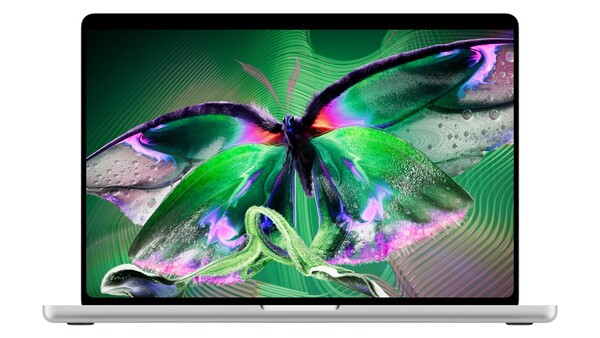
Apple's new MacBook Pro has a tandem OLED display that reaches 2,000 nits, holds a 10,000,000:1 contrast ratio, and covers Adobe RGB as well as P3. For the first time on a Mac, you can also touch the screen. Apple calls it the PROLED XDR display, and it comes in 14-inch and 16-inch models with M5 Pro or M5 Max chips, with preorders open today, October 28, and availability starting Friday, November 6.
Apple announced the new MacBook Pro at its event on Wednesday, and its display is the most exciting screen Apple has ever put in a laptop. Tandem OLED stacks two layers of light-emitting pixels, and Apple reworked every layer of the panel to keep brightness and grayscale even across the whole screen and to cut the internal reflections common in older OLED designs. It holds 1,000 nits across the full screen and peaks at 2,000 nits, and unlike the mini-LED Liquid Retina XDR display, which peaks at 1,600 nits on HDR content only, it reaches that peak on SDR content outdoors, too. Contrast jumps from 1,000,000:1 to 10,000,000:1, and because every pixel makes its own light, blacks are truly black while the deepest shadows keep their detail. ProMotion runs from 10 Hz to 120 Hz, and the display engine adjusts the color and brightness of every pixel in real time to account for the content, the temperature, and how much each pixel has been used over time.
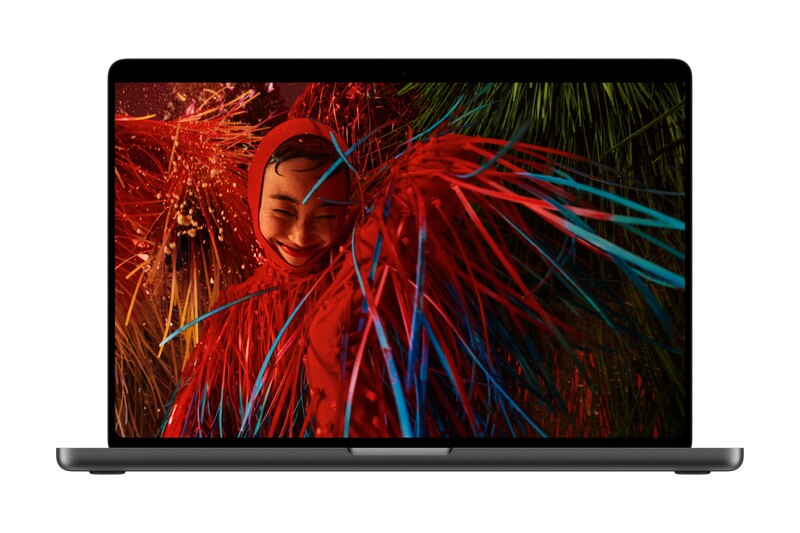
For photographers, the Adobe RGB coverage is a first for the MacBook Pro, whose screens have covered P3 only until now, although Windows laptops such as Dell's XPS 15 have offered Adobe RGB panels for years. P3 suits HDR video and color grading, but Adobe RGB is the space many photographers work in when their images are headed to print, and the new panel reaches further into greens and cyans as well. Apple calibrates every panel at the factory and puts both color spaces in a single default preset, which Apple says makes switching between them seamless. The reference modes now include Adobe RGB versions of the Photography and Design and Print modes, plus a new HDR Photography mode, and the Apple Pro Display Calibrator lets you calibrate the screen to your own targets. Apple pitches the MacBook Pro as a portable reference display, and with an SD card slot on the side, it's a superb machine for anyone who edits on location and prints the results.

Touch is the other big first. Apple built the touch sensor into the display panel itself, not layered on top of it, which cuts latency, and you can scroll with a swipe, pinch to zoom on a photo, drag slides between presentations, or flick a window to tile it. Adobe Lightroom and DaVinci Resolve are among the third-party apps adding touch support, alongside Blender, Cinema 4D, and ZBrush, and many existing apps work right away because macOS translates touches into clicks. In the Creator Studio apps, you can draw, paint, and select directly on the canvas in Pixelmator Pro, and in Final Cut Pro, you can mark ranges, drop clips into place, and pinch to zoom on a cut. A redesigned hinge keeps the screen steady while you touch it, and the Dynamic Island arrives on the Mac, holding Spotlight, Live Activities, and Siri AI.

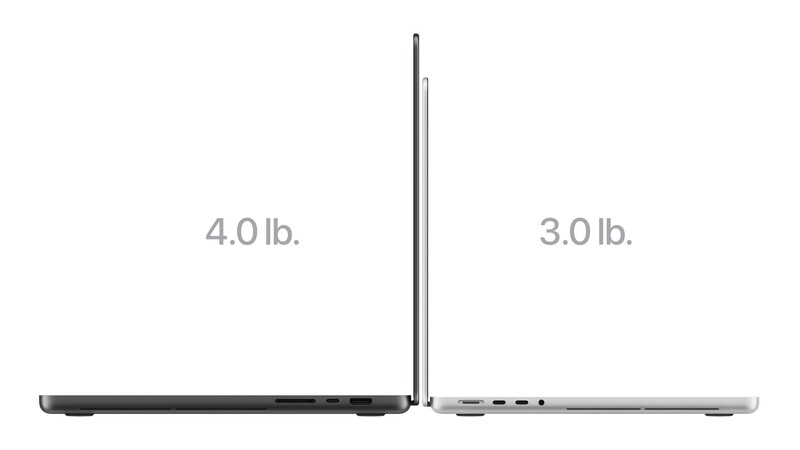
The new design is thinner and much lighter. The Apple 14-inch MacBook Pro with PROLED XDR Display weighs 3 pounds, half a pound less than before, and the Apple 16-inch MacBook Pro with PROLED XDR Display weighs 4 pounds, 0.7 pounds less, with OLED's slimmer display stack trimming half a millimeter and nearly a millimeter of thickness, respectively. Slimmer borders grow the larger screen to 16.3 inches. An antireflective coating comes standard, and the optional nano-texture finish is now etched into the cover glass itself. Apple rates the 16-inch M5 Pro model for up to 24 hours of video streaming and the 14-inch M5 Pro model for up to 22. The ports cover everything a photographer needs: an SDXC card slot, HDMI, MagSafe 3, a headphone jack, and three Thunderbolt 5 ports. Genlock support syncs the display's refresh rate to a camera's capture, which cuts ghosting and tearing on set and in virtual production.
Inside are the M5 Pro and M5 Max, with up to 128 GB of unified memory, and storage now goes up to 16 TB on M5 Max models. A redesigned thermal system keeps the same sustained performance in the lighter body and directs warm air away from the display, and the six-speaker sound system gets new woofers with 50% deeper bass. Apple's OLED iPads came first, with the M4 iPad Pro in May 2024 and the new iPad mini this week, and now the MacBook Pro gets an OLED display of its own. The mini-LED MacBook Pro stays on sale, including the M6 version of the 14-inch model Apple announced on Tuesday, so the PROLED XDR display is the step up for anyone who wants the best screen Apple makes in a laptop.
Key Specs
- Display: 14.2-inch (3,024 x 1,986) or 16.3-inch (3,472 x 2,266) tandem OLED with touch, 254 ppi
- Brightness: 1,000 nits full screen, 2,000 nits peak (HDR, and SDR outdoors), 1 nit minimum
- Contrast ratio: 10,000,000:1
- Color: P3 and Adobe RGB, more than 80% of Rec. 2020
- Refresh rate: ProMotion from 10 Hz to 120 Hz
- Chips: M5 Pro (up to 18-core CPU and 20-core GPU) or M5 Max (18-core CPU and up to 40-core GPU)
- Memory: up to 128 GB unified memory
- Storage: up to 16 TB
- Ports: three Thunderbolt 5, HDMI, SDXC card slot, MagSafe 3, headphone jack
- Battery: up to 22 hours (14-inch) or 24 hours (16-inch) of video streaming
- Weight: from 3 pounds (1.38 kg) for the 14-inch and 4 pounds (1.82 kg) for the 16-inch
The Apple 14-inch MacBook Pro with PROLED XDR Display starts at $2,899 with M5 Pro and $4,499 with M5 Max, and the Apple 16-inch MacBook Pro with PROLED XDR Display starts at $3,399 with M5 Pro and $4,799 with M5 Max, with preorders open now ahead of November 6 availability.




Join the Fstoppers community for free
-
Post comments and join in the discussions
-
Browse the site ad-free
-
Share your work and get featured in the community
-
Compete in the photo contests for fun and prizes