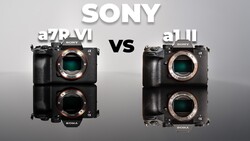
Sony's a7R VI pairs a 67-megapixel stacked sensor with 30 fps blackout-free shooting and 8K video, yet a lot of the early talk has centered on its readout speed trailing Sony's dedicated speed bodies. If you shoot detailed work but also need a camera that holds up when things move fast, whether that gap ever shows up in your actual photos decides which body goes in your bag.
Most of the criticism comes from comparing spec sheets, so Bobby Tonelli took the a7R VI somewhere the numbers would get tested: the paddock and media areas of the Singapore Grand Prix, on an accredited pass. Next to the Sony a1 II and Sony a9 III, the a7R VI runs 60 autofocus calculations per second instead of 120, and its sensor reads out more slowly. Tonelli shot the a1 II at the World Aquatics Championships the year before, so he has a direct comparison, and he never caught himself wishing for faster autofocus at the track. At a working event, you can't stop to fiddle with settings, and a frame that misses focus is a frame you can't deliver to a client. His position is that the readout gap is real on paper and rarely visible in practice for most kinds of work, from lifestyle and product shoots to a good share of sports.
Rolling shutter was the other worry going in. Cars passing at close to 300 km/h showed no warping or banding in his frames. The only problem came at a Janet Jackson concert he shot during the race weekend, where LED panels behind the stage caused banding at high shutter speeds. Dropping the shutter speed or switching to the mechanical shutter fixed it right away. If you shoot events with LED walls, keep that fix ready on any camera you use with an electronic shutter, because flicker from those panels shows up across plenty of bodies.
For years, the a7R line meant trading speed for resolution. The a7R V gave you 61 megapixels and topped out at 10 fps, and getting both meant paying for the a1 line. Other makers got there first at this price. The Nikon Z8 put a 45.7-megapixel stacked sensor in a smaller body than the Z9, and the Canon EOS R5 Mark II did something similar with a stacked 45-megapixel chip that shoots up to 30 fps. The a7R VI pushes resolution higher still while keeping speed in that same range. Once one body can cover both jobs, the most useful thing you can do is look at what you shot over the last year and buy for that, instead of for the rare situation a flagship speed camera solves. Extra resolution also works as extra reach. Cropping a 67-megapixel file to an APS-C frame still leaves around 30 megapixels, so a 400mm lens behaves like a 600mm without you swapping glass mid-session.
That reach came into play with the Sony FE 100-400mm f/4.5 GM OSS, which Tonelli used for most of his driving shots. From the media stands, he wanted tighter frames of the cars rounding turn two, so he switched to APS-C crop mode and kept shooting with plenty of detail left over. He found the lens light for its range, with internal zooming, a short zoom throw, and autofocus that kept pace with the cars. His one complaint is that the lens creeps when pointed down, and he couldn't find a way to lock it. An aperture of f/4.5 made him nervous about low light, and he was more impressed with the high-ISO files than he expected. He shows straight-out-of-camera samples so you can judge the noise yourself.
The viewfinder is the other standout for him. It's a 9.44-million-dot EVF, and he puts it on par with the a1 II, maybe a touch better. On the video side, the camera has dual base ISO at 800 and 3200, plus a dual gain mode for more dynamic range. Dual gain tops out at 4K 30p by his account and doesn't work in 8K. The 4K footage is subsampled from 5K, and he points out that most of it ends up compressed on YouTube, Instagram, or TikTok anyway.
The new battery held up well, too. He got through the race weekend on a single battery, recharging at night, and after about 3,000 frames at the Janet Jackson concert, it still read 87%. He then shot at the track and went home with roughly 70% left. He also took the Sony FE 50-150mm f/2 GM to Singapore's Nine Emperor Gods festival at night and found f/2 just enough for low light. He calls the lens very special for its focusing, sharpness, and detail, though it's on the heavy side. His only real complaint about the body is the grip, which he wishes matched the a9 III and a1 II, along with a drive dial on the left side for what is mainly a stills camera.
You can judge the soft-footage complaints for yourself: Tonelli plays his 4K all-intra clips, with dual gain off and then on, near the end of the video.




Join the Fstoppers community for free
-
Post comments and join in the discussions
-
Browse the site ad-free
-
Share your work and get featured in the community
-
Compete in the photo contests for fun and prizes