

If you've ever photographed a fast-moving propeller and watched it turn into a series of curved boomerangs, or captured a golf swing where the club looks like overcooked spaghetti, you've met rolling shutter. It's one of the most misunderstood phenomena in digital photography, but don't worry, I'm here to teach you what you need to know.
The Tech: Your Camera Is an Office Scanner
Here's the uncomfortable truth: when you set your shutter speed to 1/8,000 s, you're not controlling how fast your sensor captures the image. You're only controlling how long each individual pixel collects light. The actual capture process? That takes much, much longer. Most modern camera sensors don't capture an entire image simultaneously. Instead, they use what's called a row-by-row readout process. Think of your sensor as a flatbed scanner at a copy shop. The scan bar starts at the top and moves downward, reading one horizontal strip at a time. Row 1 gets scanned, then row 2, then row 3, all the way down through row 4,000+ on a typical 24-megapixel sensor.
This sequential scanning takes time. The critical metric here is "readout speed" or "sensor scan rate," and it's often not mentioned in camera specifications because the numbers aren't flattering. In video mode, a standard sensor like the one in the Sony a7 IV or Fujifilm X100VI takes roughly 20 to 30 milliseconds to scan from top to bottom. For full-sensor stills readout, the numbers get worse: the a7 IV takes about 66 milliseconds, while the X100VI clocks in around 40 milliseconds. Compare even the faster video figures to your 1/8,000 s (0.000125 s) shutter speed, and you begin to see the disconnect.

The exception is leaf shutters, found in cameras like the Ricoh GR IV and Fujifilm X100VI. They function as mechanical global shutters for practical purposes, which is why these cameras can sync flash at very high speeds (though leaf shutters are often limited to slower speeds at wide apertures due to the physical travel distance of the blades). Their rolling shutter issues appear only when using electronic shutter modes or video.
The Artifact: When Time Becomes Space
Let's work through a specific example. A golfer is mid-downswing. The club head is traveling at approximately 100 mph, which translates to roughly 1,760 inches per second. At t=0 milliseconds, the sensor begins its scan at the top of the image frame. It records the golfer's hands and grip in their actual position at that moment. At t=10 milliseconds, the sensor reaches the middle rows of the frame and starts recording the shaft. But in those 10 milliseconds, the club head has physically moved about 18 inches. The sensor faithfully records the shaft in its new position, placing it further forward in the frame than the hands. At t=20 milliseconds, the sensor finally reaches the bottom rows of the frame and captures the club head. It has moved another 18 inches, or 3 feet!


The Spectrum of Solutions
There are three approaches to managing rolling shutter, each with distinct trade-offs.
Software Correction: The Band-Aid
Devices like the GoPro Hero 13 and modern smartphones use gyroscope data to digitally compensate for rolling shutter artifacts in video mode. The gyro tracks camera movement during the readout period, and the processor applies a counter-distortion to straighten the warped frame. This works reasonably well for camera motion like hand shake or panning, where the gyro can measure exactly how the camera moved during the scan.
The limitations are significant. First, this correction crops into your sensor and reduces both resolution and field of view. Second, and more importantly, gyros only correct for camera movement. They cannot fix subject distortion. If your camera is locked on a tripod and a golf club swings through the frame, the software has no way to detect or correct that motion. The club will still appear bent. Software correction helps with the "jello effect" of handheld video but does nothing for geometric distortion of moving subjects.
Rolling shutter also creates visible banding under artificial lighting. LED and fluorescent lights flicker at rates synchronized with AC power (typically 100 Hz or 120 Hz). As your sensor scans row by row, different rows capture the light at different points in its flicker cycle, creating horizontal bands across your image. In-camera flicker detection and multi-frame processing can reduce this effect, but pure post-processing on an already-captured single frame is extremely difficult to fix without specialized AI tools.
Stacked CMOS: The Professional Standard
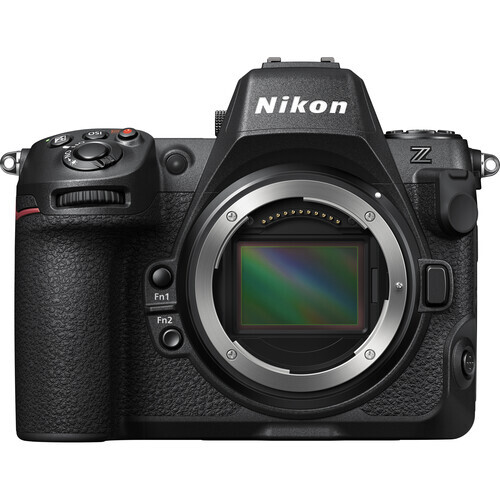
Stacked sensor architecture represents the current sweet spot for high-end cameras. Models like the Nikon Z8 and Z9 use this design, which layers the sensor's memory directly behind the photodiodes instead of off to the side. This seemingly small change dramatically reduces the physical distance data must travel during readout. The gain is substantial. The Z8 and Z9 achieve readout speeds of roughly 3.7 milliseconds, while Canon's flagship EOS R1 hits an even faster 2.7 to 2.8 milliseconds. The high-resolution EOS R5 Mark II sits around 6 milliseconds. Compare any of these figures to conventional sensors at 40 to 70 milliseconds for full-sensor stills readout, and the improvement is dramatic. Your golf club is still technically bent in the image, but the distortion is reduced by roughly 85 to 95%. At that level, the curvature often becomes imperceptible to human vision. For most professional applications, this is sufficient. Sports photographers shooting with Z9 or R1 bodies rarely encounter rolling shutter artifacts that matter.
Global Shutter: The Nuclear Option
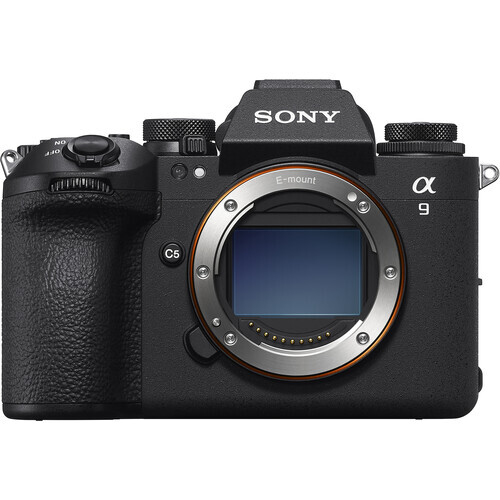
The Sony a9 III, announced in late 2023, remains the only full frame mirrorless stills camera with global shutter technology. It takes a fundamentally different approach. Instead of reading out pixel data sequentially, a global shutter sensor captures and stores the charge from all 24 million pixels simultaneously at t=0. This eliminates rolling shutter artifacts entirely. A golf club at 100 mph looks perfectly straight. A helicopter rotor appears solid, not warped. Flash sync works at 1/80,000s because there's no mechanical or electronic curtain to outrun.
The Trade-Off: Why Global Shutter Isn't Universal Yet
If global shutter technology is so superior, why doesn't every camera use it? The Sony a9 III has been shipping since early 2024, yet Canon and Nikon's flagship sports cameras (the R1, R3, R5 Mark II, Z8, and Z9) still rely on stacked sensors with rolling shutters. Even compact cameras like the Fujifilm X100VI (released early 2024) and Ricoh GR IV (released September 2025) continue using conventional rolling shutter sensors. The answer lies in physics and economics.
Global shutter requires additional circuitry at the pixel level to simultaneously capture and store charge before readout begins. This circuitry occupies physical space that would otherwise be used for light gathering. The technical term is "fill factor," and global shutter sensors have a lower fill factor than their rolling shutter counterparts. The real-world consequence is measurable. The a9 III has a base ISO of 250, compared to ISO 100 on most rolling shutter cameras. At base ISO, you lose roughly 1.5 stops of dynamic range compared to the best stacked sensors like the Canon R5 Mark II and Nikon Z9. You also get slightly higher noise at equivalent ISOs. For landscape and studio photographers who live at base ISO, this is a meaningful penalty. For action and sports shooters working at ISO 800 and above, the differences shrink and become irrelevant because the alternative is a bent subject.
Manufacturing cost is the other barrier. Global shutter sensors are significantly more expensive to produce. That expense filters through to retail pricing, which is why the a9 III costs substantially more than cameras with similar resolution and features but conventional sensors. Canon and Nikon have apparently concluded that stacked sensors provide sufficient rolling shutter suppression for most professional applications without the image quality compromises and cost penalties of global shutter. They're probably right for 95% or even 98% of use cases.
For cameras like the Ricoh GR IV or Fujifilm X100VI, designed primarily for street photography and general use, the equation is different. Both use conventional (non-stacked) rolling shutter sensors, but both also feature leaf shutters. In mechanical shutter mode, they expose the frame essentially simultaneously and can sync flash at very high speeds with no rolling shutter distortion. The rolling shutter issue only appears when using electronic shutter or video modes. Their target users benefit far more from better low-light performance and lower cost than from eliminating an artifact they'll rarely encounter. For the Sony a9 series, global shutter is the defining feature. When your primary job is freezing elite athletes mid-motion with zero geometric distortion, spending an extra millisecond on readout or tolerating any spatial artifacts isn't optional. You pay the dynamic range penalty and move on.
What This Means for You
The practical takeaway depends entirely on what you photograph. If you shoot sports, wildlife, or action, rolling shutter artifacts matter, and sensor architecture should factor into your buying decisions. Stacked sensors provide substantial improvement over standard rolling shutters, and global shutter eliminates the problem entirely at the cost of some dynamic range. If you shoot portraits, landscapes, products, or street photography, rolling shutter is largely irrelevant. Your subjects either don't move fast enough to create visible distortion, or the occasional bent object is so rare that it doesn't justify the trade-offs required to eliminate it.

Rolling shutter isn't a flaw. It's a consequence of sequential readout, which itself is a consequence of sensor design priorities that favor image quality over temporal precision. Whether that trade-off works for you depends on what you point your camera at and how fast it's moving when you press the shutter button.






Join the Fstoppers community for free
-
Post comments and join in the discussions
-
Browse the site ad-free
-
Share your work and get featured in the community
-
Compete in the photo contests for fun and prizes
1 Comment
Yeah well.. it is what it is.