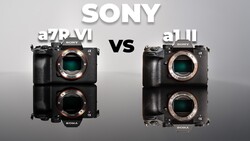
Sony's new a7R VI packs a 66.8-megapixel sensor and lands $3,000 cheaper than the flagship a1 II, which forces an awkward question for anyone weighing a hybrid body. When a camera two-thirds the price does most of what your top-tier setup does, the math starts to sting.
That tension runs through the whole review from Mike North Borders, where he walks through his own buyer's remorse after picking up the Sony a1 II last year to replace an aging a7R IV. He shoots both video and stills, which is why the a1 II fit better than the a7R V at the time. Then Sony released the a7 V, and now the a7R VI, each one narrowing the gap. Rather than reading a spec sheet, he takes the camera to a night street event full of smoke, crowds, fences, and cars sending it into the first corner hard enough to lose bumpers.
The battery result is the one that stops him mid-shoot. Sony built a new battery for the a7R VI so it can fire 66.8 megapixels at 30 frames per second, and the real-world numbers are hard to argue with. He shoots roughly 2,000 photos and burns 15 percent. At another point he's an hour into a cold night in gloves, sitting at 96 percent after nearly 1,500 frames. Battery life was his loudest complaint about the a1 II, where a single shoot could drain a battery and force him to carry backups. The a7R VI also carries the same 30 fps drive mode, similar AI autofocus, and pre-capture.
The autofocus holds up in exactly the conditions that usually break it. Cars barrel through thick tire smoke, and the focus stays locked instead of hunting, something he says the a7R IV would have struggled with badly. The a7R VI runs 60 autofocus calculations per second against the a1 II's 120, and he admits he couldn't feel the difference in the field. Then there's the resolution payoff. He shows a shot taken at ISO 5,000, cropped down from a frame that originally held the full sky, a track light, and the whole vehicle, and you can still read the lettering on the driver's side pillar and see scratches on the helmet visor. That kind of latitude turns one exposure into several usable compositions.
If you shoot events, motorsport, or anything where you can't always get close, this is the practical case for high resolution: the crop becomes part of your kit. A 66.8-megapixel file gives you room to reframe after the fact, pull a tight portrait out of a wide grab shot, and salvage the moment you couldn't physically walk toward. That approach pairs naturally with a fast telephoto and clean high-ISO performance, since you're leaning on the sensor to do work the lens and your feet used to do. It also changes how you think about "getting it right in camera." With this much sensor real estate, framing loosely on purpose and cropping in later is a legitimate technique, not a rescue job, and it fits street and action shooters who work in chaos more than studio shooters who control every element.
The a7R VI isn't a clean win over the a1 II. Under a car park light, banding shows up in some portraits because the sensor reads top to bottom and does it slower than the a1 II's stacked sensor. That slower readout is also why fast panning shots leave him wanting the extra confidence the a1 II provides. The electronic shutter tops out at 1/16,000 of a second versus the a1 II's 1/32,000, which may or may not matter depending on how you shoot. Mike's verdict lands on nuance: more resolution, far better battery, comparable autofocus, but the a1 II still holds an edge for rolling and panning work that defines his own workflow.
Watch the full breakdown above to see the smoke-test focus results and the crop that pushed him toward calling this camera "diabolical."


Join the Fstoppers community for free
-
Post comments and join in the discussions
-
Browse the site ad-free
-
Share your work and get featured in the community
-
Compete in the photo contests for fun and prizes
5 Comments
4x faster readout is why I replaced my a7IV & a7RV with a pair of used a1s rather than a7Vs. And, I don't even shoot video. But, I do shoot events a lot under flickering artificial light.
Sony needs to make a camera that will compete with the Fujifilm GFX 100 II, but with some of their newer sensor improvements, and possibly push things to the 150 megapixel range. This will help allow for a good balance of resolution and features so that people will not have to struggle with making due with only 66.8 megapixels.
Because nowadays everybody is making mural-sized prints.
"The electronic shutter tops out at 1/16,000 of a second . . ."
Far too slow for casual photography/s.
Just a note - in B&H - the price difference is just about 2500$, and the shutter speed in A7RVI tops just at 1/8000 :)