Sony now offers a 600mm super telephoto that weighs under a kilogram and costs $3,699, roughly $10,000 less than the f/4 version most shooters assumed they'd never afford. Reach at this length used to mean hauling a lens over 3 kilograms and paying five figures, so a lightweight option that keeps G Master image quality changes the math for anyone weight-constrained in the field.
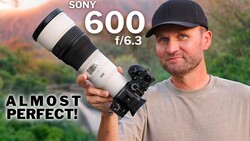
Reviewing the new Sony 600mm f/6.3 GM OSS, Dustin Abbott treats it as the companion to the 400mm f/4.5 GM OSS he covered days earlier. At its lightest the lens measures 995 g without the hood and tripod foot, and 1,217 g with both. Abbott fit both primes, Sony's 1.4x and 2x teleconverters, and a Sony a1 II into a single Peak Design Medium Camera Cube. The optical design places a single element up front with most of the glass toward the rear, which keeps the balance forgiving when you handhold it.
Autofocus runs on two of Sony's XD linear motors, driving focus from both sides of the focusing group. Shooting a champion golden retriever charging straight at the camera, Abbott reports that a burst of roughly 100 frames came back with every one in focus. He repeated the test with the 1.4x attached at 840mm and got the same result after backing up to create working distance. Birds in flight and even bees pulled from the air held focus, so the tracking holds up even as the aperture narrows to f/9 with the 1.4x. The harder part, he notes, is initial framing, since the angle of view is so tight that finding your subject takes more effort than keeping it sharp.
Sharpness tells a clear story against the cheaper 200-600mm f/5.6-6.3 G. In the center of the frame the zoom competes on resolution, though with slightly weaker contrast. Move off-axis and the prime pulls ahead sharply, with the corners showing what Abbott calls a radical difference. The lens corrects fringing and lateral chromatic aberration well, distortion sits around a mild two points of pincushion, and vignette stays light. Stopping down from f/6.3 to f/8 adds a touch of corner punch rather than a center gain, and by f/11 diffraction begins eating into the results.
Understanding where this lens fits starts with the physics of an f/6.3 aperture. Add the 1.4x and you're at 800mm f/9; add the 2x and you reach 1200mm f/13, at which point Abbott recommends the teleconverter only in dire situations. The practical consequence shows up in your ISO, since narrow apertures at high shutter speeds push you into ISO 10,000 territory in anything short of bright light, and that noise follows you into the file. This is why super telephoto reach has always favored shooters who work in open, well-lit conditions or on tripods, and why the lightweight body matters most to travelers and wildlife shooters who can't justify the size or cost of an f/4. If you shoot in forests or low light and need speed, the wider 400mm f/4.5 sibling makes a stronger case, which is the exact split Abbott lands on for himself.
Watch Abbott's full breakdown in the video above to see the autofocus sequences and chart tests that reveal how far this reach really stretches.




Join the Fstoppers community for free
-
Post comments and join in the discussions
-
Browse the site ad-free
-
Share your work and get featured in the community
-
Compete in the photo contests for fun and prizes
No comments yet