
Most photography now lives online. In the feed, in algorithms, in a constant stream of images. This is where the idea of what a photographer is supposed to need gets formed. Cheap did not become better. It became sufficient.
The Anxiety the Medium Creates
Most photography now lives online. In the feed, in algorithms, in a constant stream of images. This is where the idea of what a photographer is supposed to need gets formed. This is where the usual anxieties appear. The lens is not good enough, there is not enough experience in post-processing, framing feels uncertain, filters are not being used. It starts to seem that without these, you cannot grow or compete. But this set of requirements does not come from photography itself. It comes from the medium the image lives in.
If your photographs live online, you do not need high-end optics. Algorithms will compress and remove what you saw as valuable in the lens. You do not need experience in post-processing. Most of that complexity belongs to print, not to the correction of a finished image for a backlit screen. You can crop later. You do not need physical filters. At low resolution, digital ones produce the same result. In the end, low screen resolution, wide monitor color gamut, and backlight make a huge range of photographic skills redundant.
And that is right.
When Cheap Becomes Sufficient
The lenses are not the same. Quality did not disappear. The difference stops being legible in the medium where the image lives. What used to matter as precision, rendering, tonal transitions, and character stops working as an argument in the feed, because in the feed that difference no longer registers. Cheap did not become better. It became sufficient. That is enough to beat expensive in a medium where expensive can no longer show its advantages.
Photography as Language, Not Statement
The problem runs deeper. The function of photography changed. Instead of a statement, it became a language. The demand placed on each frame changed with it. There must be many of them. They must be easy to take in. They must not demand close looking. A statement needs a separate act of attention. Language runs on repetition, circulation, and immediate recognition. A statement can stand alone. Language works only when there are many images. The medium itself no longer asks for the strength of a single frame. It asks for uninterrupted production of easily readable images.
What used to be a strength of a single image now often becomes extra resistance. Not because the image became worse. Because it is no longer asked to do what once made it a statement. This is not photography losing value. It is a change in its social function. It did not become worse. It became different. That is why older skills are no longer required by default.
Language does not rest on the strength of one frame. It runs on circulation, simplicity, speed, recognition, and repetition. It has to enter the feed easily, not stop it. Quantity stops being a byproduct here. It becomes a condition. When photography works as language, one strong image is not enough. There has to be a constant supply of new, clear, quickly replaceable images. This is a different mode of production. Seriality is no longer a side effect here. It becomes necessary.
Why Young Photographers Win Prizes Now
That is why prizes increasingly go to young photographers with little experience. This is not a deviation and not a drop in standards. It follows directly from the change in the image's function. They do not have to be more precise or deeper, because that is no longer what the image is asked to do. They do not win despite lacking experience. They win because the old requirements no longer get in the way. Where no one expects density, finish, and depth from a single image, lack of experience stops being a fatal weakness.
The Niche That Didn't Die
Photography for reading did not disappear. It moved into a niche. Precision still matters there. Material still matters there. Scale still matters there. Surface still matters there. So does the way an image stands on its own without the screen, without the feed, without scrolling, without backlight. This is where the contrast becomes a test rather than a metaphor. What the screen supports and levels out, the physical object has to do by itself. In print, those eighty percent matter again — the eighty percent that simply do not register as visible value online.
The issue is not that skills disappeared. A vast range of skills stopped being necessary in the main environment where images now live. That is why photography for reading, for sustained attention, for the object, for scale, for physical presence did not lose and did not die. It moved into a different mode of existence. The niche is not defeat. It is a different condition. Not mass, not stream, not primary, but separate and still active.
The difference is not quality as such. It is in the function of the image, in the mode of its production, and in the way it is consumed. In one setting, the expensive became excessive, the complex became unnecessary, and precision stopped paying off. In the other, all of this returns. That is why photographic skills can no longer be treated as universally valuable. For most images, they really are not needed. For another kind of photography, nothing happens without them.
Ask Yourself What the Work Is Actually For
Before worrying about skill and lack of equipment, it makes more sense to ask what kind of work you are actually making, and what photography is for in your case. Not abstractly but literally: where the image will live, and how you make money from it, or plan to.
If the image stays in the digital stream, you need less than you have been told. Not because you are falling short. Because the medium does not ask for more. Extra precision does not pay off there. Complex skills do not convert into results. What works there is speed, simplicity, and circulation. This is why a $500 lens beats a $7,000 one in the online feed.
When the Screen Disappears
But once you move beyond the screen, the difference becomes visible again. Scale is fixed. Light hits a surface instead of coming from the device. Distance appears. The image no longer sits inside a backlit display. Scale, surface, light, and physical presence return. The lens can show what it actually does. And not only the lens, but the rest of the workflow. This is where image resolution, file preparation for print, and fine control over sharpness, contrast, and color come back into play. When light hits the image from outside and the palette becomes limited, another set of skills becomes necessary, and another type of equipment is required.
You can see this in group shows. Side by side, there are photographers used to print and photographers whose work grew out of digital circulation. The difference is not talent. It is not taste. It is whether the image can stand without the screen. The issue is not the photographer's level. It is the environment the skill was built for. If you spend years refining tonal transitions and microcontrast for an image that lives for half a second as a compressed JPEG on a phone screen, the problem is not mastery. The problem is the address. This is not an error of skill. It is an error of where that skill is applied.
But the real question is elsewhere. How often do we actually end up in those conditions?



Join the Fstoppers community for free
-
Post comments and join in the discussions
-
Browse the site ad-free
-
Share your work and get featured in the community
-
Compete in the photo contests for fun and prizes
10 Comments
If you recall, Alvin, I've often asked several times in the past for you to post images as examples in support of your words. You are not the only author of whom I've asked that question. In fact, I often posted pictures along with my comments. After all, this is a photography site, right?
However, as months turned into years, I'm realizing that those pictures have proven to have virtually no impact on anyone reading my comments. If comments are scarcely read, pictures are even more invisible. Hardly ever has anyone responded in a manner that would indicate they even saw or observed the image. Which sort of goes along with the way you describe the average attention given to an avalanche of online photography. Nothing. Might as well be empty space for all the recognition we're going to get from posting a photograph. Reality maybe, but disappointing nevertheless.
Sharing any sort of work on social media simply does not align with my desire to have the images observed, examined, explored, and felt, and at least acknowledged. So to be fair, maybe you're better off sticking to words. I emphasize composition, technique and skill in my work... those elements to which you've correctly identified as overrated in a digital environment. My passion for photography has always been rooted in making the print, so wherever that leads, I will follow. Maybe nowhere other than in my own possession. Sometimes it's hard to find meaning in our work outside of ourselves.
Thank you, Ed. Years of posting images and watching them disappear into silence is not a small thing to sit with.
What stands out is that you didn’t test this once. You did it over time, consistently, and arrived at the same result. That carries more weight than any argument.
The print being for yourself is not the worst outcome. It might be the most honest one, I’m sure.
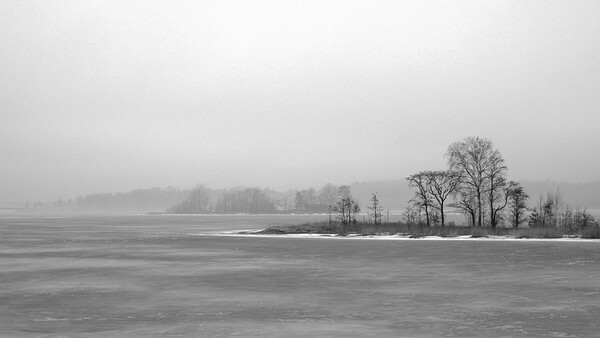
I do like your article's lead picture. A cold and melancholy kind of scene, enhanced by rendering in black and white. A little bit of sunshine struggling to peek through the clouds, but not succeeding very well.
Thank you, Ed. You read the image exactly as it was intended!
And this photograph of yours is exactly why the fundamental nature of photography never changes. You wrote an article recently about how contemporary photography is viewed differently than historical values rooted in technique (Why So Much Art Photography Feels Historically Late). I wanted to reply but every time I began, I found myself exhausted from just thinking about something that would end in an argument for the sake of argument. Ultimately, in the context of photography, words don't matter.
Good photography in my opinion is timeless. Your image here could have been made a hundred years ago, or yesterday, and they would both be relevant and worthy of contemplation. Contemporary art hasn't replaced 20th century work; it's simply adding a layer. Abstract expressionist, impressionist, cubism, pop art and all of the 1900s modern art genres never eliminated traditional painting... they just added something different. Another dimension. The Mona Lisa is still relevant. Nobody looks at an Ansel Adams print and says "Wow is that outdated." Even if you think you can get the same results with your iPhone, his work from 1950 is still a masterpiece.
Capturing the nuance of life through light and emotion never changes. It's only the manner of presentation which evolves. The fact that the world is flooded with images is merely a distraction. Words are distracting. It's my responsibility to stop, slow down, observe and feel what you have to show.
What makes this interesting to me is that the image itself is actually quite conventional. There is nothing especially original or difficult about it. A photographer with some experience could make something very similar.
And I think that is part of the problem today. Traditional photography is still fully capable of being good, moving, atmospheric, even timeless. But so much of it has become interchangeable. The issue is not that such images stopped working. The issue is that they now exist inside an endless stream of visually similar work, where very little separates one from another.
I actually make many photographs like this, but almost never publish them. For me, they belong more to technical practice than to my own photographic language.
A good photograph originates in the heart. No one can tell you or me what we should photograph, or how we should go about doing it. If my photo speaks to someone else in the same way as it does to me, that's great. If it's perceived as boring or conventional to someone else, that's okay too. The fact that a million other people could make interchangeable pictures is not a problem. It simply is what it is. Photography today is a testament to technology which enables far more people to even make any picture at all, compared to a hundred years ago. More of the same or similar does not diminish my love of photography.
The endless stream of images only makes a difference if you choose to recognize it, or give it any control over your thoughts and decisions. The minute you allow social media to determine what you should photograph or not photograph, you've lost control. If that's what motivates you, or separation is of most importance, fine. It does seem a little like the proverbial cat chasing its tail, though. Separation might just be an illusion.
I would rather direct my attention to the known values in photography that have worked for me all along, as they have for others before me. I have no interest in conceding my skills and craft as a relic of the past, no matter how the rest of the world is changing. Photography is like my security blanket... something stable and secure in a world full of change and chaos. Yes, the visual environment changes, or it can change. But it doesn't have to. A print in my hands is the same experience as it was a hundred years ago. If the rest of the world wants to mindlessly stream photography entirely on an iPhone, that is their prerogative. If you want to compare yourself to every other photographer on Instagram, that's okay too, I suppose. To each their own. However, as long as I have paper and ink, I will view photography in the manner I am accustomed and gives me the most pleasure. Maybe what needs to be taught is how to view a photograph, rather than how to redefine what a photograph should be.
I think we are now being forced to mix together two different kinds of photography. One became a method of communication, like SMS used to be. The other, the kind of photography you are talking about, remained outside the feed, in print, for slower reading like a book. That separation has already redefined photography.
This phenomenon I believe is linked to doomscrolling, which slowly removes the ability to stop and question the felt. That's interesting actually because it's comparable to somatic in the continuity side of a person's life. But instead of looking at the flow to self study and find clarity, the mind actually does not catch up with stop stations where the pose is the moment of reflection. That also conflicts with science deliberate intent on capturing sharp snap shots in order to study and codify with rigidity. It's interesting because neither doomscrolling nor empirical dissection can satisfy the stability of the nervous system. I think that it's because neither find value in noise where noise often is more valuable than understanding. If we consider that noise is a value and not something to avoid, to eliminate, then we get the process: the value of what is offered in front of our eyes, plus the quality more or less good we can find in images. It's a complete information that allows to gain clarity and specific interests like finding an image touching. May be solution is to just give enough time to the limbic layer in our brains to start an emotional spark and let the cortex freely allow discovery.
I think the part about time matters. A lot of images today are not really looked at long enough for any emotional or perceptual reaction to fully develop. Recognition happens almost instantly, but recognition is not the same thing as observation.
And once photography becomes tied to speed and continuous flow, the image starts competing for interruption rather than attention. That changes not only how photographs are consumed, but also what kinds of photographs get rewarded.