

In today's lens market, we're spoiled with clinical perfection. Every new release promises sharper corners, less chromatic aberration, and faster autofocus. But rewind a few decades, and the photography industry was a wild west of mechanical experimentation, questionable engineering decisions, and ideas that made perfect sense to exactly nobody. Some of these experiments became beloved cult classics. Others became cautionary tales whispered in engineering departments. All of them are gloriously, magnificently weird.
These aren't prototypes or one-off custom builds. These are lenses that actually made it past the bean counters, got approved for mass production, and landed on store shelves where real photographers handed over real money. That's what makes them so fascinating. Someone, somewhere, thought these were good ideas. And you know what? Sometimes they were right. Sometimes they weren't. Either way, they're fun to look at.
Here are five of the weirdest mass-produced lenses and lens systems ever made, each one a beautiful reminder that photography's history is far stranger than its present.
1. Canon FD 150-600mm f/5.6 L (The 'Trombone')
Imagine a lens so massive it requires its own support system, so optically ambitious it earned Canon's premium L-series designation, and so mechanically unusual that using it feels like playing a musical instrument. That's the Canon FD 150-600mm f/5.6 L, and it earned its "Trombone" nickname honestly.
The weirdness here is all about the physical operation. This beast uses an aggressive push-pull mechanism for both zooming and focusing, controlled by a single massive grip on a sliding barrel. There's no separate focus ring in the traditional sense. Instead, you're simultaneously pushing and pulling to zoom while twisting the same barrel section to focus. It's a completely alien experience for anyone raised on modern dual-ring systems, requiring a kind of full-body coordination that's more choreography than photography. The learning curve is real, and your first attempts will produce more blurry photos than keepers as you accidentally zoom when you meant to focus and vice versa.
But here's the thing: this design wasn't just Canon being weird for the sake of it. In the 1980s, push-pull zooms were actually common on telephoto lenses because they offered faster zoom adjustments than twist rings. For wildlife and sports photographers who needed to reframe quickly, that speed advantage was real. The FD 150-600mm just took the concept to its absolute extreme, packaging it in a lens that weighed nearly 10 pounds and stretched nearly two feet long at full extension. It's a reminder that before autofocus and electronic controls, lens designers were solving problems with pure mechanical ingenuity, even if the solutions look bonkers to us now.
2. Tair-11A 135mm f/2.8 (The 'Preset' Lens)
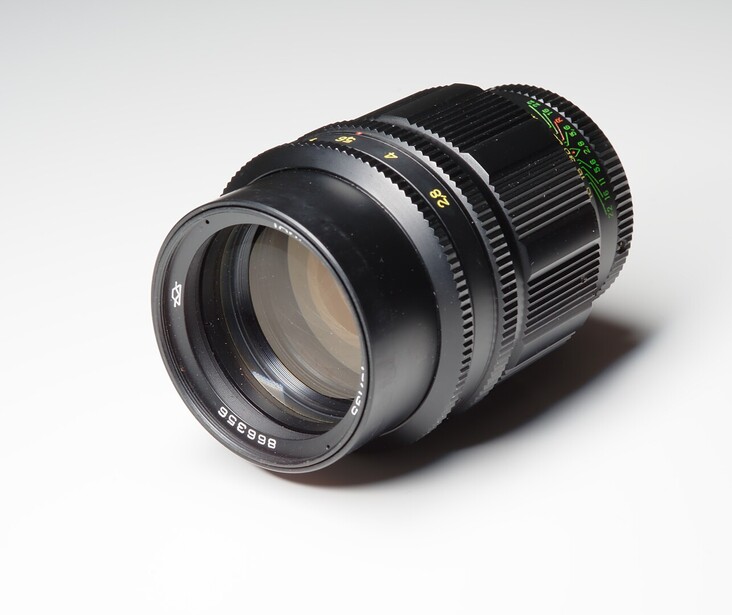
The concept sounds like a Rube Goldberg machine. You get two aperture rings instead of one. The first ring lets you preset your desired shooting aperture as a physical stop. The second ring, which is completely clickless and smooth, is what you actually manipulate during shooting. Here's the workflow: you set your desired f-stop on the preset ring, maybe f/8 for decent depth of field. Then you open the second ring all the way to let in maximum light for focusing. You compose, focus through your nice bright viewfinder, and then, without looking down at the lens, you smoothly twist the second ring until it hits the mechanical stop you preset. Click the shutter. That's your exposure.
Why on earth would anyone design a system this convoluted? Because these lenses didn't have automatic apertures. Western lenses of the era were moving toward automatic diaphragms that stayed wide open for viewing and focusing, then snapped down to the shooting aperture at the moment of exposure. Soviet manufacturers either couldn't or wouldn't adopt that technology, so they engineered this elaborate manual workaround. The result is a system that feels absurdly complicated until you've used it for a roll or two, at which point your fingers learn the dance and it becomes oddly satisfying. It's manual photography at its most manual, and there's a whole community of film shooters who actively seek out preset lenses for that tactile, deliberate shooting experience.
3. Canon RF 5.2mm f/2.8 L Dual Fisheye
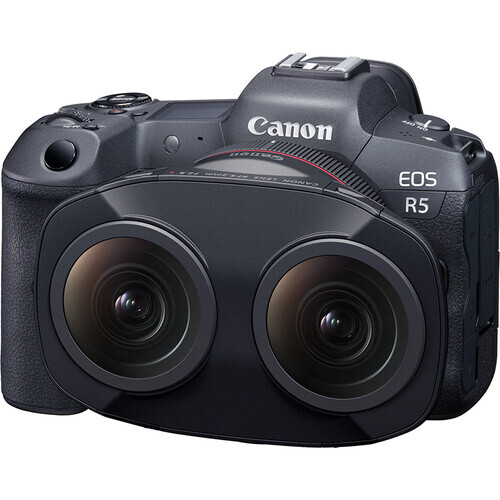
The purpose behind this madness is hyper-specific: capturing stereoscopic 3D footage for VR headsets. Each "eye" captures a complete 180-degree hemisphere, and when processed together, they create true spatial 3D video that you can view in a VR headset with proper depth perception. It's actually a brilliant solution to a real problem in VR content creation, which previously required elaborate dual-camera rigs that were nightmares to align and synchronize. Canon just said, "what if we made the dual-camera rig into a single lens?" and the result looks like something from a sci-fi movie.
But here's what makes it truly weird: this is an L-series lens. Canon's premium designation, normally reserved for their finest professional glass, stamped on what is essentially a specialized tool that 99.9% of photographers will never need or use. It's built to Canon's exacting standards, weather-sealed, and optically excellent. It also costs around $2,000 and requires Canon's specialized software to even process the resulting files into usable VR content. It's a lens that exists in its own universe, serving a tiny niche market, and yet Canon committed to manufacturing it properly.
4. OM System 9mm f/8 Fisheye (The 'Body Cap' Lens)
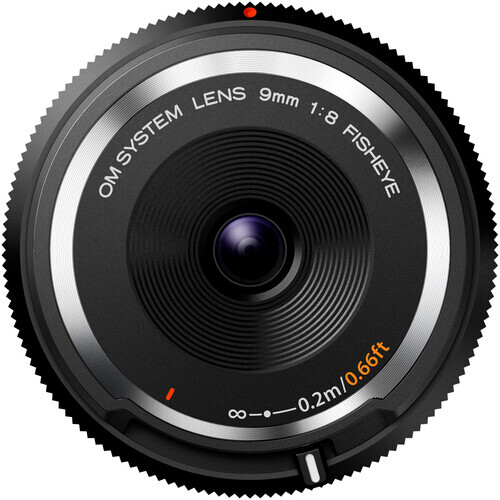
At just 12.8mm thick and weighing a mere 30 grams, this is a lens you can forget is in your bag. Actually, it's a lens you can forget is on your camera. The fixed f/8 aperture means there are no aperture controls to fiddle with. Focusing is accomplished via a tiny lever that manually shifts the optical elements between two zones. That's it. That's the whole lens. It creates dramatic diagonal fisheye images on Micro Four Thirds cameras, and despite its toy-like construction, the image quality is surprisingly respectable. Not amazing, not professional-grade, but good enough to produce fun, usable shots.
The genius of body cap lenses is in what they sacrifice to achieve their impossible form factor. They're slow, manual-focus only, and optically simple. But they're also so small and cheap that you can justify keeping one mounted on a second body or stuffed in your pocket as a creative emergency lens or the most discreet option possible. The OM version sells for $125, which is less than many people spend on a single nice dinner. For that price, you get a genuinely unique perspective in a package that barely exists. It's the antithesis of modern lens design, which constantly pushes for larger elements, more complex optical formulas, and heavier builds in pursuit of perfection. Sometimes, weird is just fun.
5. Canon EF 35-80mm f/4-5.6 PZ
In the 1990s, Canon had a vision of the future, and that future involved motorized zoom. The EF 35-80mm f/4-5.6 PZ (Power Zoom) was their attempt to bring "smart" electronic control to the zoom function, years before focus-by-wire became standard on mirrorless lenses. It was an ambitious idea. It was also a failure that Canon quietly discontinued and never spoke of again.
The fundamental concept was zoom-by-wire: the zoom wasn't mechanically connected to the lens elements. Instead, it was an electronic control operated by button that told a motor what to do, and the motor physically moved the optics. In theory, this could enable features impossible with mechanical systems, like programmable zoom speeds or automated zoom functions. In practice, it felt disconnected, laggy, and deeply unnatural. You'd press a button and wait for the motor to catch up, destroying the immediate tactile feedback that makes mechanical zoom rings so intuitive.
The PZ was a fascinating experiment. It's also a reminder that camera companies don't always get it right, even when they're trying to innovate. Sometimes the old mechanical solutions exist for good reasons, and sometimes progress means abandoning dead-end paths and trying something else. The power zoom dream isn't dead, though. Modern cinema lenses sometimes offer motorized zooms for smooth video work. But for still photography? It's been mostly relegated to bridge and compact cameras, and very few have the zoom controls on the lens. That's what makes the PZ such a perfect example of weird: it's not broken, it's not badly made, it's just solving a problem that photographers never asked to have solved.
Conclusion
These lenses represent moments when the photography industry zigged when everyone expected it to zag. Some were brilliant solutions to real problems. Others were solutions searching for problems that didn't exist. But they're all reminders that the history of photography is richer, stranger, and more interesting than the relentless march toward optical perfection might suggest. In an era where every new lens promises to be sharper than the last, there's something refreshing about gear that simply promises to be weird.





#/media/File:Tair_11A_oblique_view.jpg)
Join the Fstoppers community for free
-
Post comments and join in the discussions
-
Browse the site ad-free
-
Share your work and get featured in the community
-
Compete in the photo contests for fun and prizes
3 Comments
The preset diaphragm wasn't just a soviet characteristic. I remember a Yashica 50 mm macro preset lens and a brand unremembered short mount (for bellows, without focus ring) macro lens in Minolta mount.
The defunct Spiratone shop also carried preset diaphragm long teles with orientalish, non-russian names. All this in the Seventies.
I’ve owned four of these and still have the Tair which I adapt quite often. Quite pleasing bokeh.
The cow actually looks like it is impressed by the guys lens choice...