

If you thought the first batch of weird lenses was strange, buckle up. The history of photography is deeper and weirder than anyone gives it credit for, and manufacturers have tried some truly bonkers ideas in pursuit of solving problems both real and imagined. Some of these experiments were brilliant engineering achievements that the market simply wasn't ready for. Others were solutions so specific they could only ever appeal to a handful of users. And one of them literally reinvented what a camera lens even is.
If you enjoyed the first five weird lenses, here are more five systems represent some of the most unusual approaches to optical design ever mass-produced. They're just profoundly, beautifully weird in ways that make you appreciate how wild the camera industry used to be before things felt more predictable.
6. Nikon 1 AW 11-27.5mm f/3.5-5.6
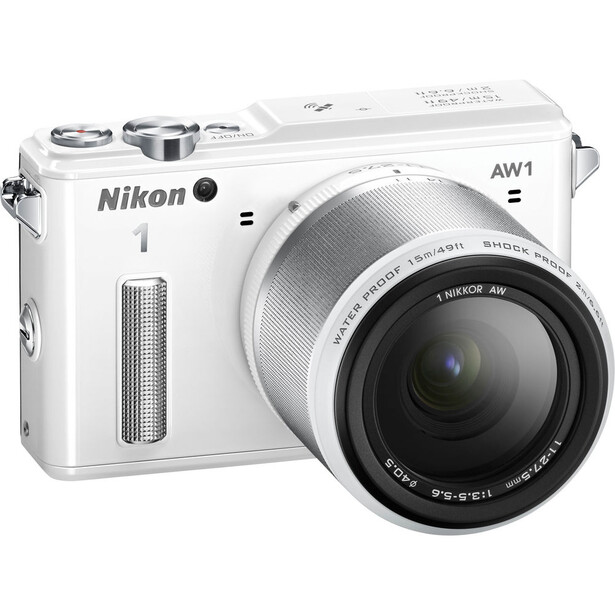
The AW 11-27.5mm is weird because it's a waterproof interchangeable lens, which is a category that basically doesn't exist anywhere else in photography. Making this work required completely reimagining lens construction. The mount needed O-rings and gaskets to create a watertight seal with the camera body. The zoom mechanism had to be entirely internal, with no extending barrel that could compromise the waterproofing. Every potential point of water intrusion had to be sealed, which meant the lens was essentially a submarine that happened to focus light. The engineering challenge here was enormous, and Nikon actually pulled it off.
But here's the problem: making a waterproof interchangeable lens system means you're fighting against one of the fundamental advantages of interchangeable lenses, which is versatility. The Nikon 1 AW system launched with exactly two waterproof lenses: this 11-27.5mm zoom and a 10mm pancake. That's it. If you wanted anything else, you had to break the waterproof seal by changing to a non-AW lens, at which point you might as well just use a regular Nikon 1 camera in a waterproof housing. The system was solving a problem that most underwater photographers handled differently, and the market responded accordingly. The AW1 was discontinued after just a few years, making these waterproof lenses some of the shortest-lived experiments in modern camera history. But for that brief moment, Nikon actually manufactured a lens that you could take scuba diving without a second thought, and that's genuinely impressive even if it was commercially doomed.
7. The "Pancake Zoom" (Panasonic 12-32mm f/3.5-5.6)
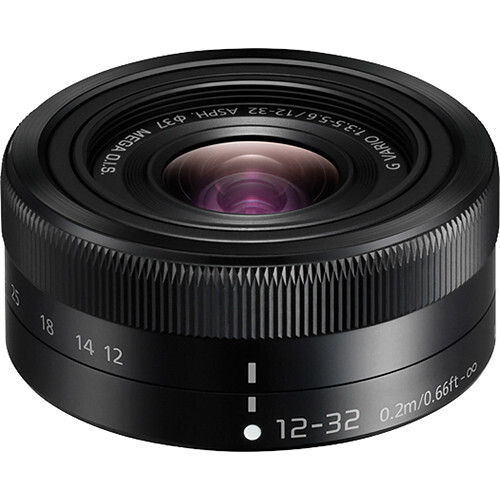
The Panasonic 12-32mm is the poster child for this category, though other manufacturers have made similar designs. When "off," it's genuinely tiny, barely thicker than a body cap and light enough that you forget it's mounted. But here's the weird part: the camera treats it as non-functional: no autofocus, no shooting, nothing until you extend it. The lens is mechanically locked and optically useless until you perform a multi-step ritual: unlock the barrel lock, physically twist the barrel to extend the lens, wait for it to click into place, and only then can you actually use your camera. It's like having a lens with a safety switch, except the safety switch is the entire lens barrel.
This creates a bizarre psychological relationship with your camera. Is it "ready" or not? With a normal lens, your camera is always ready. With a collapsible zoom, you're in this weird in-between state where you have a camera with a lens attached, but it's not actually a functional camera until you remember to twist that barrel. Miss a shot because you forgot to extend the lens? That's on you. The trade-off is pure portability. These lenses can genuinely transform a Micro Four Thirds camera into something that fits in a large pocket, which is legitimately useful for travel and everyday carry. But you pay for that portability with an extra step in your shooting workflow that feels antithetical to the "decisive moment" philosophy of photography.
What makes this truly weird is that it's a modern solution. In an era of electronic everything, we've gone backward to a purely mechanical lock system that requires manual intervention. It's weirdly tactile and almost old-fashioned in a camera market that's increasingly removing physical controls. And yet it works.
8. Sony 16mm f/2.8 E-mount and VCL-ECF1 Fisheye Converter
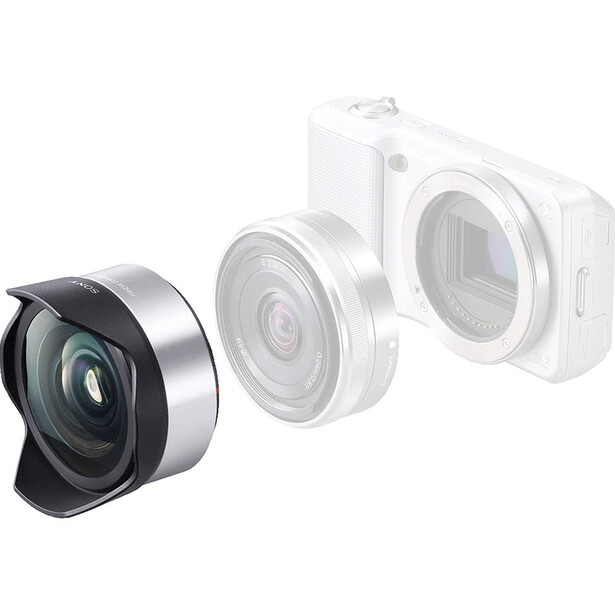
The base lens, the Sony 16mm f/2.8 pancake, is perfectly normal. It's a compact, sharp, unremarkable wide angle prime for APS-C E-mount cameras. But Sony designed it with a specific bayonet mount on the front specifically for the VCL-ECF1 fisheye converter. This wasn't a screw-on adapter. You physically bayonet-mounted an entire optical assembly onto the front of the lens, and suddenly, you had a completely different lens with completely different characteristics. The 16mm became an ultra-wide fisheye with that characteristic curved distortion and 180-degree field of view. Take the converter off, and you're back to a normal rectilinear wide-angle. It's a transformer lens.
What makes this weird is the philosophical question it raises: what exactly are you buying? Is the converter a lens? It has multiple optical elements. It dramatically changes the focal length and character. But it can't function without the base 16mm lens. So is it an accessory? Sony priced it like an accessory, at around $200, when the base lens was $250. But it performed like a completely different lens. This created a strange value proposition where you could buy two very different looks for about the price of one normal lens, as long as you didn't mind the hassle of mounting and unmounting the converter. Converters are not unheard of, especially on fixed-lens cameras, but converters on ILC cameras is most unheard of.
The system was also surprisingly good. Unlike cheap screw-on fisheye adapters that destroy image quality, the Sony converter was actually sharp and well-corrected. It felt like a legitimate fisheye lens, not a toy. And yet it never really caught on. Sony discontinued it relatively quickly, perhaps because the target market for this kind of modularity was smaller than they hoped. Most people who want a fisheye just buy a fisheye. The modular approach appeals to a specific kind of photographer who values versatility and compact storage over simplicity, and apparently that niche wasn't big enough. But for those who owned the system, it was a genuinely clever way to get two lenses in the space of one.
9. Hartblei 40mm f/4 Super-Rotator Tilt-Shift
Tilt-shift lenses are already weird. They break the fundamental assumption that the lens and sensor are parallel, allowing perspective control and depth-of-field manipulation that looks like reality-bending magic. But the Hartblei Super-Rotator takes this already complex concept and adds so much mechanical complexity that it looks more like a piece of industrial equipment than a camera lens.
The core innovation of the Super-Rotator is right there in the name. Normal tilt-shift lenses let you tilt and shift the optical axis relative to the sensor, but those movements are constrained to specific directions. You might be able to tilt vertically and shift horizontally, or vice versa, depending on how you orient the lens. The Super-Rotator says, "what if you could do all of that in any direction simultaneously?" and the answer is a lens mounted in a complex rotating mechanism that allows 360-degree independent tilt and shift. You can tilt up, down, left, right, or any angle in between. You can shift in any direction. You can combine these movements in ways that would be physically impossible with a normal tilt-shift lens.
The result looks absolutely insane. The lens itself sits in this rotating mechanism that wraps around the camera mount, creating an assembly that's less "lens" and more "articulated optical apparatus." Using it requires thinking in three dimensions about how your adjustments affect the image plane. It's not intuitive. It's not fast. It's not something you grab for quick shots. But for architectural photographers and product shooters who need absolute control over perspective and depth of field, it's a tool that enables shots that would otherwise require extensive post-production or wouldn't be possible at all. The learning curve is steep, the price is high, and the use cases are specialized. But for those specific use cases, nothing else comes close.
What makes it truly weird is how niche it is. The Super-Rotator design was made in specialized mounts for a tiny audience of photographers who not only needed tilt and shift, but wanted full 360-degree freedom over those movements in a physically overbuilt mechanical assembly. That's a very small Venn diagram. Yet Hartblei produced them for years, which proves that in the pro world, "weird" often just means "precisely engineered for five people on Earth." There's a market for almost anything if it solves a real problem well enough, no matter how absurdly specific that problem might be.
10. Ricoh GXR System
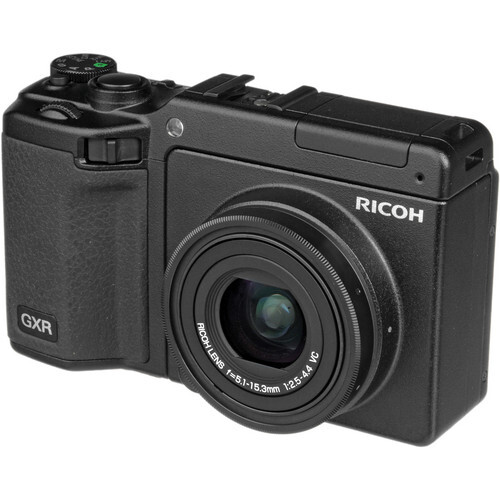
The GXR's core concept: the lens and sensor are a single, permanently sealed unit. You don't change lenses. You change camera units. The "body" of the GXR was essentially a battery, screen, controls, and grip. A smart grip, basically. When you wanted to "change lenses," you slid out the entire lens-sensor module and slid in a different one. Each module had its own sensor, its own optical design, and its own imaging characteristics. The modules spanned everything from small-sensor zoom units (like a 28-300mm equivalent) to APS-C units with high-quality fixed primes (like a 50mm-equivalent macro or 28mm-equivalent). Each one was a sealed, optimized lens-sensor combo. You weren't adapting different optics to the same sensor. You were swapping the entire imaging system. You could even get a CCD sensor in one unit.
The theoretical advantages were real. By sealing the sensor and lens together, Ricoh eliminated the problem of sensor dust completely. Each lens-sensor combo could be optimized as a unified system rather than trying to make one sensor work well with every lens. You could have different sensor sizes in the same system depending on your needs. It was modular photography taken to its logical extreme, and on paper, it was brilliant.
In practice, it was a commercial failure. The economics made no sense. Because every "lens" was also a sensor, each module was priced like an entire camera body. The cheaper units landed in the mid-hundreds; the premium APS-C units pushed toward four figures. For the same money, you could buy a conventional body and multiple lenses from other brands. The market rejected the concept almost immediately, and Ricoh discontinued the GXR after just a few years. And yet it remains one of the most fascinating experiments in camera design history precisely because it was so thoroughly weird.
The GXR asked "what if we completely rethought the interchangeable lens system?" and came up with an answer that was technically innovative, mechanically solid, and completely unmarketable. It's the ultimate weird lens system because it challenges the very definition of what a lens system is. And the fact that it failed makes it even more interesting, because failure is where we learn the boundaries of what the market will accept. Ricoh tried something genuinely new, and the photography world said "that's too weird, even for us." That takes courage, and it makes the GXR a fitting end to this list of beautiful, bizarre dead ends.
Conclusion
These five systems represent the outer boundaries of lens design, where innovation and absurdity occasionally have extremely weird children. Some of these ideas deserved better than they got. Others deserved exactly the commercial failure they received. But all of them prove that the history of photography is far richer when manufacturers are willing to take risks on ideas that might not work. In an industry that increasingly feels safe and predictable, these weird experiments are reminders that progress sometimes requires being willing to fail spectacularly. And sometimes, being weird is its own reward.





Join the Fstoppers community for free
-
Post comments and join in the discussions
-
Browse the site ad-free
-
Share your work and get featured in the community
-
Compete in the photo contests for fun and prizes
2 Comments
I didn’t realize rotation was that rare of a thing in tilt-shift lenses, but then again I don’t use them as I have a different solution: tilt/shift/rotating adapters! Slap a medium format lens on there and your full frame camera’s got movements. Or use a full frame lens with a crop camera. Fun stuff
Missed one, Sony 2013 APS-C E 10-18mm (15-27mm in 35mm) F4 OSS but can be used in full frame mode for a 2015 12mm to 18mm (18mm if you remove the light shield). Even today 2025 it is the smallest 12mm with treads for filters and OSS. With very sharp stars for then Astro Milky Way photography and today the lightest 12mm lens to put on a panorama rig for in portrait view you get more stars above the arch so the merge of images does not look like a panorama, also works great for normal panoramas with daylight. Trey Ratcliff discovered while experimenting with the lens in 2015, a landscape photographer who went Sony from Nikon.
Captures what looks like a wide panorama but with tops and bottoms.
The Sony FE 12-24mm f/4 G and f/2.8 GM (I have both and know) are very big and heavy and all things holding up have to be tight when on an arm of a panorama rig and the bubble changes while doing the 200 degree swing and require filter holders with big glass filters needing more room in your bag Also to add the 10-18mm is light in a bag if on a long hike and fits in a pocket.
So it is a lens to keep when going from a APS-C to Full Frame camera.
Used $369 New up to $900 2015 $720