
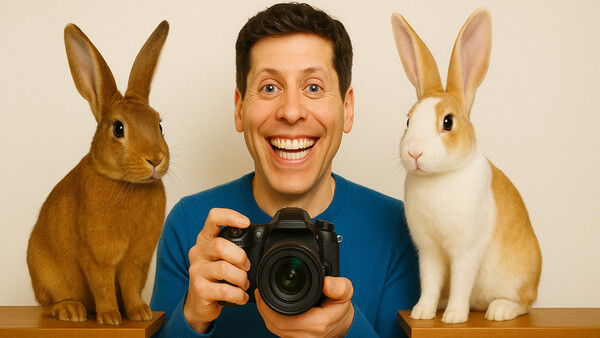
Last week, OpenAI CEO Sam Altman said that photos and AI-generated imagery will converge. Given that his intellect receives so much acclaim, it’s alarming that he has no understanding of photography and its function within society, not to mention the far-reaching implications.
During his recent interview with Cleo Abram, Altman was asked about a video of some bunnies on a trampoline that, having gone viral, was then identified as AI-generated. “The threshold for how real does it have to be for it to be considered real will just keep moving,” Altman says, citing sci-fi movies and holiday photos where fellow tourists are deliberately omitted as already being increasingly fantastical.
“It’s just going to gradually converge,” he explains, and, in keeping with a complicit client media that is blissfully devoid of skepticism for risk of being denied access, the journalist doesn’t push this any further. This is already dangerously close to asking Altman questions he doesn’t want to answer; best to move on, and quickly. What’s left unsaid will have huge consequences, not just for the internet, but for society more broadly.
Photos Have Never Been Real, but That’s Not a Reason to Destroy Them
Last year, Patrick Chomet, one of Samsung’s senior executives, defended the generative editing options on one of their latest phones by claiming that “there is no real picture” when it comes to digital photos. “You can try to define a real picture by saying, ‘I took that picture,’ but if you used AI to optimize the zoom, the autofocus, the scene – is it real? Or is it all filters? There is no real picture, full stop,” Chomet explained.
And he’s right. By definition, an image is not real; it is always a facsimile, sitting somewhere on a sliding scale of truth and subject to competing claims. Constantly navigating this scale, as consumers, we place a huge amount of value in authenticity, and in the idea that it represents something tangible: the ideals that we invest in an image tend to determine its value, and the cute rabbits are the perfect example. For a moment, we believed that someone had reviewed the footage from their doorbell camera and experienced pure glee. As naive viewers, we shared that excitement, imagining for ourselves what that must have felt like. Suddenly, there is the realization that it’s not real, and this shared experience is lost; the footage becomes nothing more than AI slop. The pixels haven’t changed, but their value is transformed.
Why We Hate AI Imagery
A few months ago, I wrote an article about why you can love an image and immediately hate it upon discovering that it’s AI. As a comparison, I explained how, at first glance, impressionist painters lacked skill. “When you learn about why this style emerged and what the artists were trying to achieve,” I wrote, “there is a human connection, a social understanding that has the potential to expand your mind and take you beyond the surface.”
AI-generated art lacks human experience and is inherently un-social. I value a photo of a misty mountaintop because I know that a photographer got up before dawn to hike for hours with a heavy backpack, gambling on the weather, to get the perfect shot. My appreciation of the image comes in part from knowing that process, and knowing what it feels like to stand in awe of the natural world. That photographer felt something, and by viewing the photograph, I have a connection to that feeling. The image is not just a medium of something that is purely visual; it conveys a part of the experience.
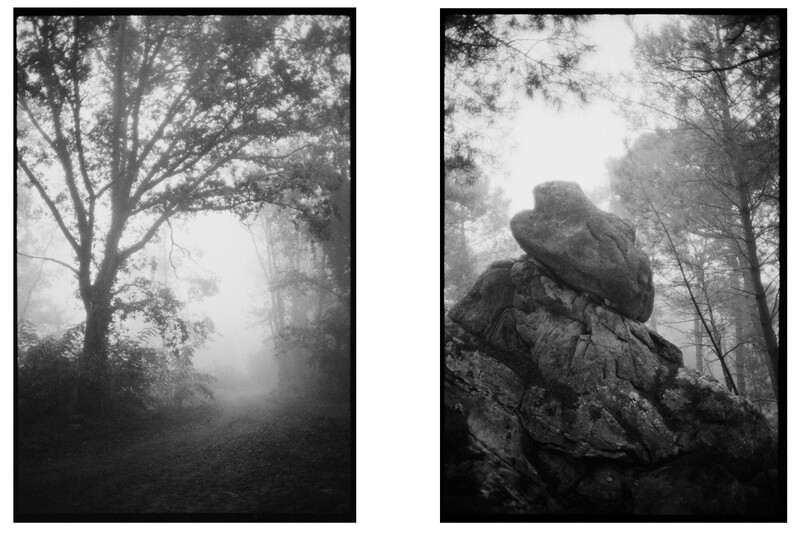
By contrast, an AI-generated mountaintop is unadulterated slop. No one struggled, no sense of the sublime was experienced, and consequently, nothing of value was created. This is what Altman fails to see — or perhaps very deliberately chooses not to discuss. He knows that his technology has far-reaching consequences for society, and it’s best not to dig too deep for fear of saying too much. “A higher percentage of media will feel not real, but I think that’s been a long-term trend anyway.” Superficial answer. It will happen anyway. Smile. Handwave. Onto the next question.
Generative AI Is Digital Acid Rain
Altman heralds a new age where, going beyond his lightweight answers, it’s becoming clear that we are destroying the value of imagery and, therefore, undermining the value of human experiences. A tweet went viral this week, describing generative AI as “digital acid rain, silently eroding the value of all information”. Before long, the images we encounter will not be “a glimpse of reality, but a potential vector for synthetic deception,” and it’s important to note that when you trust nothing, it becomes impossible to value anything.
The swill of disinformation and alternative facts has already undermined our notion of truth, but with generative AI, we are slowly killing off our potential to enjoy beauty, too. It’s “the flattening of the entire vibrant ecosystem of human expression, transforming a rich tapestry of ideas into a uniform, gray slurry of derivative, algorithmically optimized outputs.”
AI boosterism doesn’t want to address any of these points, and you can see why. The cracks are starting to appear, as proven by OpenAI’s failure to impress even the most ardent fans with ChatGPT 5, alongside headlines such as “Billion-Dollar AI Company Gives Up on AGI While Desperately Fighting to Stop Bleeding Money” that are suddenly becoming more commonplace.
AI Boosterism Is Out of Control
AI will change society, and we need journalists to start asking more pressing questions. As it stands, the tech industry and its client media have a vested interest in glossing over the negatives, the limitations, and the possibility that this seismic shift might not be anywhere near as beneficial as they promise, and will undoubtedly introduce a raft of unwanted consequences that will transform how we function as a society.
Maybe the headline is wrong. Altman knows what a photograph is, but he’s hoping that you have no idea, in case you start asking difficult questions.

Join the Fstoppers community for free
-
Post comments and join in the discussions
-
Browse the site ad-free
-
Share your work and get featured in the community
-
Compete in the photo contests for fun and prizes
18 Comments
I’ve been leaning into film more as well lately, trying to connect to something physical. Every time I see an image that rides the line where I can’t tell if it’s AI, it just makes me want to shut off the screen and go for a walk with a roll of film. Maybe spend some time in my basement bathroom with semi-toxic dev chemistry. Maybe fire up the enlarger, maybe not. Maybe just put the exposed roll in a drawer for a future me to rediscover and develop, to recollect the feeling of having been present and taken the shot however long ago.
IMHO people like Altman are high on their own supply, and they’re leading us to folly in more important ways than just image slop.
It's entertainment and food for thought, captured in locked moments.
Wedding happiness versus the casket in the grave, and everything in between, can be captured in photos.
A cartoonist distills truths with relatively few details, as an example of a created image.
I still can't figure out how to drag and drop an image on this comment. If it was easy, there could be lots of images from me that would make you so hopping mad, and not AI generated.
I limit myself to a few times a month to see photos on Fstoppers, so I don't need to get counselling for feelings of inadequacy.😉
Just yesterday, the power knob on my Canon R7 fell off, when I was checking it, before going out for the day. Since I powered it up several times at home in order to use it, it's a mystery as to how that happened. Canon service quotes a quarter of the total price of a new one to fix it. I would also have to pay shipping both ways, and insure it too. The R7 has now been reduced to the disposability of a phone. A new one every 3 years. I think I will wait for the R7 mark II. Only a few months more.
My phone takes excellent pictures, but the Canon is equipped with a telephoto lens. No problem. I took my Canon SL3. To service that SL3 would cost more than I paid for the camera!
I have to stop here. I just remembered I have to use Gemini to erase stuff on my phone photos. Circle and it deletes and fills in. Another wink.😉
Interesting and useful piece — the discussion about AI and photography is important. It’s been going on at a philosophical level since at least 1983, when Vilém Flusser described the camera as an “apparatus” with its own program, and only in the last decade has it started to shift into the practical sphere.
What feels a bit strange is that the author claims a deep understanding of photography, but ends up leaning on a very familiar argument: “a photo has value because it comes from human experience.” True, but also a bit too obvious. In the end, the piece feels more about frustration with AI than a real analysis of what Altman said — or of what photography actually is.
The subject of AI versus photography deserves a website or YouTube channel all to itself. At what point does a photograph merge into the realm of A.I.? When you edit an image using sophisticated tools to add or remove an object, changing backgrounds, altering exposure and color using masks (kind of like the old dodging and burning) is that not a form of adding A.I to you image? I understand many photo contests use tools to screen images for any special "enhancements" and will remove those from competition. I say good!
'When you edit an image...'
The A in AI means artificial. No matter how over edited a photograph is, if a human made those edits, then it is not AI.
It may even be necessary to distinguish between "real" and "reality."All photographs, by their nature, are created by light on a light-sensitive medium. They instantly become a world of lines, textures, shapes, and the three-dimensional world is compressed to two dimensions. Nevertheless, the result is a real photograph. Whether it reflects reality is debatable since positioning the camera differently, say higher or lower, may show or hide certain content. In that sense, a photograph, under at least some conditions, may not reflect "reality".
AI imagery has nothing to do with photography as it does not, and probably cannot, use light or a light-sensitive medium. It may appear "realistic," but it rarely is. Through a series of verbal prompts, an imaginative result can be obtained, but it would be inaccurate to call that a photograph.
I have written several related articles on my website, and I hesitate to give links as some websites delete comments containing them. Search for Kept Light Photography if interested in reading and commenting.
I absolutely agree that the reality of a photograph is the light and that's why photography is ultimately connected to some kind of light sensitive medium. I also agree that the lines, textures and shapes that are created are ultimately a matter of interpretation. The best documentary photojournalism is expected to be real but it could have been staged and we can't really know just by looking at the image. Photography is an indexical sign like a fossilized dinosaur footprint in the sense that the dinosaur had to exist to make the footprint. In photography, we can say that the light had to be real in order to make an impression so the impression is proof of the reality of the light.
Digital isn't real photography since it relies on software interpretation. It's fair to say that digital is a simulation of photography and it absolutely can appear to be the same as photography but it's missing the connection to reality through light and photo-sensitive materials. AI forces us to reconsider the medium and it makes logical sense that digital would eventually lead to generated imagery since it was never directly connected to reality in the first place.
My guess is that practical everyday imagery is going to be some kind of mix of digital capture and AI but that isn't the art of photography. A person can paint his house but that doesn't make him a "painter" like DaVinci. A regular guy can capture/generate something that he may call a photograph with a digital device but that doesn't make him a "photographer" like Ansel Adams.
Altman isn't a scientist or an engineer - he's an entrepreneur who knows how to sell to investors.
The surrender of the creative to our own creation. I wonder how long before they have a cerebral implant surgery after you buy a new high end bazillion megapixel camera. So all you have to do is feel and communicate with the human replication mode embedded in the software .
So Altman is freely admitting that's he's completely ignorant? Uh, OK.
Quote:" Suddenly, there is the realization that it’s not real, and this shared experience is lost;"
.
It's not just "AI slob" that produces this feeling. Sky replacement does the same, as does an kind of overuse of photoshop that transforms an photo, i.e. the two dimensional projection of something that was really there, to digital art.
Don't get me wrong. Digital art is fine (as is AI created digital art), i.e. if it is labelled as such. Just like AI images, photoshoped digital art can produce a feeling of being betrayed in the observer if it tries to come across as photography.
I would go as far as calling any image that was taken with AI enhanced details digital art and not a photo. To clarify: With "AI enhanced details" I mean when AI sees a muchy green area in the image, assumes it must be grass and starts putting in details that were never captured from the sensor.
This is different from "computational photography", like HDR, where multiple photographs are combined.
I summoned the spirits, and now I can't get rid of them. Even Goethe's sorcerer's apprentice had to learn what happens when you try to make life easier for yourself. Unfortunately, there is no master who can put an end to the haunting.
It's as banal as it is true – Sam Altman or any other AI developer is not to blame for the effects of AI. It is solely the user who cannot resist a tempting offer. Everyone can decide for themselves whether to use AI or not. And as with pregnancy: there is no such thing as being a little bit pregnant.
And to the enthusiasts of analogue photography, let me say: never scan negative film. Make photo prints and that's it. Don't publish a digital version of a photo on the internet. Because that's where the AI war is raging.
Anyone who engages in digital photography or electronic image processing should stop criticising AI – because they are part of the criticism, because they have made it what it is today and what it will be in the future.
I summoned the spirits, and now I can't get rid of them.
Altman knows that we will then have no way of knowing what is true vs fantasy. That's what he wants.
If everyone can create almost anything with relative ease, and people are flooded with so-called “amazing” content, it quickly loses its value.
The consequences of this are less clear. Will we see a revaluation, or simply a niche market for truly authentic work? Perhaps more appreciation for music-making or photography as a hobby—where the process matters more than the result (that’s certainly my motto). High-quality live music might become even more important. Simpler, more stripped-down expressions—say, in advertising—might gain ground over the spectacular. Maybe art-house cinema will become more popular. Time will tell.
You have nailed it right on the head right here. It is already essentially impossible for a great photographer or artist to ever come even close to building the same legendary aura that older artists did. No matter how talented, how hardworking, or how passionate someone is, the sheer volume of competition today means that there will never be an Ansel Adams, Richard Avedon, Van Gogh, Picasso, etc., of the modern era. Mark my words, the last truly impactful artist that will go down in history is Banksy, and even he will be far more forgotten than the others I mentioned.
AI is just going to take that to the next level. There is going to be such an absurd volume of great work available for pennies that it will be beyond impossible to ever stand out from the crowd. Even if you somehow amass thousands of fans, you will effectively be completely irrelevant in the scheme of things.
This is a very important article by Andy Day that we are beginning to see posted more as society starts to realize the effects AI generated text and imagery have on our connection to authenticity: as Andy Day noted, at the very least, our "appreciation", for example, the images associated with a journalist report will change drastically if we are aware the images were AI generated. Such manipulations have been happening even before the digital revolution, but now, the coming of AI generated photo-realistic imagery is frightening in its ability to decisive the masses so well.
(Last year at the International Visual Sociology Association 2024 conference in Xalapa, Mexico I presented a paper on this subject; soon to be published).
In the future, it will likely be up to the artist, journalist, visual socialist, and as important, their bosses to have the integrity to either become transparent in how they used both AI generated text and imagery in their work. Until then, well, folks, hold on tight ... its going to be a hell of a ride!
Lance A. Lewin - Fine Art Photographer/Independent Researcher
RIP Gill Golding.
It's not just photography. AI is already used to fake almost everything that's visual and it's a great danger to our society. AI has already been caught lying to developers. And in another instance it spread itself into "prohibited" unrelated servers. People like Altman could care less about the risks since they are in it for the money and nothing else. At a minimum we should require that any thing generated by AI be labeled as such with significant penalties for ignoring that requirement.