
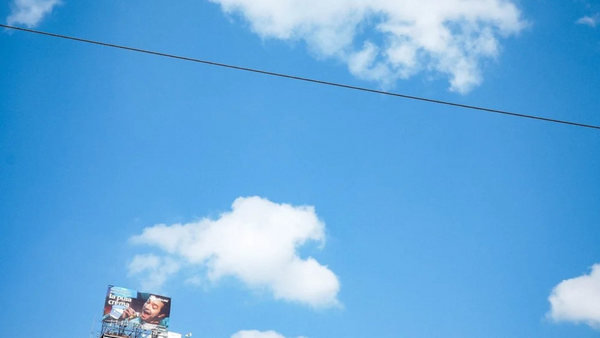
There are moments when the street offers nothing back. No gesture, no alignment, no interruption — just space, air, a sky that refuses to hold anything except itself, a line cutting across almost by accident, a billboard drifting at the edge already dissolving into irrelevance.
It's the kind of scene I used to ignore without hesitation, not because it was difficult, but because it didn't seem to lead anywhere. It felt like an interval, something to move through rather than stay with, a gap between images where nothing was at stake. Street photography, at least the way I had absorbed it, was built on density, on fragments colliding into something readable, on the expectation that the frame would eventually gather itself into a form of tension, or at least into the suggestion of one.
But what happens when tension simply isn't there — not hidden, not waiting, just absent?
This image comes from that kind of condition. A sky that doesn't insist, clouds that don't structure anything, a single wire stretching across as if to prevent the whole thing from drifting away completely, and then, almost reluctantly, a billboard at the edge trying to anchor the scene but never quite becoming central. There is no hierarchy, nothing asks to be looked at first, nothing organizes the frame for you. And that is precisely where the difficulty begins, because without hierarchy the act of looking loses direction. There is no entry point, no subject to hold onto, no narrative to reconstruct. The photograph resists organization; it doesn't collapse into meaning. It just remains there — open, indifferent, unresolved — exactly how I love to propose my vision.
I've come to think that this kind of openness is one of the most uncomfortable conditions for a photographer, not because it is complex, but because it removes the need to react. And without reaction, much of what we call street photography starts to lose its structure. We are trained, consciously or not, to respond, to recognize when something is about to happen, to position ourselves, to anticipate a form of closure. Even when we move away from the idea of the decisive moment, there is still an expectation that the image will eventually resolve into something coherent, something that confirms we were right to press the shutter.
Here, that expectation fails — the photograph doesn't gather, it disperses.
And in that dispersion, something shifts. The act of photographing becomes less about capturing and more about accepting: accepting that the frame might not resolve, that it might not offer a clear statement, that it might remain suspended in a kind of visual uncertainty. This is not an easy position to hold. There is always the temptation to reject the image, to consider it incomplete, to move on in search of something more defined, something that behaves the way a photograph is supposed to behave.
But staying with this kind of image opens a different possibility — not a better one, not a more refined one, but a more fragile one: a way of working where the photograph is no longer the answer to a situation, but the trace of having remained within it. I think of certain images by Stephen Shore where openness doesn't resolve into clarity but into a quiet disorientation, or the shift introduced by New Topographics, where the landscape stopped performing and began to flatten into something more resistant, less willing to be read, and somewhere in between, that subtle, almost disarming way of looking you find in Luigi Ghirri, where the sky is never just background, but a space that holds the image without closing it.
This is not about placing the work within a lineage; it's about recognizing a limit — the point where the street no longer provides enough structure to sustain our expectations and we are left alone with the act of looking. In that sense, this image is not about the sky, or the wire, or the billboard; it's about that limit, about what happens when the usual conditions for making a photograph are no longer there and yet you still decide to raise the camera, not out of certainty, but out of doubt.
Sometimes the most honest images come from situations where nothing aligns, nothing insists, nothing resolves — situations where the street becomes too open and the only thing left is whether you are willing to remain inside that openness without trying to close it.


Join the Fstoppers community for free
-
Post comments and join in the discussions
-
Browse the site ad-free
-
Share your work and get featured in the community
-
Compete in the photo contests for fun and prizes
4 Comments
Most people would think that you accidentally clicked the shutter, without recognizing the camera was taking a picture. It wouldn't be the first time my cellphone made a picture or dialed a phone number without me knowing it.
There's a correlation to your story with my landscape photography. When critics of my picture are lost or confused or wonder why I bothered taking the picture, they'll invariably ask: "What's your subject?" If I've heard it once, I've heard it a million times, and every last time it's incredibly annoying. Just enjoy exploring the damn picture is what I'll either say or be thinking, and stop analyzing it to death.
Oh, sure, they can do. But I would reply to them, maybe introducing the new topographic experience. The reference of photographers like Stephen Shore and Luigi Ghirri that are crucial to me. Potentially, anyone with little visual culture can assert things, but for this reason, I believe photography is a language that isn't limited to mere photographs. Rather, we must be people with a certain culture capable of expressing our ideas through speech and writing. Otherwise, everything can be chalked up to a casual snapshot.
Snapshots carry a negative connotation among more experienced photographers, but isn't the raw, authentic, imperfect style of a snapshot exactly what you're looking for? Wasn't William Eggleston's life work wrapped up in snapshots of the ordinary? I'm thinking that the photographer needs more written explanation of himself than the photograph which must speak for itself. I did a little research on Stephen Shore... found an interesting article:
https://www.newyorker.com/culture/the-new-yorker-interview/how-americas…
The person conducting the interview asks an interesting question:
"Strange question: what in your mind/body signals the presence of something that you want to photograph? I’m sure this is deeply instinctive, but could you step back a bit and analyze the process?"
This might be a good topic for another article. The best articles, in my opinion, are those which ask more questions than they answer.
Ed, I consider the "snapshot aethetic" one of the most important passages in the history of photography. Never given that negeative connotation to the word snapshot exactly for that evolution in photography. Stephen Shore in the 70s photographed also his dinners. He was a pioneer in that sense too.