
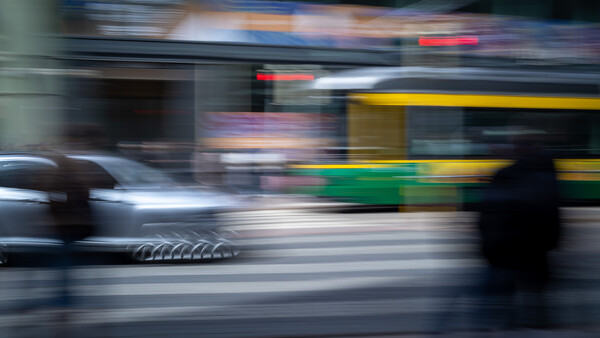
In today’s digital environment and on social media, the topic of printing is rarely discussed. Yet printing your own work is a challenge that can change not only how you process images but how you see them.
Most images now appear on screens and vanish a moment later. Printing is no longer required, but it still carries a meaning that the screen cannot hold. Screens exaggerate. They make images appear brighter and higher in contrast, and that illusion quietly shapes how we edit. As with excessive retouching, photography loses its connection to reality and begins to exist in an environment where it can easily be replaced by a generative image.
Three Traps of Screen Perception
The first is speed. The screen teaches us to look fast. Images move in a constant flow, and attention lasts for seconds. Even a strong photograph on a display rarely lives longer than a swipe. The fight for quick attention becomes a fight against naturalness. Printing pulls the image out of this mode. Once removed from its screen context, the image starts to behave differently. It exposes mistakes that were invisible on the display and makes you look again at composition, color, and light.
The second is physics. Once you move from screen to paper, everything shifts: tone, contrast, depth. What looked clean and rich on the monitor suddenly feels thinner, flatter, less stable. On a material surface, there is no backlight, and every inaccuracy becomes visible. No preset can fix this shift, and no automatic correction can predict how an image will behave under real light. You start accounting for this already when you shoot. Regular printing develops visual memory and turns such decisions from reactive to proactive.
The third is the lack of scale. A screen allows endless zooming, but for an artistic statement rather than pixel-peeping, this becomes a weakness, not a strength. More on that below. It deserves a closer look.
You never really know an image until it exists in space, under real light, and on a real surface, seen from a real distance. Printing turns that discovery into a discipline. It shows where you control the viewer’s attention and where you rely on the display’s artificial enhancement. It is not a step back but a test of control. Printing remains the only format in which the author controls not only the image but also the duration of contact with the viewer.
From Perception to Responsibility
On paper, you see the image as others will, under real light, not the glow of a screen. Every choice becomes visible: what holds attention, what slips away, what strengthens, what distracts. The question is no longer about how precisely you shot but about how clearly it reads.
No two screens show the same photograph. Color, tone, contrast, and even mood shift with the light. A printed photograph looks the way the author intended. But to achieve that, the author must answer one question: how should this work be perceived? Responsibility shifts from parameters to perception. This is what authorship means in practice: the ability to shape how an image is seen in the real world.
Printing not only verifies how you see; it teaches you to plan. Each iteration shows the limits of technical decisions and shifts attention from correcting mistakes to preventing them. This is the growth of competence: a movement from reaction to prediction. The experience carries back into shooting and editing. You stop hoping to fix things later and start shooting with the final form in mind. The result becomes predictable, not because you repeat methods, but because you understand how decisions translate into visual effect.
Shooting Is Only the Beginning
If you look at the process as a whole, shooting and editing take less than half of it. Often only a third. Everything else starts once the image is technically ready. Then come test prints, checking how color and tone behave in the physical world. After that comes the choice of medium and method of presentation, mounting, and framing. There are no automatic solutions. Everything is verified by eye and by hand. That’s where the real work begins. This stage turns a file into an image that can be presented to an audience. It shows the professional difference between someone who takes pictures and someone who builds a photograph as an object.
Display calibration, print profiles, test strips, and evaluation under standard lighting create a coordinate system between decision and result. The more consistent your system, the fewer surprises at the end. It is a discipline that restores control.
Printing is not a finishing step but a repeating process. Different media, sizes, and formats show where the image holds and where it falls apart. The next file is corrected with this experience in mind, and each repetition makes the result more stable. It’s how precision is built — by testing. Printing becomes a learning cycle. It does not just fix the work; it develops vision. Mistakes become measurable, and improvement visible. This mechanism cannot be replaced by on-screen analysis. It fosters understanding rather than perfectionism. But the result is seen not only in color and tone — the decisive factor is scale.
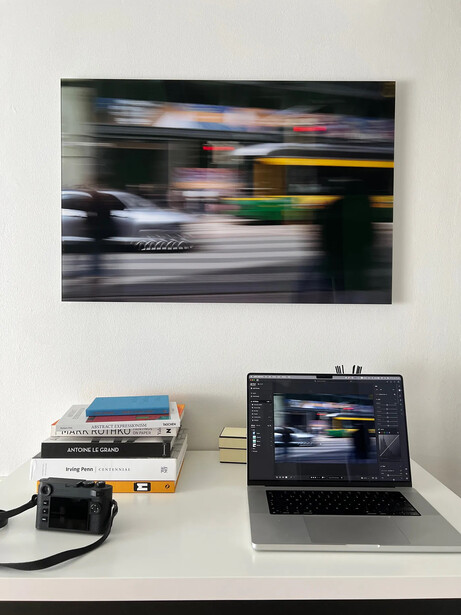
Why Scale Matters
The size of a print is a structural element, not decoration. A large format is read from a distance and defines the rhythm of the gaze. A small one requires closeness and creates a sense of presence. By choosing size, the photographer controls both distance and duration of attention. Changing formats forces the viewer to move. It is the same tool as choosing focal length or depth of field, only applied after shooting. Scale defines how the viewer enters the image and how long they stay inside it.
Scale is the part of the work that is often ignored on the monitor by the nature of the digital medium. On a screen, we can zoom in and out endlessly, losing authorial control. But in print, everything changes, especially in large formats. What seems like an artifact on screen becomes a structural element at 120×180 cm (about 47×71 inches) and even a focus of attention. Micro-details you might notice on a screen do not behave the same way when you see the entire work at once. In a Polaroid print, the opposite happens: you come into intimate contact with the image, and the surrounding space fades away. This too can be a planned form of viewer immersion.
Today, working with scale has its limits. When screen size approaches A2 or A3 formats, immersive photography must move beyond them. But even at similar dimensions, a print lives differently through its material and its presentation. The physical form is never limited to paper.
Choosing Materials
Your image can live on almost anything: cotton, baryta, rice paper, canvas, fabric, acrylic, glass, metal, or even concrete. Every surface handles light in its own way. Some reflect, some absorb, some scatter. Contrast, texture, and depth all shift with the material. Even color temperature and gradients behave differently once the light hits a real surface.
Even the basic properties of a surface make a visible difference. The level of gloss and texture affects light areas and detail readability. The density of the base influences depth. The shade of white shifts the overall balance and requires precise color correction. These are not decorative choices but an extension of the composition. The material becomes part of the language because it affects how the viewer reads the image over time and from a distance. A file can look impressive, but on a physical surface, it will behave differently. Understanding this saves endless attempts and builds a system.
Mounting and framing add another level of control. Acrylic adds an additional plane and changes the way dark zones are perceived. Aluminum composite panels make the presentation more technical. An open-textured canvas makes it softer and more painterly. These choices change the context and demand the same precision as exposure in the camera. When a photographer controls material, scale, and presentation, they are no longer managing a file on a screen but directing how the work is actually seen.
If you look at the process as a whole, shooting and post-production often make up only a third of the process. The rest is the translation of the image into physical form and a series of decisions that cannot be delegated to algorithms or automation. A file becomes strong only when it reveals itself predictably in its chosen physical configuration. Printing is not the end but a tool for building that predictability. When everything can be automated, attention becomes the last manual skill.
Authorship as the Result
Authorship begins when the photographer takes responsibility for perception. Printing makes this level of work visible and verifiable. If the image behaves consistently in physical form, if it reads in typical light, at the intended distance, and in the chosen presentation, then the system of decisions is complete. If not, it means the concept or execution needs revision. In both cases, printing gives an honest answer without the self-deception that easily appears on screen.
Each iteration increases both the quality of output and the precision of shooting and editing. You gain confidence in how each decision affects the viewer. This is what practical authorship means: taking control of the conditions in which the work exists. In an age where more and more processes are handled by algorithms, this layer remains human. They demand attention, patience, and responsibility for the final form. Printing keeps these skills alive and teaches you how to use them.
Perhaps this is how printing helps a photographer become an author.




Join the Fstoppers community for free
-
Post comments and join in the discussions
-
Browse the site ad-free
-
Share your work and get featured in the community
-
Compete in the photo contests for fun and prizes
11 Comments
Excellent article. It encapsulates the issues of going from the pushing the shutter to the hanging on the wall. I've been an amateur photographer since the late 1960s. Photography has always been a process: which film, which shutter speed, f-stop, and what do I do in the darkroom? Now, the process has seemingly infinite options, with digital technology bringing more options all the time. If you assume perfection is not attainable, how much time does the amateur devote to the approaching perfection weighed again when does the process cease being fun and affordable? And, with AI and other tools, when is the end product what I, the photographer, created, vs. a creation of unseen AI?
Thank you for such a thoughtful comment.
I am relatively new to photography and have been working with it consciously for about three years, but I started printing my work almost immediately, literally within the first weeks of learning to use a camera. From the very beginning, the final stage of the process for me has always been a photograph on paper.
In my view, the screen forgives many mistakes and reveals additional possibilities simply through the fact of backlighting. Contemporary photographic art, as I see it, lies in transferring to paper without loss what is created by the camera and post-processing. In this sense, working with a digital camera is significantly more demanding than working with film and a darkroom.
The number of tools available throughout the entire process is extremely high, and the range of choices is enormous even without considering AI. Finding an optimal solution becomes very difficult, but also engaging, because even the choice of paper radically affects how the work is perceived. A wrong choice at this stage can easily undermine the image itself.
In the book "Mona's Eyes," by Thomas Schlesser, art history is told through the story of a ten year old girl and her grandfather, who go together one afternoon each week for a year to a museum in Paris. Grandfather chooses just one work of art, for which they will quietly observe without speaking a word for twenty or thirty minutes. Only after that quiet period of thought and reflection do they discuss the artwork. The little girl learns to see, and understand how the lives of the artists influenced their work. The grandfather was a great storyteller, and the girl cultivated a rich imagination... exactly why we have artwork.
I have two reasons to print my photographs... the first to earn some money, the second to satisfy my own desires. People buy large prints for wall art, often in the form of canvas, acrylic, metal, or paper framed under glass. Metal and canvas are generally softer in focus and detail than I like. Large glass and acrylic pieces are fine for viewing from a distance, but distracting when attempting to look closely at details, and are a barrier to the tactile experience of touching paper. After the photo is placed on a wall, my control over presentation is further eroded by light. At our home, my wife likes cooler temperature light bulbs; I prefer warmer softer light. She likes lots of larger windows and natural light; I prefer less bright light. As I wander around the house with a print in hand, the appearance of color in the image and paper changes dramatically. So the manner in which a print is viewed is never universally the same for everyone. Wall art generates an income of sorts, but it's almost never presented in a manner of my first choice, so I'm always making concessions. The finished artwork is produced according to the customer's wishes, not mine. I'm not really the author, they are, but that's how business works.
The second reason for printing is purely for my own satisfaction, and this is where I get really excited about talking prints. I don't care much at all for metal that customers typically prefer, but I love paper. I like the tactile experience of different textures. I enjoy playing with the subtle differences in tone and contrast produced by different papers. Every picture seems to call out for one type of paper more so than another. For my own collection, I print a size conducive for holding in my hands rather than sticking on a wall, either 13x19 inches or 17x22 (approximately A3+ or A2) and store them in clamshell boxes or original packaging. My passion for printing is grounded in the act of sitting quietly with a small print in hand, a tangible object that I have made, able to appreciate the impact of the whole scene at once, or interchangeably with finer details as I wish. A great photo motivates me to explore its nooks and crannies. A more minimalist image helps settle and calm the mind... a perfect way to begin meditation. A print in hand almost always triggers emotions for me that viewing an image on a computer monitor does not. If it were not for printing, I would never have picked up a camera in the first place.
Thank you for such a thoughtful reflection, Ed. I relate to much of what you describe, especially the distinction between printing for oneself and printing as a compromise shaped by context, light, and presentation.
For me, however, each photograph exists in its own scale. Size is not a preference but a structural part of the work. The image discussed in the article exists in its smallest intended form at approximately 35 × 24 inches (90 × 60 cm). In some cases, a hand-held format simply does not provide enough distance or surface to read the internal relationships and finer details that matter to me.
This works both ways. Just as reducing a work can limit what it reveals, enlarging it can also break the sense of intimacy where an image functions best through closeness and tactile engagement.
I think this is where scale stops being about comfort and becomes part of authorship. Some images ask to be held, others ask to be entered. Neither replaces the other, but they function differently, and choosing the wrong scale can shift how the work is actually experienced.
I would much prefer to limit the size of my prints to that of my own choosing. I certainly understand and appreciate your point of view as an artist. If I were able to do that, nothing would ever go out the door larger than 17 x 22, on paper, but interior designers have their own needs which depend on the configuration of wall space. Therein lies one sales and marketing advantage though that photography has over original paintings: the capacity of the image to be reproduced to fit any given wall space... if we are willing to sacrifice that control. I will even crop the image in order to accommodate their requested proportions, and then I'm further entrenched with the customer as co-author of the work and, yes, I'm the image maker. That's how I earn money.
My practice is a bit different. Size is not something I decide on after the fact. Scale and materiality are part of the idea from the very beginning, and each work exists as a single object (edition 1/1), in one specific size and one specific material. That’s why control over scale matters so much to me.
When it’s an interior job, I shoot with the understanding of how it will work in the space and at what size. I do that rarely for now. I like working with architects and designers; it’s where this way of thinking actually makes sense.
I built my first darkroom over 50 years ago and it was a long learning process. Discovering the papers, learning the tools. It wasn't easy as there was no youtube around it was a lot of trial and error. I have a tremendous respect for printed pictures as a result. The craftsmanship required and pointed out in the article is something most will never understand. I actually go to galleries and look at how some of my idols have printed their work. Irving Penn had an exhibit that was amazing. And of course the Ansel gallery in Yosemite, and others. Respect the print, its not easy.
Every so often when I see your name pop up in one of these threads, I go and look at your website. Your black and white landscapes are fantastic. They certainly deserve a place on paper, and with your background it should be pretty easy. It's certainly not as hard as some people make it out to be. A good pigment inkjet printer and some trial and error, and you'd be making awesome prints. I understand about seeing prints by the legends, but nothing is as rewarding as seeing my own images in print.
When I was around seven or eight years old, I had a small home darkroom where I learned to develop film and make prints. At that time, the results were quite decent, but only in black and white. That’s where my darkroom practice ended, and everything I do today is digital.
My understanding back then was very basic, but it really changed my relationship with photography, and that experience still feels relevant to me now. For me, without printing, digital photography feels only partially complete, maybe thirty percent of what it can actually be.
Thank you for authoring a provocative and well reasoned argument on the utility of printing. While I agree with many of your suppositions, one which you've overlooked is the object permanence of prints. Images projected on a screen are transient by nature and the stream of electrons creating them are much more transitory. A print is something tangible, subtly immutable yet it changes character as the surrounding light changes. It essence, it more permanently captures and projects a moment in time and is the ultimate expression of the photographer.
That’s a very important point, and in many ways it’s the foundation of my own work. What I actually sell are not images, but material prints, finished and presented as physical objects. The permanence of the object, its presence in space and time, is essential to how I think about photography.
This is an excellent argument, and a very useful one. It articulates something that often remains implicit when we talk about printing, but really sits at the core of why it still matters.