
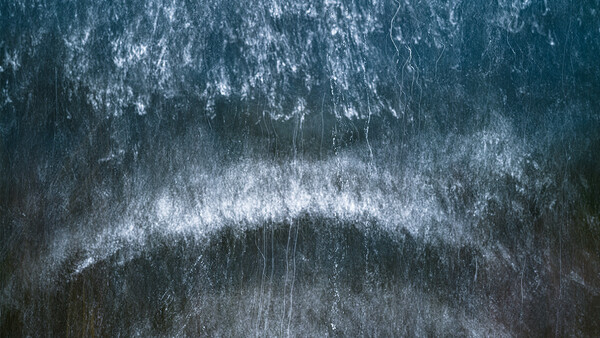
This is not a guide, but a way to think about abstraction as one way for photographers to regain control and meaning when technology learns every technique.
Photography has lived in a state of anxiety for several years. Once neural networks began generating realistic images and 3D graphics became the standard for commercial and product shoots, the boundary between photography and simulation finally dissolved. Today, even wedding photographers and sports reporters have no reason to feel safe.
Yet there are areas algorithms cannot reach for objective reasons. The problem is not processing speed or computing power. The issue lies in how AI models function: they cannot handle ambiguity and fail to analyze what has no clear boundaries or recognizable objects. This means that the less “reality” your image contains, the harder it becomes to analyze, codify, or clone.
What Abstract Photography Really Is
Strictly speaking, abstract photography is an image without perspective and scale — without the visual anchors that help the viewer recognize an object. It is a visual environment without a central subject, where meaning does not depend on what is depicted. Still, between pure abstraction and documentary photography lies a spectrum of hybrid forms where reality remains visible but transformed. Such work keeps its link to the visible while shifting attention from the object to the act of seeing.
People often find abstraction difficult because it demands time — literally to stop and look. It cannot be scrolled past. When we look superficially, we seek what to see, but here the question is how to see and how long to stay with it. That shift from “what we look at” to “how we perceive” requires effort, but that is precisely what makes abstraction special. It attracts through its ambiguity and through its resistance to simple explanation.
And that is exactly what algorithms cannot reproduce. The object is either absent or so deeply masked that it stops being the basis of interpretation.
A Brief History of Refusal
We can recall painting in the late nineteenth and early twentieth centuries, when artists gradually abandoned representation. By then, photography had already claimed the role of precise depiction, and painting had to step aside — not out of weakness, but to preserve its freedom. Many portrait and landscape painters lost their livelihood as photography, even black-and-white photography, proved more accurate and engaging. Attempts to imitate painting through pictorialism came almost immediately but found little understanding.
Of course, the process was far more complex than a single paragraph can show. I must apologize to the reader for oversimplifying it, but I’ve tried to keep the essence the same: art saved itself by abandoning the function that cameras could perform better, even without color. This shift from depiction to expression gave rise to the artistic movements of the early twentieth century and allowed painting to remain art. Today, photography faces the same moment.
Photography now faces the same need to redefine its role within a visual economy.
Why Abstraction Becomes Protection
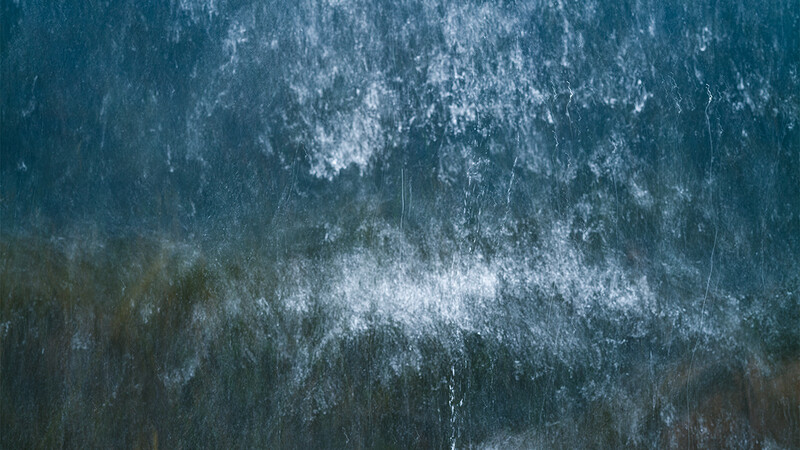
Abstract photography is not the opposite of technology but a way to reclaim initiative. Its protection lies not in isolation from tools but in the fact that it requires personal decisions, not automated ones.
Abstraction demands a conscious refusal of automation because algorithms serve a different purpose — even within the camera itself. Smart technology resists abstraction, constantly trying to preserve a recognizable, documentary image: properly exposed, in focus, with the “right” depth of field and natural color balance. Algorithms are trained to avoid mistakes, while the photographer working with abstraction searches for them and turns them into the foundation of personal style.
To regain creative control, one must act against what technology has taught us. Where the camera corrects, intervene. Where automation stabilizes, allow instability. This is the rare case where manual settings truly matter and help you control the process with precision. This is perhaps the only case where the phrase “real photography in manual mode” regains its meaning.
Abstraction does not reject technology; it changes the logic of its use. As I wrote earlier, specialization is not a limitation but a way to survive in a niche. Abstraction is a new kind of niche built around a method, not around a subject. It is a strategy, not a genre.
Potential and Opportunities
Abstract photography is a space where the human remains necessary. Where there are no objects, perception becomes the subject, and perception cannot be automated. That is its strength. It restores attention because it asks the viewer not to recognize but to look. It deals not with content but with perception: with how we see, not what we see.
From a market and stylistic perspective, new opportunities emerge. First, abstraction lets photographers move beyond genre boundaries, freeing them from the need to be “portraitists” or “landscape” specialists. It becomes direct evidence of what I wrote previously: style is born from refusal. Abstraction is the ultimate form of that refusal, a visual realization of a strategic “no.”
Second, abstraction opens new ways of working with space and material. It moves naturally from digital to physical form, demanding printing, scale, and tangible interaction with light and surface. This requires the full production cycle — printing, framing, and mounting — and brings the craft back into a profession that has gradually forgotten it. It restores a sense of presence and materiality, returning the viewer to physical contact with the image.
Finally, abstraction becomes a new language. It no longer speaks about the world but about how we look at it. It is not reduction; it is expansion. When algorithms endlessly generate recognizable imagery, uniqueness becomes a rarity once again.
Difficulties and Weaknesses
Let’s be honest: abstract photography has its challenges. It is harder to explain, harder to sell, and harder to fit into a commercial logic. For many clients and even institutions, it still appears ambiguous, and ambiguity rarely fits the requirements of competitions and exhibitions that expect a plot, an object, a story, and a dose of social drama.
Yet that ambiguity is precisely the measure of its strength. For abstraction to work, it must become material. A digital screen often destroys its effect when the choice of medium lacks intention. Scale and physical presence do not just define its meaning; they shape how the viewer experiences it. Therefore, abstract photography demands a full production and presentation process to reach completion. It revives craftsmanship in an age that has mostly forgotten it. Still, such a process is costly and requires skills many photographers no longer possess.
Internal Threats
The main threats are not external but internal. The “inner photographer” is the one afraid of being misunderstood, still searching for a subject to justify the image. The fear of emptiness, of lacking an object, of the viewer not understanding — these are real barriers. They are joined by vulnerability to accusations of meaninglessness. An abstract image is easily dismissed as “nothing.” That is why internal grounding is essential — not as an excuse, but as an understanding of why you are doing it.
These threats cannot be eliminated but can be understood. That awareness is maturity: not defending against misunderstanding but using it as part of perception. The less you explain, the more freedom you leave for the viewer, and that freedom becomes strength. Still, clichés like “the author invites the viewer to interpret the meaning for themselves” provoke laughter in the professional art world. It is better not to overuse them in photography either. Even freedom of perception needs direction — set by the author through the title and the statement of intent accompanying the work. This is another challenge: the need to articulate meaning clearly, something documentary photography rarely required. Traditional photography could “speak for itself,” though, to be fair, that was never entirely true.
Fears and Resistance
To overcome these fears and internal barriers, you must shift from the paradigm of “what is depicted” (and what I shoot) to “how it is seen” (what I want you to feel). It is a serious shift, one that no YouTube tutorial can teach. Yet there is more than enough material to learn from — abstract photography appeared almost simultaneously with documentary photography in the late nineteenth century and has always existed alongside it. Only now is it stepping out of the shadows.
Digging deeper is not easy, but it strengthens the photographer’s position. The deeper you dig, the greater your possibilities and strength. The fewer your threats and weaknesses become. Because behind every work stands not just its title but the meaning you have built into it.
It becomes a haven not because it is closed to machines, but because it remains open to the human. The more automated the visual world becomes, the more value lies in what resists recognition.
Conclusion
In my previous articles, I explored how photographers can preserve themselves within the profession. This piece is about where that preservation becomes possible. A haven is not an island but a zone of responsibility. The more consciously you shoot, the more stable your position becomes.
This piece is not a recommendation but rather a possible scenario, a path that is long, difficult, and uncertain. It carries risk, yet when it works, the reward can be significant. The chances of success are small, but what I do know is that such experiments are incredibly valuable for learning and practice. Experience is not about repeating the same thing for 20 years; it is about exploring what might never be directly useful but will profoundly expand your ability to see and to notice. And between pure abstraction and traditional photography lies a vast field of experimentation that remains perfectly comfortable for both the viewer and the client.
It does not protect from technology; it restores control. Abstraction becomes a safe haven not because it is closed to machines, but because it remains open to the human. The more automated the visual world becomes, the more value lies in what resists recognition. And that may be its quiet advantage. Because when every process becomes predictable, the only real progress left is to look differently.
To be continued.



Join the Fstoppers community for free
-
Post comments and join in the discussions
-
Browse the site ad-free
-
Share your work and get featured in the community
-
Compete in the photo contests for fun and prizes
18 Comments
I consider a safe haven to be an illusion. Nothing is immune from change of popular consumer tastes, or impact from technology. Nothing. From a business position, the best we can do is determine our strengths that lie in skill, passion, and marketing… and go do it. If your competency is abstract photography, do it well and work hard at promoting it. The same for portrait or any other genre of photography. The closest thing to a safe haven starts in the mind with an unfailing belief that what we’re doing is the best possible option. Where there’s a will, there’s a way. Listening to a million opinions about the future of photography, or the future of anything, may not be all that productive. I wish I hadn’t been persuaded during my 40 years in the commercial printing business by those who proclaimed paper to be dead. The business evolved as the internet diminished the market for paper, but it’s still a viable business. In fact, far fewer commercial printers in existence today have reduced competition substantially.
And painting is still a viable business despite the impact of photography… for exceptionally good painters who are not shy of sales and marketing. Photography undoubtedly impacted the work of painters throughout the 19th and 20th centuries, but to say that painters in mass abandoned realism because of photography, is a common argument that I am not convinced. Modern artists were often renegades looking to upend the status quo, revolting against traditions and conservative values. I see changes in art style throughout history as more of an evolution, an expansion of ideas by artists open to them at their particular time, rather than forced out of work because of photography as a replacement for painting. After all, many of these artists were financially poor regardless of their manner of art. I’m pretty sure the work of impressionists such as Claude Monet influenced the post-impressionists like Cézanne and Van Gogh, who painted what they thought they saw instead of what they really saw, which paved the way for cubists like Picasso to paint in the form of geometric shapes, and then abstract artists like Kandinsky and Pollock. The Dada movement, born out of the disillusionment of World War 1, questioned our definition of art. Diego Rivera and others were political activists and painted social commentaries. Art in the middle part of the 20th century began focusing on racism and sexism. None of those conceptual forms of art were born out of the invention of photography as a replacement for realism. They evolved out of the culture and social issues at the time they began. Many of these pioneering artists were initially rejected, and some were very poor. Photography has never eliminated painting; it has merely added another dimension of communication.
Ed, thank you. I was genuinely waiting for your reaction. Your comments always bring in real experience and widen the conversation, and this time is no different. Your example about the printing industry, and the way markets shift but do not disappear, is a strong point. I agree that stability often comes from skill, attention to the process, and the ability to work with the market. That part of your perspective is something I fully share.
My article looked at a different layer, more about how images work than about how the market behaves. I was not talking about fear or trying to find a guaranteed place of safety. I meant something else: different kinds of images interact with algorithms in different ways. Algorithms handle clear scenes very well when there is a subject, a story, and a readable structure. But they struggle when the scene has no central point, no clear logic, and no way to decide what the “story” is. This does not contradict your point that no niche is truly protected. I am talking about something else: the room for human work appears where machines cannot rely on story or structure, not where a genre feels traditionally safe.
This is where the work of a photographer still matters. You are right that the profession survives through attention, persistence, and the ability to follow one’s own direction. I simply add another layer to this: the medium itself is changing, and the parts of it that cannot be reduced to objects or clear structure remain in the hands of the author. In this sense my article was not about protection. It was about a possible direction, one where a photographer is not competing with AI because the form of the image gives the machine nothing to hold on to.
That is why I tried to separate these two levels. Your comment shows how markets and practices evolve. My text looked at how the visual environment works and where the limits of algorithms are today. Inside those limits there is room for authorship, not as a safe place but as a space where human decisions still carry weight.
I had chosen to avoid writing about algorithms and AI because I know so little about them. Nor do I really care much, as I don't see the future of photography for me at my age as particularly governed by their terms.
I sometimes get confused by your layers of writing; however, best I can tell, you seem to be saying that AI is limited or does not have the capacity to create abstract art, because abstract art is void of a clearly recognizable subject. Therefore abstract art is reasonably AI-proof. At least in short form, that's what I hear you saying, but at the surface level, it seems like AI could learn and create much about shapes, color and form based on the styles of various abstract artists.
So I asked Google about AI and abstract art, and found this article very interesting. Would love to hear your thoughts on it...
https://deepdreamgenerator.com/blog/abstract-art-and-ai
You are right that AI can create images that look like abstract art. It can generate shapes, colors, and patterns, even something that resembles the style of well-known abstract painters. That part is not difficult for a model trained on thousands of examples.
The difference I was pointing to lies elsewhere.
Abstract work does not become meaningful because of its outer form. It becomes meaningful because of the decision behind it. The form is only the visible result of that decision.
An AI model can draw a black square or imitate the surface of abstract painting, but it does not create the reason for that form to exist. It can reproduce the appearance, but it does not produce the intention or the context that gives the work its meaning.
And in fact, copying the style of painting is much easier for AI than copying the style of a photographer. Painters work within recognizable visual languages, while photographic language often depends on decisions that are not visible as isolated effects. This makes it simpler for a model to mimic painting and much harder to recreate a photographer’s actual way of seeing.
That is why the examples in the link you shared are visually interesting, but many of them are not abstraction in the artistic sense. They are generative surfaces built from patterns the model has learned. They work as images, but they do not grow out of an internal choice about what the work needs to be.
This is the layer I meant: not a technical limit of AI, but the difference between producing a surface and making a decision.
You say: "Abstract work does not become meaningful because of its outer form. It becomes meaningful because of the decision behind it. The form is only the visible result of that decision."
From a business perspective, which is how I thought you were framing your article, people buy the outer form and visible results of your thoughts and decisions. Practically speaking, nobody has ever asked about my thoughts or decisions that determined the final appearance of one of my photographs. They buy something because it speaks to them on their level, not mine. Jackson Pollock left many of his abstract works untitled so that the viewer would respond in his own way without being told by the painter what to see or how to engage with the painting. I would have to read a full biography of the man in order to better understand his thoughts and intentions underlying his paintings. And... nobody probably bought a Pollock painting because of purely who he was until after he was dead, which is the case of many famous artists. Maybe I need to rethink that issue, but people are not buying Edward Kunzelman, his thoughts or ideas; they're buying something that looks nice on their wall... something that reminds them of a special place, or has calming effect, or complements their interior design color scheme.
The meaning, understanding, or perception of any work of art or photograph is attributed to both the artist and the viewer. In that regard abstract and literal landscapes are no different. My realistic landscapes are comprised of thoughts, decisions and emotions, the same as your abstracts... manifested in slight variations of one photographer's perspective from another. Your ICM abstracts are not entirely original... they are forms shared by many other artists, differentiated only in a small way by the precise colors and patterns. Each of us considers our work special or unique because of the thought and intentions that we have given it, but the viewer only sees the outward forms. The world in this age of electronic communication is going to see a lot of too "common" work. Even the images in National Geographic are becoming routine. I think you're trying to make a case otherwise, but I'm not convinced. I fail to see why either abstracts or landscapes would be any safer, on any level, than another.
I'm not even sure that the mind of the human is altogether different than the mind of the machine. You might claim that a human possesses original thought and the machine merely copies. But virtually every human thought is a derivative of things we have seen, heard or experienced in some way in the past. Don't people essentially learn in the same manner as machines?
I fully agree with your point that buyers respond to the outer form of a photograph. On the level of the market, people choose what speaks to them visually, whether it is abstract or literal. Most of them do not ask about the decisions behind the image, and this is completely true.
In my article I was speaking about a different layer, not about sales or taste. I was looking at how images are made and how a photographer arrives at a decision. Viewers see the final form, but the form does not appear on its own. The decisions that lead to it are invisible to buyers, yet they shape the profession from within. These two layers do not contradict each other; they simply describe different parts of the process.
Your example of Pollock is a good one. His paintings are often encountered as pure surface, open to any interpretation. But their place in art history is tied not only to what they look like, but to how they were made. The act of creation — the physical gesture, the performance, the method — is part of their meaning, even if a buyer only sees the finished canvas. The market responds to the result; the artistic value grows from the process that created it.
The same is true for landscapes. Two photographers can stand in the same place and produce images that look similar to a viewer. Yet the internal choices can be entirely different. Viewers respond to the surface; photographers work with the decisions that shape that surface. Both perspectives are valid, just centered on different roles.
About AI: I am not arguing that abstracts are “safer” than landscapes. I do not think any genre is protected. My point was simpler. AI works by reinforcing what it already recognizes. This produces a huge amount of very similar ideas, which is exactly what you noted about the world being full of common images. That is why AI can be useful as a filter: anything it can generate endlessly is often the kind of idea a photographer may want to avoid.
As for the comparison between human and machine learning, there is indeed overlap. We all learn from what we have seen. The difference is that a person makes choices not only from patterns that repeat, but also from what breaks those patterns. A photographer often moves toward the things that do not align with what he already knows. A machine does the opposite: it strengthens the patterns it has already found.
So we are looking at the same situation from different positions. You are describing the viewer’s and buyer’s side; I was describing the internal side of making images. Both perspectives are true, and together they give a fuller picture of how photography works today.
"anything it can generate endlessly is often the kind of idea a photographer may want to avoid."
Funny thing. Most successful photographers/artists have developed a distinct voice and AI is the ultimate mimicking tool. So the more distinct your look, the easier it is for AI to replicate. If you created a series from abstract ocean wave photography with whatever gimmicks you wanted to apply to them, like long exposure, it's incredibly easy for AI these days to recognize all the subtle details and reproduce endlessly. If you don't realize AI can do this very well now, you haven't been paying attention to the latest models.
It ultimate comes down to selling yourself as an artist and simply accept the fact that your work can easily be reproduced by some mouth breather if they wanted to.
You’re raising an interesting point, but the risk of “AI copying a style” is often overstated. Photography has lived with imitation for more than a century, long before AI appeared. Most of what we call a photographic style has always been copied, repeated and adapted by thousands of people. The medium never depended on visual uniqueness in the sense of a protected pattern.
AI can mimic the surface of a look, and in many cases it is easier for a model to imitate painting than photography, because painting relies on stable visual languages. But copying a surface is not the same as reproducing a photographer’s work. A photographer’s voice is not a single image or a recognizable trick. It is a chain of decisions across years, a trajectory, a way of approaching subjects, a sense of timing, a body of work, and everything that surrounds it.
And there is also a practical point. AI itself does not copy anyone. People copy. A model can produce a variation, but it is a person who decides to use it as an imitation of someone else’s work. And in most real situations that motivation is low, because imitation does not create value for the imitator and has no place in the professional field.
From a market perspective, copying has never been a threat in photography. People have always been able to imitate anyone whose work they admire, and the field has survived just fine. What usually harms a photographer is not being copied by others, but copying themselves — repeating the same idea until it loses its energy.
So yes, AI can echo the look of a photograph. But that has very little to do with the actual value of a photographer’s work, which comes from the decisions that build a career, not from a pattern that can be reproduced.
Although I mostly agree with everything you've said and there is much value in these words, it sounds like you are no longer defending the thesis of your article: AI can't replicate abstraction
I appreciate the thought, but I never argued that AI cannot replicate the appearance of abstraction. It obviously can. My point from the beginning was different.
AI can imitate the surface of almost anything. What it cannot reproduce is the decision that gives the work its direction. Abstraction becomes meaningful through the reasoning behind the form, not through the form itself. So the question was never about whether a model can mimic shapes and colors. It was about where authorship actually begins.
There is also another part that matters in abstraction. Materiality and scale are not optional. They are part of the image. If you work with abstraction, you work with print, and the physical presence of a large abstract work is something no model can generate or replace. A file can imitate the look, but it cannot become the object.
The discussion naturally shifted toward these deeper layers, which may sound as if the thesis changed, but it has not. I have been speaking about the difference between surface and decision, and about the parts of photography that remain physical and intentional, not about the technical ability of AI to produce a visual imitation.
To keep it simple, AI can only recreate an image when it can recognize the objects inside it and rearrange them in some new way. If there are no identifiable objects, it can repeat surface patterns — color, rhythm or texture — but it cannot build the relationships between elements, or create scale, depth or an internal logic to the image.
And that is exactly the task of an abstract author. Not producing effects or patterns, but deciding how the elements connect and why the image is built the way it is.
Interesting hypothesis. It would be a fun experiment to present a series of abstract photos and see if the public can tell which ones were made by a real photographer vs an AI that was trained on that photographer's abstract images. My assumption is that it would barely be different than a coin toss, all except for a subtle minority.
Still, I respect your idealism on the matter. I also think these things matter, but I feel its lost on the general public...
The general public considers abstract art “a mess of paint” anyway, so it is not surprising that they would not distinguish between an abstract photograph and an AI version of it. This has always been the case with abstraction.
The essence of your argument appears to be contained here: "We all learn from what we have seen. The difference is that a person makes choices not only from patterns that repeat, but also from what breaks those patterns. A photographer often moves toward the things that do not align with what he already knows." Okay, you're talking about internal thoughts and decisions.
Maybe a few well known photographers could claim to have broken established patterns... Eggleston and Porter, perhaps, in changing the world's perceptions of color photography. Something clicked inside their minds which was entirely different than Ansel Adams' view that art was best expressed in black and white. But, honestly, how much of your photography, abstract or otherwise, charts a totally new course from what you have seen in the past? Our work typically evolves as a result of incremental steps. Same for music and literature. Rock and roll did not directly follow 19th century classical. It evolved out of blues, jazz, country and even some gospel music.
My point is that the internal process and decisions which you cite as defining the creative mind are more evolution than revolution. We see, we copy, we tinker and modify, we add to what we know, we repeat and improve in small incremental ways, which builds energy rather than diminishes it. The best craftsman keeps working at the same thing, whether it's woodworking, leather finishing or photography, persisting day in and day out refining their craft to the point of excellence. We don't quit because it's been done before, or someone else thinks it's too common. In fact, we don't obsess over comparing our work to others. Focus on excellence.
Ed, there is one clarification that seems important here. What you describe as development, the gradual refinement of what is already familiar, was necessary for a long time in photography. But in practice it was not creative evolution. It was compensation for technical limitations.
Most of these limitations no longer exist. Modern cameras and software remove almost the entire technical barrier. Refining the familiar has stopped being development because it no longer adds anything new to the work.
That is why I separate technical growth from creative growth. Technical growth compensates for shortcomings. Creative growth begins when decisions move beyond what is simply repeated.
We're discussing the internal thought and decision making process used to make a photograph, in which case technology is mainly irrelevant and only serves as an input into the process. It really doesn't matter whether we're talking about state-of-the-art modern cameras or crayons. Our minds think in terms of staying in the lines or drawing outside the lines. Even while choosing to draw outside the lines, we do so because of ideas from the past, or seen elsewhere, that inspired us to do so; not because of a new tool. Refining the familiar is generally the way creativity occurs. Very little under the sun, either inward as a thought or outward as a photograph, is entirely new.
To me, the difference is very simple. Craft grows through copying and improving what is already known.
Creative work grows in a different way, through experiments and through your own mistakes.
Not by repeating what already works, but by trying things that may fail yet still change the direction of your work.
Ed, here is one more way to look at AI for you. It does not need to guide your work, but it can still be useful in a very simple way. AI can show what not to do. If a model can produce an idea instantly and endlessly, that usually means the idea is too common to be helpful for a photographer.