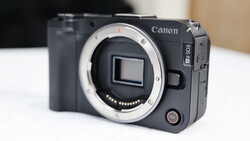
Canon’s EOS R6 Mark III mirrorless camera jumps the 6 series into serious hybrid territory with a higher-resolution sensor, deeper buffer, and far stronger video tools. If you shoot everything from indoor events to fast outdoor action and want one body to cover most jobs, this kind of leap changes what you can reasonably expect to capture.
Coming to you from Dustin Abbott, this thorough video breaks down how the Canon EOS R6 Mark III mirrorless camera evolves from the earlier R6 bodies rather than just nudging a few specs. Abbott walks through the familiar Canon layout, the three control dials, joystick, and fully articulating 3" touchscreen, showing how little adjustment you need if you already shoot Canon. The grip gets specific attention: the body is a bit wider, which gives your knuckles space when larger lenses are mounted, so you are not pinched against the mount. Abbott calls out the move to a full-size HDMI port, flap-style doors over the ports, USB-C for data, power, and streaming, plus mic, headphone, and remote jacks that make the camera ready for rigged video. The dual card slots, now CFexpress Type B plus UHS-II SD instead of two SD slots, underpin the much deeper buffer rather than just serving as backup storage.
Autofocus and speed are a big part of why this body feels like a real step forward rather than a mild tweak. The Dual Pixel system covers the frame, tracks subjects as they move toward the edge, and now has enough processing power to keep up with demanding tracking sequences instead of bogging down after a short burst. You can run 12 fps with the mechanical shutter for standard work, or push to 40 fps electronic when you want to treat a moment like a short clip and choose the exact frame later. Buffer depth jumps to around 150 full-size raw files at 40 fps, and a pre-capture mode records about half a second of action before you fully press the shutter, which matters when you are following unpredictable motion. The in-body stabilization is rated up to 8.5 stops with lenses like the Canon RF 24-105mm f/2.8 L IS USM Z, and Abbott even shows a 1-second hand-held shot at 200mm with a Canon RF 70-200mm f/4 L IS USM, which gives you a real sense of how aggressive the stabilization can be in practice.
Key Specs
-
Canon RF mount with 35.9 x 23.9 mm full frame CMOS sensor
-
32.5 megapixels (6,960 x 4,640)
-
Sensor-shift 5-axis image stabilization, rated up to 8.5 stops with compatible lenses
-
Continuous shooting up to 40 fps electronic, 12 fps mechanical
-
Mechanical shutter rated for 500,000 actuations
-
Native photo ISO 100 to 64,000 (expandable 50 to 102,400)
-
7K internal recording in 12-bit raw and high-bitrate 10-bit formats
-
Oversampled DCI and UHD 4K up to 60 fps, and 4K up to 120 fps
-
Dual card slots: 1x CFexpress Type B and 1x SD/SDHC/SDXC (UHS-II)
-
Full-size HDMI, USB-C (USB 3.2), mic and headphone jacks, remote port, Wi-Fi 5, Bluetooth 5.0
-
0.5" OLED EVF with 3,686,400 dots and 3" articulating touchscreen LCD with 1,620,000 dots
-
Uses 1x Canon LP-E6P battery, rated for about 620 shots
Abbott also spends time on how the sensor behaves rather than just reading the numbers. He runs controlled dynamic range tests by underexposing and overexposing a test setup, then recovering the files to show you where detail and color hold and where things fall apart. The pattern is clear: shadow recovery is strong up to several stops, while heavy overexposure loses highlight texture faster, so biasing exposure slightly dark gives you more safety in tricky light. High ISO tests move through 800, 3,200, 6,400, and into the top end of the native range, so you see where shadow noise, lifted blacks, and color blotching start to intrude instead of guessing from a spec sheet. Abbott then shows real-world samples, including work with the new Canon RF 50mm f/1.4 L VCM, to give you a feel for color, contrast, and background rendering in actual scenes instead of only charts.
On the video side, the review walks through why the R6 Mark III feels closer to a compact cine tool than a stills camera with a few extras. You see the 7K open-gate mode that uses the full sensor area for flexible reframing, oversampled 4K modes that trade some file size for cleaner detail, and 4K 120p for slow motion when you do not need oversampling. Canon’s old 29:59 recording limit is gone here, so practical limits become card space, batteries, and heat, and Abbott points out that typical 4K modes run long before any thermal issues appear. He also shows how C-Log 2 and Log 3, focus breathing compensation, user LUT upload, and a video pre-record option give you more control in-camera if you want to move faster in post without giving up grading flexibility. Check out the video above for the full rundown from Abbott.




Join the Fstoppers community for free
-
Post comments and join in the discussions
-
Browse the site ad-free
-
Share your work and get featured in the community
-
Compete in the photo contests for fun and prizes
2 Comments
Recheck sensor dimensions. All other Canon FF sensors are 24X36mm. Sony/Nikon sensors are 23.9X35.9mm.
It's 35.9 x 23.9: https://www.canon.ge/cameras/eos-r6-mark-iii/specifications/