

Next to the very popular nifty fifty, the 85mm prime is the most accessible fast prime lens for photographers who want to get into portrait photography without having to spend so much immediately. This redesigned 85mm from Viltrox 85mm f/2 EVO just might change things.
Viltrox has definitely been changing the third-party lens game this past year by making everything either more compact or more affordable, even if it means going against certain norms. Doing so seems to have required rethinking and redesigning what most of us have gotten used to for the sake of innovation. This new lens seems to be the redesign of the beloved 85mm lens that many photographers know and love.
The Viltrox 85mm f/2 EVO
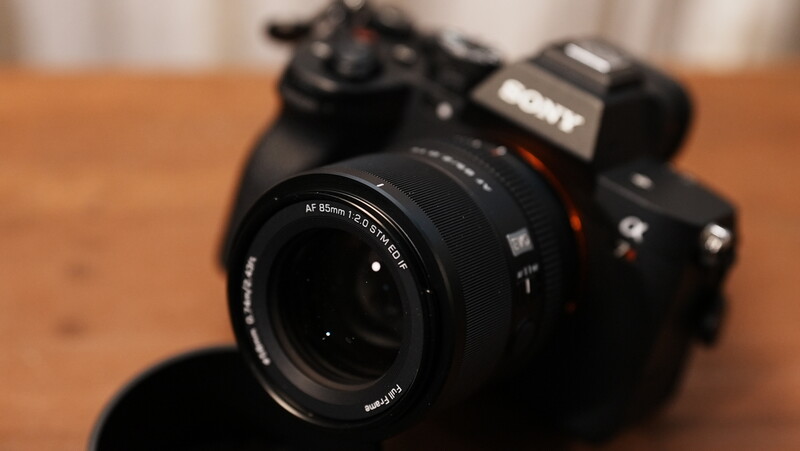
Most 85mm f/1.8 entry-level primes from the main camera brands aren’t significantly large but aren’t the most subtle lenses either. The new Viltrox 85mm f/2 EVO comes in a surprisingly compact size of just 80 x 69 mm with a 58 mm filter diameter and weighs just 383.8 grams.
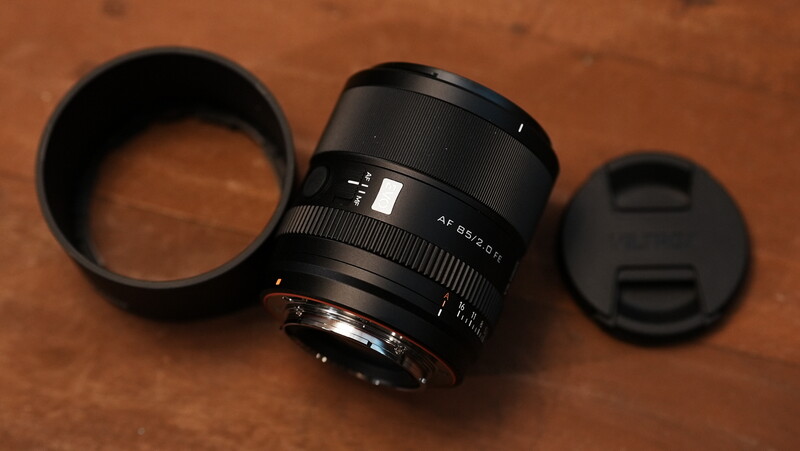
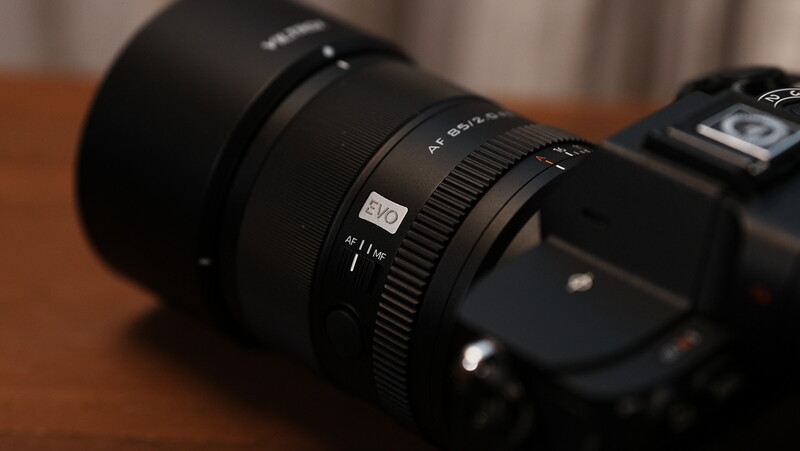
It comes with a reversible lens hood on the very front, followed by a 22 mm focus ring made of metal with a rough texture for better grip. Unlike the recent Air lenses from Viltrox, this one comes with more physical features for added control and efficiency. It has a customizable button on the side right next to a physical autofocus switch. Beside it is a noticeable silver EVO line badge. On the other side is a switch to turn off the click of the aperture ring, suggesting that this lens was also optimized for video recording.
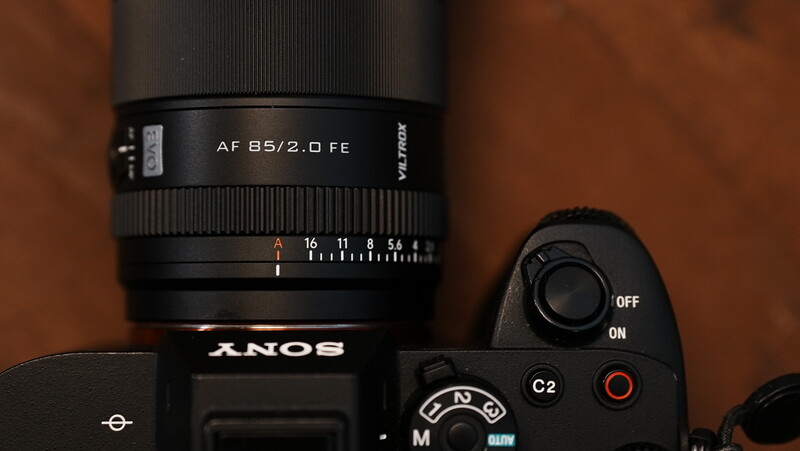
On the most distal end is a physical aperture ring with stops ranging from f/2 to f/16, along with an extra stop for “A,” which sets the aperture adjustment to an assigned dial on the camera body. Right at the bottom of the metal lens mount is a USB-C port for future firmware updates and calibration.
First Impressions
Upon first opening the box, it was apparent that this is clearly an 85mm that is more compact than the usual 85mm f/1.8. It’s not overwhelmingly small as a lens but is definitely less bulky than other existing 85mm lenses on the market. It’s a little bit shorter and thinner than the Sony 85mm f/1.8 and even the Nikon 85mm f/1.8 lenses but comes with more physical features than the latter “basic” lenses.
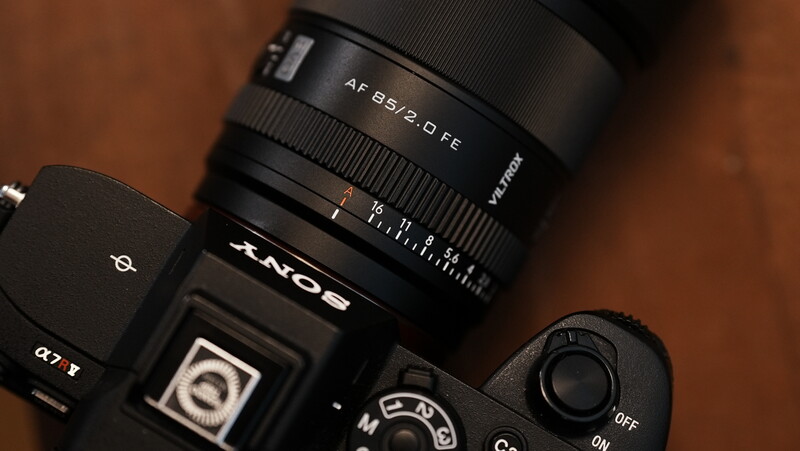
This more “evolved” design includes a physical aperture ring, which gives the user more options for control and is more friendly to videographers who change their openings in the middle of recording. It also comes with a customizable button that not all lenses at this price point have and even switches for autofocus and removing the clicks on the aperture ring. It comes with Viltrox’s minimum standard lens filter size of 58 mm. Even though the barrel has an even smaller diameter, the 58 mm filter size is definitely more available in the market, making it more practical, especially for use interchangeably with other similarly sized lenses.
Application: Portraits
Portrait photography is the most obvious use case for an 85mm prime, especially for those who are using full frame camera bodies. The first question one might ask about this new lens is whether the one-third-stop difference in the maximum aperture would have large implications compared to the usual f/1.8 opening. In terms of exposure, this one-third-stop difference has a very minimal impact, and any changes in how one would expose their images can easily be compensated for by an increase in ISO. Especially with ISO invariance in mind, the slight increase in ISO makes very little difference in noise overall. There wouldn’t be much difference in output, but there is definitely a significant difference in the physical build of the lens.

In terms of bokeh, both f/1.8 and f/2 don’t usually give you overwhelmingly creamy bokeh but will still definitely get the job done for background (and foreground) blur.

Despite the build, this lens seems to have been optimized for shooting wide open. Upon testing, sharpness is at its peak within the range of f/2 to f/5.6, and anything at f/8 onward slightly suffers from diffraction. There is a very subtle and minimal vignette at f/2, which disappears at around f/2.8, so it’s not even a cause for concern.

One notable aspect of this lens is the autofocus. In a scene with abundant light, it focuses really well and even works well with autofocus tracking, subject recognition, and eye AF features on a Sony camera.

However, this performance changes in indoor scenes, especially in low light situations. The autofocus is still fast and accurate in still or posed subjects but can miss whenever the subject is moving. This might have some implications depending on whether the person being photographed is posing for the camera or is in constant motion, such as in concerts or events. Regardless, this is nothing that good lighting won’t solve.
Other Applications:

Upon first seeing the lens, the initial goal was to test it out on other use cases aside from portrait photography, though admittedly it inevitably circled back to it. With street photography as my recent obsession, I wanted to see if this more subtle 85mm would have its benefits—and it clearly did, because the compression allows me to emphasize and capitalize on geometry that I can find around. It works well on distant, compressed compositions but, just like in shooting portraits, it can have some missed focusing in low light.

This lens can also be quite functional in photographing still life. It has a minimum focusing distance of about 65.5 cm, and while that is quite far, it is still closer than other similar lenses that have an MFD of around 80 cm. It can be useful for photographing entire medium- to large-sized objects such as food or products where no macro is necessary.
Of course, another related use case would be video, which can be quite comparable to shooting portraits with this lens. The manual aperture ring, as well as the ability to turn off the clicks, makes it even more versatile for video use, and the continuous autofocus is, as previously mentioned, quite capable in good light.

Conclusion
Overall, an 85mm f/2 lens in this shape and form is rather impressive, especially factoring in the optical performance. Viltrox’s recent lenses seem to have prioritized image quality in combination with portability. While not significantly different in performance from existing 85mm f/1.8 entry-level primes, it has many benefits considering the size, physical features, and especially the price.
What I Liked:
- Compact 85mm prime
- Good optical performance
- Affordable price tag of $275
What Can Be Improved:
- Low-light focusing




Join the Fstoppers community for free
-
Post comments and join in the discussions
-
Browse the site ad-free
-
Share your work and get featured in the community
-
Compete in the photo contests for fun and prizes
1 Comment
I am thinking about getting a 80mm since I sold my 85mm 1.4. I was looking at the samyang 75 1.8 and the tt artisan 70mm 2.0 so now I have a third option. Who's going to do the side by side.
After checking some reviews this seems to be a better performer.