Big hybrid cameras live or die on the small stuff: the screen you trust, the shutter mode you actually use, and whether the files stay consistent when you rotate the body. If one of those breaks your rhythm, you stop chasing moments and start wrestling settings.
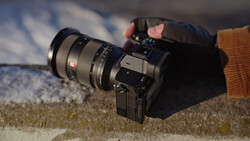
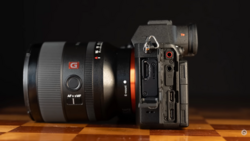
Coming to you from Pierre T. Lambert, this rain-soaked, opinionated video puts the Sony a7V mirrorless camera through real use instead of a clean studio checklist. Lambert opens with a long-standing annoyance that finally disappears: the camera’s color and tone no longer shift when you flip from horizontal to vertical. That sounds minor until you’ve tried to match a set of street frames later and wondered why the “same” scene keeps drifting. He also spends time on the new rear screen, not as a spec brag, but as a field problem solved: the display finally looks sharp enough that you can judge results without squinting or second-guessing. Expect less theory and more “here’s what changed when I got drenched and kept shooting” from the streets of Los Angeles.
A big thread is speed without the usual electronic shutter penalties, and Lambert stays practical about it. He describes the new partially stacked sensor behavior in plain terms: less rolling shutter distortion when panning, so the silent shutter becomes a default option instead of a compromise. He still flags flicker as a reason to keep mechanical shutter available, and he notes a durability bump in the shutter rating compared to the older Sony a7 IV, which matters if you shoot high volume. Where the video gets more interesting is his take on “good enough” image quality: dynamic range is strong, high ISO holds up, and the bigger gains are about how confidently you can shoot fast features without worrying that the files will be warped.
Key Specs
-
Lens mount: Sony E
-
Effective resolution: 33 Megapixel (7008 x 4672)
-
Sensor: 35.9 x 23.9 mm full frame partially stacked CMOS
-
Image stabilization: sensor-shift, 5-axis
-
ISO (photo, manual): 100 to 51,200 (50 to 204,800 extended)
-
Burst: up to 30 fps (electronic shutter)
-
Video (internal): XAVC HS/H.265 10-bit, UHD 4K up to 120 fps (crop in select modes)
-
Card slots: CFexpress Type A / SDXC (UHS-II) + SD (UHS-II)
-
Wireless: Wi-Fi 6, Bluetooth 5.3
-
Screen: 4-axis tilting 3.2" touchscreen LCD
Lambert’s most useful section is where the camera starts acting like a “borrowed” sports body without forcing you into a niche setup. He talks about pre-capture and 30 fps raw bursts as the feature that changes your hit rate on unpredictable action, especially wildlife, with a clear explanation of how buffering buys time. You also hear the downside: the feature stack can get fiddly, and the camera’s logic around switching shutter modes and keeping pre-capture enabled is not as clean as it should be. That critique lands because it’s not abstract menu whining; it’s about missing a moment because one hidden toggle didn’t come along when you hit a speed mode button. He suggests firmware could fix it, and he describes the current workaround without turning it into a tutorial, which keeps the video worth watching.
There’s also a real-world durability note you rarely get from first-look videos: Lambert shoots through heavy rain for a long stretch and says the camera keeps working, which is the kind of stress that exposes weak weather-sealing fast. He pairs it with an everyday benefit: improved power management on the same battery system, so you stretch a day without changing your kit habits. You also get a quick reality check on autofocus: it’s better, it handles obstacles well, and it still won’t rescue sloppy settings. Check out the video above for the full rundown from Lambert.



Join the Fstoppers community for free
-
Post comments and join in the discussions
-
Browse the site ad-free
-
Share your work and get featured in the community
-
Compete in the photo contests for fun and prizes
3 Comments
Fast review but why not for so much in the camera! Ok about the menus complaining will continue no matter what like it is a main complaint since the beginning of the Sony cameras, it will never end, so many choices so little time.
I advice to buy the big book of 600+ pages on the camera and practice some of the tricks/results, the deal is learn as much as you think you will ever want to do for so many genres to stuff into a little black box.
I beg most to look back to the first A7/r/s count what was and now not, on camera apps (few ever knew about even the reviewers) you could do so many things that today you need external tools also remember the panorama icon on the dial may not be as good as a rig but did what you wanted. basically you have to give a little to get more!
Also not mention when the A7M3 came out with ISO invariance is it gone or still there, or is bright monitoring gone or still there on your thrash can night astro capturers will want to know.
More fun with a Sony
Cool technique but not my territory. Thinking about it it bothers me that other issues aren't addressed since version of the a7.
As a portrait on location photographer I need playback with blinking over exposure in full screen, and not in a tiny 20% corner of a level mode.
In the real working situations you want to check the image as a whole in 1 second: eyes opened, expression, composition exposure. And you don't want to ask your model to wait a few seconds because I need to scroll trough my different modes. I really, really don't get why Sony doesn't fix this/ Canon had it in the first eos5d already.
And no, zebra's don't fix this. I'm talking about flash here.
I always wonder how it was done before digital. I still use a light meter if it matters.