
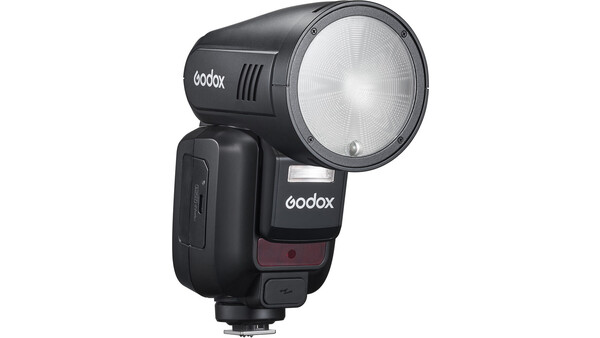
Godox has built a reputation for delivering capable and affordable lighting, with flashes like the Godox V1 and Godox AD200 becoming go-to workhorses for countless photographers. But with every new product, the question arises: is it just a minor spec bump or a genuine leap forward? The new Godox V100, the company’s flagship on-camera flash, arrived promising two major advancements: a significant power increase to 100 Ws and a modern touchscreen interface. Is that enough to make it worth an upgrade?
Taken together, the features aim to address the core needs of photographers who require a versatile on-camera light that can handle everything from fast-paced events to portrait sessions. I took a closer look to see if the V100’s performance and usability live up to its impressive spec sheet.
Build and Design
From the moment you pick up the V100, it’s clear this is a premium strobe. The build quality is solid, with a sleek design that looks professional. It weighs 619 grams with its battery, which is hefty but not overly burdensome once it’s on the hot shoe. The most prominent feature is the large and vibrant touchscreen on the back, which immediately sets it apart from the button-and-dial interfaces of its predecessors.
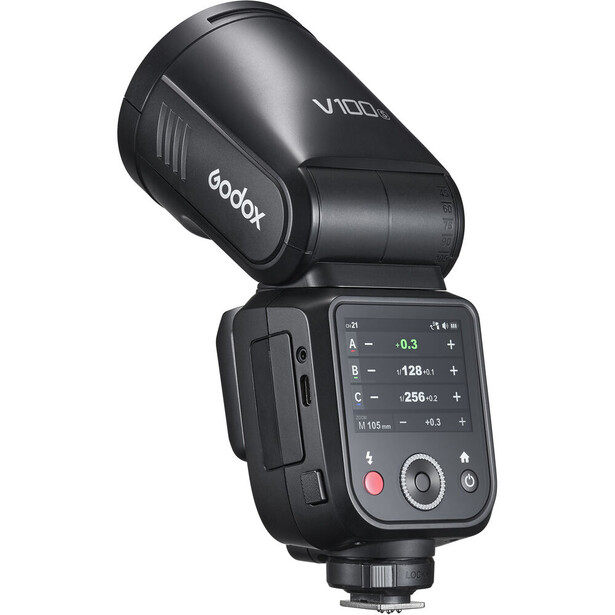
Godox has redesigned the hot shoe, and I like the new design, as it appears a bit more rugged. This is a welcome change for anyone who has experienced the frustration of a broken or malfunctioning hot shoe mount on past models. While I did not run into the same degree of issues with the old shoe design, I was also using my gear in a slower-paced studio-shooting environment. While long-term durability is yet to be proven, the new design (and attention paid to this part) inspires confidence.
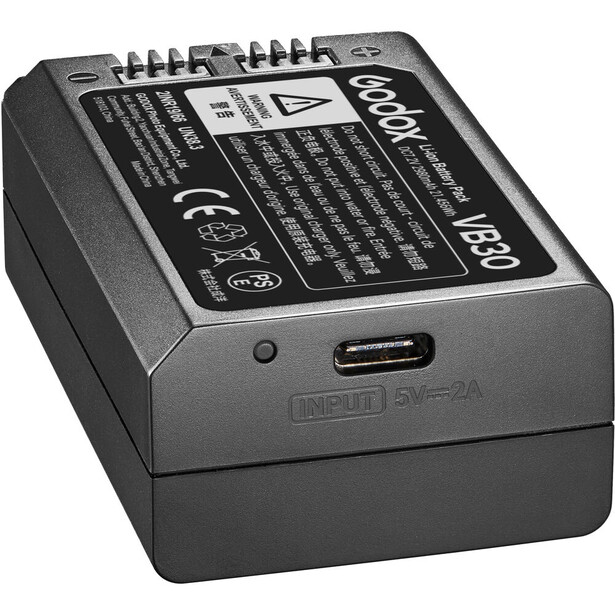
Perhaps the most practical new design choice is on the VB30 lithium-ion battery. It can be charged directly via a built-in USB-C port, reducing the need for the proprietary charging dock of previous battery models. The ability to top up a battery from a power bank, laptop, or standard USB-C wall adapter is a massive quality-of-life improvement for anyone working on location.
Power and Performance
The headline feature of the V100 is its 100 Ws power output. This represents a meaningful increase over the 76 Ws found in models like the V1 and Godox V860III. For event photographers in unaccommodating and dark venues, it means more reach and the ability to maintain lower ISOs. For portrait shooters working outdoors, it offers more juice to open up shadows or shape light through slightly larger modifiers than you would expect from a hot shoe strobe.

This extra power is paired with good thermal management. Godox claims the V100 can fire between 70 and 100 consecutive full-power flashes before its thermal protection engages. For photographers covering extended action sequences, this means the flash is far less likely to slow down or shut off at a critical moment. The full-power recycle time is a still-respectable 1.7 seconds, but at the partial power levels used more commonly, recycling feels basically instantaneous.
For those with flagship global shutter cameras, such as the Sony a9 III, the V100 is also compatible with this new tech. This allows for flash synchronization at shutter speeds up to an astounding 1/80,000 of a second, opening up new creative possibilities for freezing motion in brightly lit environments.
The Touchscreen Interface
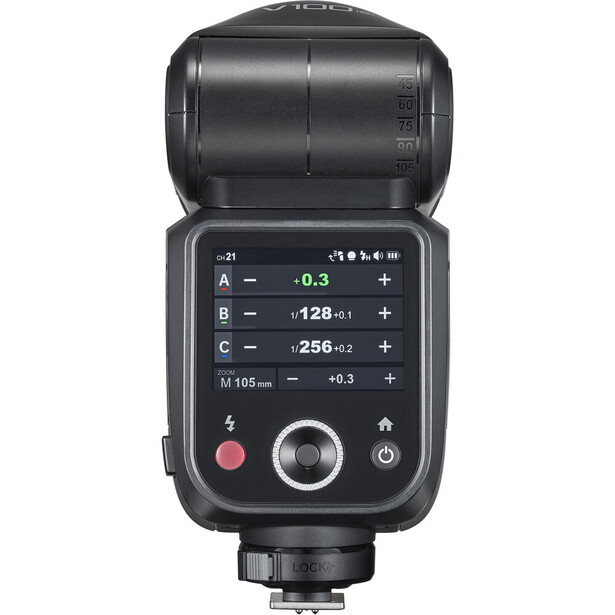
The move to a touchscreen interface can be divisive (just see the debate over touchscreens in cars), but Godox has implemented it well here. The screen is responsive, and the menu system is largely intuitive. Basic operations are fluid and reminiscent of other good touchscreen UIs, with only a little bit of a learning curve. Swipe gestures give you quick access to the key controls photographers would want: power, settings, flash modes. Power, scrolling, and flash testing all get dedicated manual buttons.
While photographers accustomed to the muscle memory of physical buttons may need a shoot or two to adjust, the visual interface is easy to grasp. Overall, the extra functionality enabled by the touchscreen outweighs concerns over muscle memory, particularly for flash workflows that are set-and-forget.
Features and the Godox Ecosystem
The V100 comes with a small, detachable sub-flash designed to provide a catchlight or a touch of direct fill when the main head is bounced. It’s an interesting idea, but I did not find myself too excited to use it. Manually setting its power for every shot is unfeasible in dynamic shooting environments, so TTL support would be a big win in a future model.
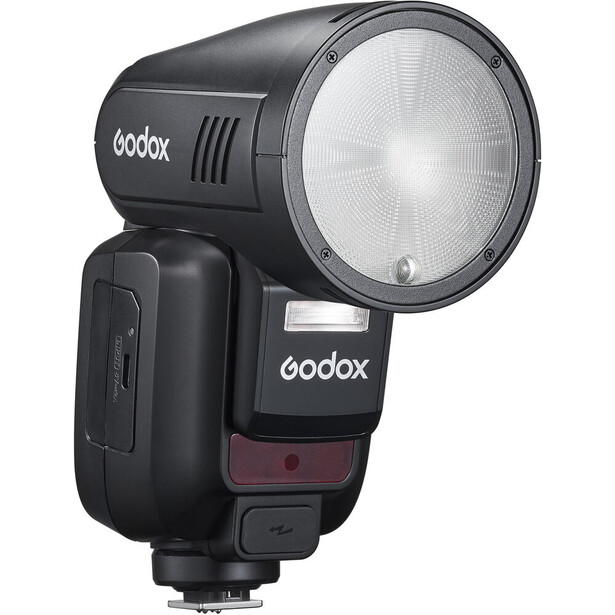
Off-camera, the V100 excels. It integrates perfectly into Godox’s well-established 2.4 GHz wireless system, functioning reliably as a receiver unit. It can be controlled from any Godox X-series trigger or another flash set to master mode. This versatility only adds to the V100’s value, and the 100 Ws output makes it a credible source for use on a stand at a bit of distance or through a modifier.
Overall, it’s clear the Godox V100 is more than just an incremental update. The combination of class-leading 100 Ws power, robust thermal performance, and the convenience of USB-C charging makes it a great option for active photographers. While the sub-flash feels underdeveloped, that does not detract from the flash’s outstanding core performance.
For event, wedding, and portrait photographers who need a powerful, reliable, and versatile flash that works seamlessly both on and off camera, the V100 presents a compelling package. It’s a modern, powerful light and yet another great entry in Godox’s flash ecosystem.
The Godox V100 is available for purchase now for Canon, Fujifilm, Nikon, Olympus, and Sony.
What I Liked
-
Class-leading 100 Ws of power provides flexibility for a strobe
-
Excellent thermal performance keeps up during intense shooting situations
-
Direct USB-C battery charging is a great convenience
-
The large, responsive touchscreen is good looking and intuitive to use
-
Seamless integration with the robust Godox wireless ecosystem
-
Global shutter sync support provides future-proofing for high-end cameras
What Could Be Improved
-
The detachable sub-flash needs TTL support to be truly useful in dynamic environments
-
Long-term durability of the new hot shoe design needs to be proven by time
Join the Fstoppers community for free
-
Post comments and join in the discussions
-
Browse the site ad-free
-
Share your work and get featured in the community
-
Compete in the photo contests for fun and prizes
10 Comments
Is this the V100 that was released in 2024? You make it sound new, but I nonetheless agree that it is a very. strong speedlight that needs a physical on/off switch for touchscreen
By physical on/off, are you referring to like a lockout to disable touch input?
I tried one and simply could not get to use high-speed sync on my Sony. Tried everything, too. Including reaching out to Godox. No luck. Sent it back. Still can't figure out what I was missing, if anything.
That's too bad. What body were you using it with?
A1 II. And an A7CR. Didn't work with either of them.
Back in my very early days with my Sony A7SM1 and only having the original flash HVL-F20M and using my first telephoto the FE 24-240mm F3.5-6.3 OSS in 2015 i was on my brother in laws farm where there had to be hundreds of Hummingbirds flying about and every since I view flashes reviews and they have gotten so good. Tracking anyone in free flight away from a feeder is like tracking butterflies.
Over the years I learned about traps and very fast SS's where not just two or three flashes are used but like five and the photographer sitting for hours in a blind or even from a kitchen window and viewing the action on a pad or computer wirelessly.
It is a hobby where some travel many thousands of miles or flying to get the rare ones.
It is one photography sport/genre seldom heard of or covered in flash reviews. But with the many used it would be a good multi sell! just saying!!!
# 1 and 2 both using the A7S with #1 using Flash and #2 no flash and hand held tracking, all photographers love a challenge.
In what world is an increase from 76WS to 100WS a "a significant power increase"? It's 24WS or not quite 1/3 power increase meaning not quite 1/3 stop. Marginally noticeable.
The round head is a nice feature and may lead to more efficency though.
It's about a 15% increase in range, which can matter for both bounce flash and big modifiers. It's not an AD200, but it also fits on top of your camera.
I don't get what kind of reviews are these when theres a bunch of words and ONE image as an example...and its the most generic food plate which btw is lit terribly. Where are the photo studio shots, whats it like for street photography, car photography, wedding/events?
We can all read the brochure that comes with it.
I'm not sure about the compatibility with global shutter cameras claim. On the A9iii it certainly doesn't work the same as the native sony flashes that are compatible where you can just dial in whatever shutter you like. Over 1/500 you need to make the same flash timing adjustments you have to dial in with any other strobe / flash - I wasn't really sure what functionality they have added to make that claim and sent mine back. I know other sony A9iii users have said the same.