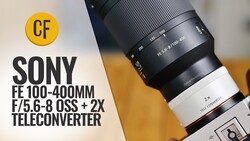
The Sony 100-400mm f/5.6-f/8 costs $850, roughly a fifth of the price of the pricier 100-400mm f/4.5, and that number tells you almost everything about the tradeoffs waiting inside. Whether you shoot wildlife, travel light, or just want the long end covered without emptying your bank account, the question is what those savings actually cost you in the field.
The full teardown comes from Steve Perry, who tests the third of Sony's 100-400mm lenses against its more expensive sibling, the Sony 100-400 f/4.5. Perry starts with the obvious wins: size, weight, and price. He adds a less obvious one that anyone shooting fast-moving subjects will recognize. A small lens keeps you mobile, and he demonstrates this with raccoons popping up unpredictably over a boardwalk, forcing him to spin and reacquire in a second or two. A 400mm f/2.8 would have been dead weight in that situation.
Then comes the elephant in the room. Perry points out that despite the f/5.6 to f/8 label, the lens hits f/8 right around 205mm, which means wildlife work at 200 to 400mm is effectively an f/8 lens. On one overcast evening in the woods, he was pinned between ISO 6,400 and 12,800 at shutter speeds of 1/320 to 1/400 s, and the motion blur piled up. He walks through the compounding problem that follows: 400mm often comes up short for wildlife, so you crop, but high ISO noise overwhelms fine detail exactly when your subject is smallest in the frame. Low light is where this lens becomes a real fight, and Perry is honest about how much he struggled with it.
The sharpness comparisons hold surprises in both directions. The center stays strong and usable across the range, and one close-focus result at 100mm falls apart so badly in the corner that Perry warns you outright to keep it away from flat copy work like photographing artwork. At normal working distances, the corners recover well, and his real-world foliage shot at 100 feet looks clean into the extreme edges. The autofocus outpaced both siblings by a tenth of a second in his testing, tracking gulls in flight shot after shot, though hit rate dipped noticeably in dim light. There's more on teleconverters and stabilization in the video, and the f/8 background comparison is worth seeing for yourself.
If you're weighing this against the used market, the math shifts in interesting ways. Sony's a7-series bodies keep climbing in resolution, and the temptation is to treat a high-megapixel sensor as a free teleconverter, buy the cheap lens, and crop to 600mm. Perry's low-light findings are the counterweight to that plan. Cropping only works when your base ISO stays low, which means bright, open conditions where the noise floor is nowhere near your detail. Match this lens to shooting situations, not just to a wish list. Deep woods at dusk, distant songbirds, and anyone chasing edge-to-edge sharpness for prints do not favor the lens. That framing turns an $850 lens from a compromise into a specialist tool, and knowing which shoots it belongs on is the whole game.
Perry lays out four clear buyers: anyone who can't justify more than $850, anyone boxed in by airline weight limits, travelers who want a long lens just in case, and landscape shooters who want the 100-400mm range without hauling something heavy on a long hike. He's equally direct about who should walk away. Low-light regulars, photographers who can't fill the frame at 400mm, and anyone who needs corners as sharp as the center will all find this lens frustrating.
The teleconverter results were the part that genuinely caught him off guard. With the Sony 1.4x teleconverter attached, the lens hits 560mm at f/11 and holds up better than he expected, giving a very slight edge over simply cropping the bare lens. He even ran the Sony 2x teleconverter to 800mm at f/16, and while he's clear he'd never actually shoot wildlife at f/16, the center detail survived better than the aperture suggests. Whether that stretch is worth attempting in your own shooting depends entirely on the light you tend to work in.
Watch the review above to see the side-by-side sharpness crops and decide whether Perry's real-world samples make the $850 price make sense for the way you shoot.



Join the Fstoppers community for free
-
Post comments and join in the discussions
-
Browse the site ad-free
-
Share your work and get featured in the community
-
Compete in the photo contests for fun and prizes
No comments yet