Focus stacking has become close to a default step in landscape work, with plenty of people blending 20 or even 50 frames so every rock and grass blade is sharp from front to back. Whether that effort shows up in the final image, or whether a single frame focused at the hyperfocal distance would look the same, decides how much of your time goes into focus while the light keeps changing.
The belief that every landscape needs a stack has a traceable history, and Michael Scott of ScottymanPhoto walks through where it came from. Sensors kept getting sharper, and expectations climbed right along with them. Phones played a part too. Their small sensors produce huge depth of field, so a casual snapshot of a close foreground and a distant mountain looks sharp throughout with no particular skill involved. Photoshop then made blending nearly automatic, and a large community of tutorials taught everyone how to do it. Scott still stacks when a scene calls for it and is clear that he isn't picking a side between techniques. His question is simpler: if one frame does the job, why spend the extra time?
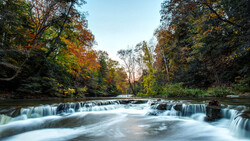
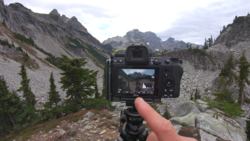
Part of his argument comes from how you actually look at a scene in person. Fix your eyes on the rocks at your feet and the distant ridge goes soft. Look up at the ridge, and the rocks blur. People viewing a print or a screen do the same thing, moving back and forth between near and far. Lens choice shifts the equation as well, since shorter focal lengths give you more depth of field than longer ones. An ultra-wide or a moderate wide angle can often hold a close foreground and the horizon in a single frame, and stepping back from the foreground buys even more. In one example shot that morning, he framed a couple of foreground rocks against a distant background at 32mm, focused at the hyperfocal distance, and got the rocks sharp enough without a second exposure.
Depth of field describes a range of acceptable sharpness, and the zone it covers isn't uniformly crisp. Scott judges sharpness by how an 8x10 print looks from about arm's length, and at that size nearly everything inside the zone reads as sharp. He says most of his own landscapes were made this way, either by focusing roughly a third of the way into the scene, by focusing at the hyperfocal distance, or by positioning himself so a stack wasn't necessary. You can also zoom into the rear LCD to check before you pack up.
Camera makers have spent the last several years building stacking into the camera itself. Nikon's focus shift shooting, Canon's focus bracketing on many EOS R bodies, Fujifilm's focus bracketing, and OM System's in-camera focus stacking all automate the capture, and Sony brought focus bracketing to its lineup with the a7R V. With the capture that easy, the decision now rests more on how the image will be used than on how much work it takes. Match your depth-of-field standard to the final output. That 8x10-at-arm's-length standard covers web posts and modest prints well. A large print that people will inspect up close calls for a stricter circle of confusion, which pushes the hyperfocal distance farther out and moves the near limit of sharpness back. Stopping down hard is the other common way to chase depth, but on high-resolution sensors, diffraction starts visibly softening fine detail past roughly f/11. Running those numbers before you shoot tells you whether a single frame will hold up at the size you plan to show it.
Conditions put limits on stacking too. When wind moves flowers and grass between frames, the blend falls apart no matter what software you use, and moving subjects in general break the method. The cracked desert floors that show up all over social media sit at the other extreme. Nothing in them moves, so dozens of frames blend cleanly in Photoshop, and those images are a big part of why so many people expect every landscape to be pin sharp.
Press play above to watch Scott use the augmented reality view in PhotoPills to find the hyperfocal distance on location.
Join the Fstoppers community for free
-
Post comments and join in the discussions
-
Browse the site ad-free
-
Share your work and get featured in the community
-
Compete in the photo contests for fun and prizes