Watch enough landscape videos and you start to believe the professionals walk out at golden hour and come home with a portfolio image every time. That belief shapes how you judge your own outings, and how hard you are on yourself when the sky catches fire and your card holds nothing you want to show anyone.
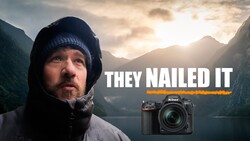
The afternoon starts with real promise: rain all day, a sky full of high cloud, and a clear gap to the west on the satellite imagery. With about an hour until sunset, William Patino loads a boat with waders and a thermos of coffee and heads along the south arm of a Fiordland lake, looking for a vantage point that faces the Murchison Mountains and the brightest part of the sky. The first obstacle has nothing to do with light. The shoreline is rocky and drops straight into deep water, so whole stretches offer nowhere to tie off a boat. While scouting from the water, Patino pre-visualizes how a small clearing will look once he's standing in it and turned around, with the little trees in his foreground. That habit of picturing the frame from the spot you haven't reached yet is one of the most useful things to borrow from watching him work, especially with a wide angle lens, where foreground decisions carry so much weight.
Parking the boat only gets him to a potential location. The actual scouting starts on foot, and it gets tricky fast. The islands are covered in dense forest, so wherever the trees are thick there's no opening to the sky, and wherever an opening appears, the trees vanish from the frame. A single plant with red berries catches his eye, but on its own it would look forced and pull attention away from the scene. He finds one window through the trees with a partial reflection in the lake, fires a few test frames with his 16-35mm, and bookmarks it to come back to. He admits he could have arrived earlier, though he finds that too much time leads him to overthink and get bored.
Most photo platforms now reward volume, and plenty of landscape shooters feel pressure to post something after every outing, even when the trip didn't produce anything they're proud of. A useful counterweight is a short debrief after each shoot, written while it's fresh. Note the location, the conditions, where you stood, what blocked the composition you wanted, and whether the spot deserves a second visit. Over a season, those notes turn a string of frustrating evenings into a map of which places work in which light, and which ones to cross off. It also gives you something concrete to take from a night with no keepers, which makes it easier to hold back a mediocre frame instead of posting it out of obligation. Landscape work has always involved returning to the same places many times, and a written record makes each return smarter than the last.
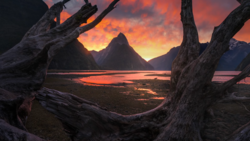
When the color finally arrives, Patino falls back on what he calls a safety shot: reflective pools in the foreground, open water behind them, and the pink sky overhead, taken at ISO 100, f/11, and 1/3 of a second. It frames the backdrop nicely, yet he says it's the kind of image he would have made 15 years ago. He tries one last composition with a branch arching over the scene before the light fades. Later, going through the raw files, he explains why a foreground element that rises above the horizon line closes the frame in and kills any sense of depth, and how simply getting higher would have let him look down and separate the layers. He also walks through the frame he liked most, with a backlit tree and color in the water, and the specific spot in the bottom of the frame that held it back.
Patino explains why he should have set up farther from the mountains, a mistake he spotted only on the boat ride home, in the last few minutes of the video.


Join the Fstoppers community for free
-
Post comments and join in the discussions
-
Browse the site ad-free
-
Share your work and get featured in the community
-
Compete in the photo contests for fun and prizes