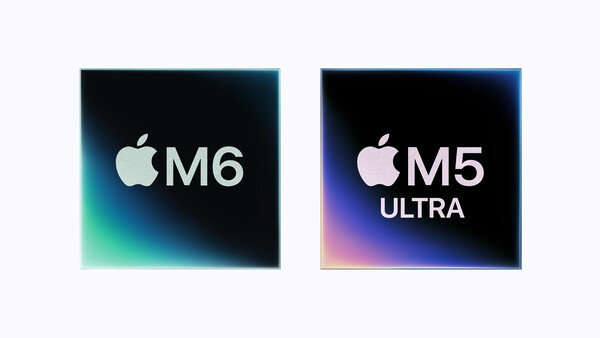
Apple has announced two new Apple silicon chips aimed at very different levels of desktop computing: M6 for the new Mac mini and M5 Ultra for the new Mac Studio. M6 introduces Apple’s first 2 nm chip design, while M5 Ultra uses a new quad-die architecture to push CPU, GPU, memory, media, and AI performance further at the high end.
Both chips place a particular emphasis on local AI processing, but the upgrades also have clear implications for more conventional creative workloads, including photo editing, video editing, rendering, visual effects, and other tasks that depend heavily on CPU, GPU, and memory performance.
M6: Apple Moves to a 2 nm Process
M6 is Apple’s first chip built using a 2 nm manufacturing process. Apple says the smaller process allows greater transistor density while improving both performance and power efficiency.
The chip uses a new 12-core CPU configuration, adding two cores compared with M5. It consists of two super cores, four performance cores, and six efficiency cores.
Apple says M6 delivers up to 1.2x faster multithreaded performance than M5 and up to 2.4x faster multithreaded performance than M1. The company also describes the new super cores as delivering the fastest single-threaded CPU performance available, though that claim is based on Apple’s own testing.
For photographers and other creators, CPU improvements remain relevant even as more applications move workloads to GPUs and dedicated accelerators. Apple specifically lists image editing, file indexing, code compilation, and AI workloads among the tasks that benefit from the new CPU.
A Larger GPU With Neural Accelerators
M6 also moves to a 12-core GPU, again adding two cores compared with M5. Each GPU core includes a Neural Accelerator for AI processing.
According to Apple, this produces nearly 30% more peak GPU compute for AI workloads than M5 and more than eight times the peak GPU AI compute of M1.
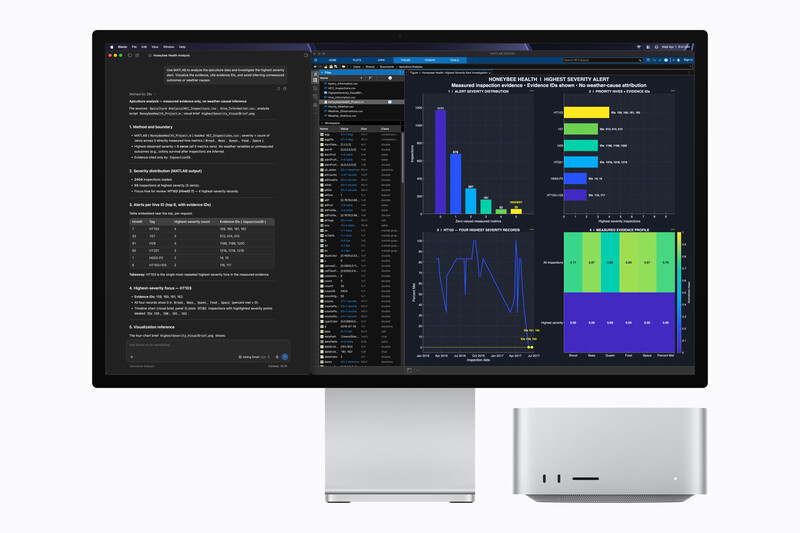
The GPU architecture also incorporates updates to Apple’s shader cores, Dynamic Caching, and hardware-accelerated ray tracing. Apple says geometry processing rates have increased by 50%, which should be particularly relevant to applications involving complex 3D scenes and graphics.
These changes are not limited to gaming. GPU performance increasingly affects creative software, including image processing, effects, denoising, upscaling, color work, 3D rendering, and AI-assisted editing tools.
Dual Neural Engines and More Memory Bandwidth
One of the more unusual changes in M6 is what Apple calls a Dual 16-core Neural Engine. Rather than relying on a single Neural Engine, the chip incorporates two 16-core engines that supported system frameworks can use simultaneously.
Apple claims up to twice the peak Neural Engine compute of previous generations.
M6 supports up to 32 GB of unified memory and provides up to 170 GB/s of unified memory bandwidth. That represents a 10% increase over M5 and 2.5x the bandwidth of M1, according to Apple.
The 32 GB memory ceiling will naturally separate M6 from Apple’s higher-end desktop chips for users working with especially large photo libraries, complex video timelines, large 3D scenes, or substantial local AI models. Still, the increased bandwidth should help the CPU, GPU, and other parts of the chip access shared data more quickly.
M6 Key Specifications
- Built using a 2 nm process
- 12-core CPU
- Two super cores
- Four performance cores
- Six efficiency cores
- Two additional CPU cores compared with M5
- Up to 1.2x faster multithreaded CPU performance than M5, according to Apple
- Up to 2.4x faster multithreaded CPU performance than M1, according to Apple
- 12-core GPU
- Two additional GPU cores compared with M5
- Neural Accelerator in each GPU core
- Nearly 30% higher peak GPU compute for AI than M5, according to Apple
- More than eight times the peak GPU compute for AI of M1, according to Apple
- Updated shader core architecture
- Dynamic Caching
- Hardware-accelerated ray tracing
- 50% higher geometry processing rates
- Dual 16-core Neural Engine
- Up to twice the peak Neural Engine compute of previous generations, according to Apple
- Up to 32 GB of unified memory
- Up to 170 GB/s of unified memory bandwidth
- 10% more unified memory bandwidth than M5
- 2.5x the unified memory bandwidth of M1
M5 Ultra Introduces a Quad-Die Architecture
M5 Ultra occupies a very different position. It is designed for the Mac Studio and for workloads that can use substantially more CPU cores, GPU cores, and memory than M6 provides.
The major architectural change is Apple’s move to a quad-die configuration.
M5 Ultra uses UltraFusion to connect two dual-die M5 Max chips. The result is four dies operating as a single system on a chip. Apple says the latest UltraFusion implementation provides more than 4.4 TB/s of inter-die bandwidth and more than six times the connection density of the previous implementation.
The goal is to allow the four dies to behave as a unified processor rather than forcing applications to manage separate processors or memory pools.
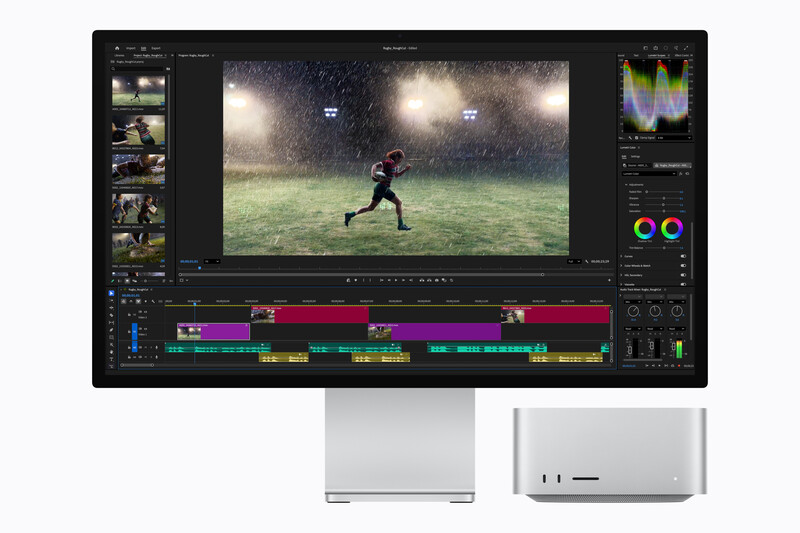
Up to 36 CPU Cores
M5 Ultra offers up to a 36-core CPU consisting of 12 super cores and 24 performance cores.
Compared with M3 Ultra, Apple claims up to 1.25x higher single-threaded CPU performance and up to 1.3x higher multithreaded CPU performance.
That combination is intended for demanding professional workloads such as 3D rendering, visual effects, scientific computation, and local AI processing, but the additional CPU resources can also benefit traditional photo and video workflows where applications can effectively distribute work across many cores.
An 80-Core GPU With Dedicated AI Hardware
The M5 Ultra GPU can be configured with up to 80 cores, with a Neural Accelerator built into every GPU core.
Apple says this produces up to 4.5x the peak GPU compute for AI of M3 Ultra and more than six times that of M1 Ultra.
The GPU also receives Apple’s latest shader architecture, second-generation Dynamic Caching, hardware-accelerated mesh shading, and third-generation hardware-accelerated ray tracing.
Apple claims graphics performance is up to 40% faster than M3 Ultra.
These improvements should matter beyond AI workloads. Video effects, 3D rendering, motion graphics, GPU-accelerated image processing, noise reduction, and other computational photography and video tools can all benefit from additional GPU throughput when the software is optimized to use it.
Up to 512 GB of Unified Memory
One of the most significant specifications for M5 Ultra is its memory system.
The chip supports up to 512 GB of unified memory with up to 1.2 TB/s of memory bandwidth. Apple says that represents 50% more memory bandwidth than M3 Ultra.
Because Apple silicon uses a unified memory architecture, that memory can be accessed by the CPU and GPU rather than being divided into conventional system RAM and dedicated graphics memory.
That capacity will be particularly notable for workloads involving very large datasets or AI models. Apple says the system can hold large language models with hundreds of billions of parameters entirely in local memory.
For creative professionals, the same underlying advantage applies to applications that need to keep substantial amounts of image, video, 3D, effects, or computational data readily accessible.
Video Gets Dedicated Hardware
M5 Ultra also includes a more capable Media Engine, an area that may be more immediately relevant to working video professionals than some of the chip’s AI specifications.
The Media Engine includes dedicated hardware for H.264 and HEVC along with four ProRes encode and decode engines. Hardware-accelerated AV1 decoding is also included.
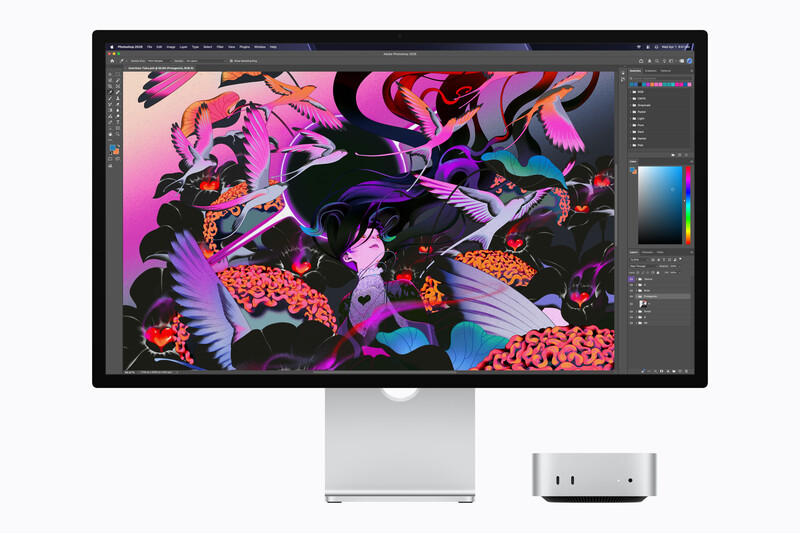
Dedicated media hardware can reduce the amount of general-purpose CPU and GPU processing required for supported video formats, making it particularly useful for high-resolution editing and other workflows involving multiple streams of compressed footage.
Apple is specifically positioning M5 Ultra for high-resolution video editing in addition to 3D rendering, visual effects, scientific workloads, and local AI.
M5 Ultra Key Specifications
- Quad-die architecture
- Built by connecting two dual-die M5 Max chips using UltraFusion
- More than 4.4 TB/s of inter-die bandwidth
- More than six times the UltraFusion connection density
- Up to 36-core CPU
- 12 super cores
- 24 performance cores
- Up to 1.25x higher single-threaded CPU performance than M3 Ultra, according to Apple
- Up to 1.3x higher multithreaded CPU performance than M3 Ultra, according to Apple
- Up to 80-core GPU
- Neural Accelerator in every GPU core
- Up to 4.5x the peak GPU compute for AI of M3 Ultra, according to Apple
- More than six times the peak GPU compute for AI of M1 Ultra, according to Apple
- Updated shader core architecture
- Second-generation Dynamic Caching
- Hardware-accelerated mesh shading
- Third-generation hardware-accelerated ray tracing
- Up to 40% faster graphics performance than M3 Ultra, according to Apple
- 32-core Neural Engine
- Up to 512 GB of unified memory
- Up to 1.2 TB/s of unified memory bandwidth
- 50% more unified memory bandwidth than M3 Ultra
- Dedicated H.264 hardware
- Dedicated HEVC hardware
- Four ProRes encode and decode engines
- Hardware-accelerated AV1 decoding
Local AI Is Becoming a Bigger Part of Apple Silicon
Both M6 and M5 Ultra reflect Apple’s increasing focus on running AI models locally rather than relying exclusively on cloud processing.
Apple says its Core AI, Core ML, Metal, and Xcode developer tools can distribute work across the CPU, GPU, Neural Engine, and Neural Accelerators where appropriate. Developers can also work with Apple Foundation Models, App Intents, or their own models.
M6 is aimed at more mainstream local AI workloads within its 32 GB memory limit, while the much larger memory capacity and GPU configuration of M5 Ultra are intended to accommodate substantially larger models.
Apple Intelligence features remain in testing through the Apple Beta Software Program, according to the announcement, with broader availability planned alongside macOS 27 this fall for supported devices, languages, and regions.
Why This Matters for Photographers and Video Creators
For photographers, the most meaningful part of these announcements may not be any single benchmark. Modern image-editing software is increasingly spread across several types of processing hardware. Raw development, masking, selection tools, denoising, sharpening, generative features, panorama stitching, exports, and other operations can variously rely on CPU, GPU, memory bandwidth, or machine-learning accelerators.
M6 increases capacity in nearly all of those areas at once. Its larger CPU and GPU, increased memory bandwidth, and Dual Neural Engine could make the new Mac mini a more capable option for photographers whose workloads fit within 32 GB of unified memory.
M5 Ultra addresses a different class of workload. Its 512 GB maximum memory capacity and 1.2 TB/s of bandwidth stand out for applications that need to manipulate unusually large datasets without constantly moving information between different memory pools.
For video creators, the dedicated Media Engine is equally significant. Four ProRes encode and decode engines, alongside H.264, HEVC, and AV1 hardware, give the chip specialized resources for dealing with common production and delivery codecs without depending entirely on the CPU or GPU.
The GPU improvements also matter for effects, grading, rendering, AI-assisted processing, and other accelerated operations. How much of the theoretical performance reaches a particular workflow will depend heavily on the application, codec, project configuration, and degree of optimization.
It is also worth keeping Apple’s performance figures in context. The comparisons in the announcement come from Apple’s own August 2026 testing using preproduction systems and selected benchmarks. Real-world gains will vary by application and workload.
Conclusion
M6 and M5 Ultra represent two different approaches to Apple’s latest desktop silicon. M6 brings a new 2 nm process, additional CPU and GPU cores, dual Neural Engines, and increased memory bandwidth to the Mac mini. M5 Ultra scales much further with four connected dies, as many as 36 CPU cores and 80 GPU cores, up to 512 GB of unified memory, 1.2 TB/s of memory bandwidth, and substantial dedicated video hardware.
For photographers and video professionals, the practical significance will ultimately depend less on headline AI figures than on how effectively creative applications make use of the additional CPU, GPU, memory, Neural Engine, and Media Engine resources. On paper, however, Apple is continuing to push both its compact desktop and high-end workstation toward increasingly demanding local creative and computational workloads.






Join the Fstoppers community for free
-
Post comments and join in the discussions
-
Browse the site ad-free
-
Share your work and get featured in the community
-
Compete in the photo contests for fun and prizes
No comments yet