
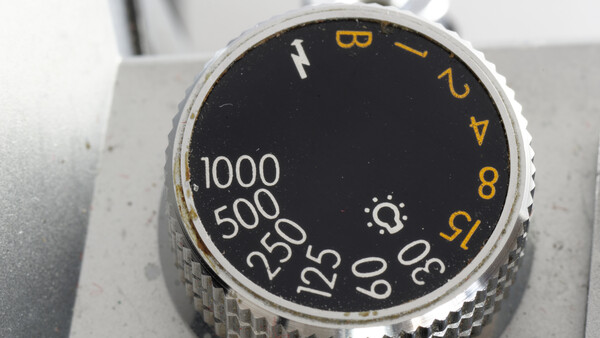
The 1/125 on your shutter dial is a rounding error that stuck. The scale it sits on halves at every step, which puts that rung at 1/128, and 1/128 is an ugly number to stamp into metal. Your camera is full of settings like that: numbers and buttons whose shape was fixed by brass, gears, and gelatin, and that crossed into digital without anyone stopping to re-derive them.
Three Fossils the Shutter Left Behind
1. The B on Your Shutter Dial Was a Rubber Bulb
Before there was a button, there was a rubber bulb on the end of an air hose. You squeezed it, the pressure pushed a small piston inside the shutter, and the blades opened. Let go, and they closed. A 1909 Sears Roebuck catalog described the setting exactly that way: with the indicator on B, the shutter opens when the bulb is pressed and stays open as long as pressure is maintained.
The etymology is not unanimous. Around 1894, C. A. Steinheil and Söhne in Munich marked the same setting B, and the company's own literature glossed it as beliebig, German for "any time." Eastman Kodak, in brochures for cameras such as the Folding Autographic Brownie and in Pocket Kodak manuals, glossed the same B as "brief time." The pneumatic bulb is the standard explanation and the one that fits the hardware, but if you see it asserted as settled fact, the record is thinner than that.
B still earns its place, though it is not the only route past your camera's longest numbered speed. Nikon extends the Z8's timed range to 900 seconds in manual mode, and Fujifilm's T setting lets you dial a timed exposure with the rear command dial and leave the closing to the camera. What B gives you that those do not is open-ended duration: on a Fujifilm body it stays open for up to 60 minutes, for as long as the button is held. Holding it yourself is the thing to avoid. Use a remote, a phone app, or a timed setting.
2. Every Shutter Speed You Use Is Rounded
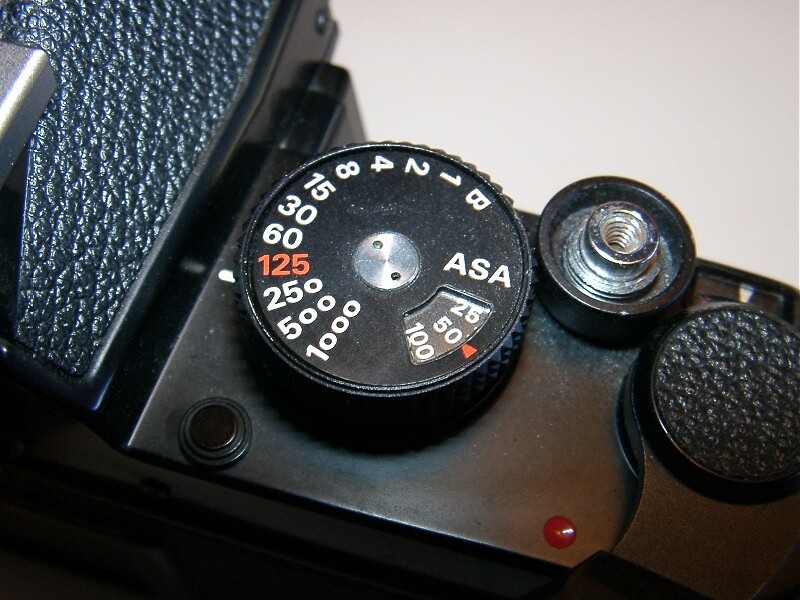
The modern sequence runs 1/8, 1/15, 1/30, 1/60, 1/125, 1/250, 1/500, 1/1,000. Written exactly, it is 1/8, 1/16, 1/32, 1/64, 1/128, 1/256, 1/512, 1/1,024. Every doubling is real; every marking above 1/8 is a lie of convenience. Thirty seconds is really 32. The 1/8,000 at the top of a modern dial sits at 1/8,192.
This is not folklore, it is written into the rules. ISO 516, now in its 2019 edition, is the standard that governs exposure-time markings and the tolerances a shutter is expected to hold against them. It defines the underlying series by the formula tE = 1/2n, lists it out as 1/64, 1/128, 1/256, 1/512, 1/1,024, and then instructs that shutters be marked with the "rounded-off values" of that series: 15, 30, 60, 125, 250, 500, 1,000.
Older shutters used a different rounding of the same idea, running 1/10, 1/25, 1/50, 1/100, 1/200, 1/500. Through its middle that series doubles too, just anchored to a decimal number instead of a power of two, though at its ends it does not. The industry drifted from one to the other, and transitional cameras turn up with both. Standard references do not credit the switch to any single maker or date, so treat anyone who names one with suspicion.
None of this changes a photograph. If you are calculating exposure ratios or testing an old shutter against a meter, use the exact values, not the engravings. And under LED or fluorescent light, the rounded ladder is simply the wrong ladder to be standing on. Fluorescent tubes pulse at twice the mains frequency, 100 or 120 Hz depending on where you live, and that is what an ordinary flicker reduction mode is built to catch. LEDs are less predictable, because their flicker comes from the driver rather than straight off the mains and can run far higher. Sony draws that line in its own documentation, offering anti-flicker shooting for 100 and 120 Hz sources and a separate variable shutter for the higher frequencies LED lighting produces. Fujifilm's flickerless shutter speed setting takes the manual route, allowing shutter speed to be fine-tuned against flicker from LED lighting, which in practice means stepping off the rounded values onto ones matched to the light.
3. Flash Sync Speed Is the Width of a Moving Slit
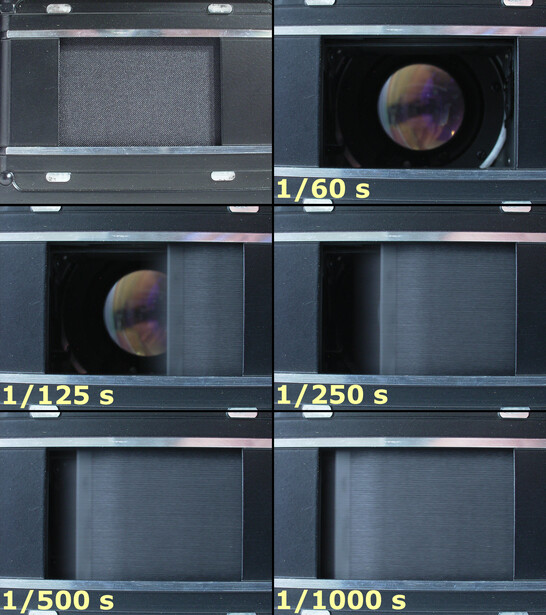
A focal plane shutter is two curtains. The first uncovers the frame, the second covers it back up, and both travel at the same speed no matter what you set. Shutter speed is the delay between them. Below a certain speed, the first curtain finishes its run before the second starts, so there is a moment when the whole frame is open at once and a flash can fire into all of it. Above that speed, the second curtain launches before the first has finished and the frame is exposed by a moving slit. Fire a flash then, and you light a stripe.
That number is on your camera today because the physics never changed. The Sony a7 IV syncs at 1/250 with its mechanical shutter, and 1/320 in APS-C crop mode, because the shorter crop height needs a briefer moment of full opening than the whole frame does. The Nikon Z8 has no curtains at all, and Nikon still specifies flash sync at 1/250 or 1/200 second or slower, because the sensor is read out row by row and that scan is its own traveling slit.
Sync speed is a genuine physical limit. Work below it. High speed sync will get you past it by turning the flash into a long, dim pulse, which costs you a great deal of power, so reach for a neutral density filter or a leaf shutter lens before you reach for HSS. If flash is a weak spot, a solid lighting foundation pays for itself faster than any modifier.
Three Fossils the Film Box Left Behind
4. ISO Is a Property Your Sensor Does Not Have
ISO started as a way to grade emulsions. The German DIN 4512 standard was published in January 1934, the American ASA scale arrived as Z38.2.1 in 1943, and a 1960 revision, ASA PH2.5-1960, dropped the safety factors that had been built into the method and effectively doubled the published speed of many black-and-white negative films overnight. The two systems were folded into ISO from 1974 onward, which is why the full form of a film speed is written ISO 400/27°: the arithmetic figure from ASA, the logarithmic degrees from DIN.
A sensor has no emulsion, so the number had to be redefined. ISO 12232, first published in 1998 and now in its 2019 third edition, gives manufacturers more than one way to arrive at a figure: a saturation-based speed, a standard output sensitivity tied to where 18 percent gray lands, and a recommended exposure index, which is the manufacturer's own opinion about what produces a decent picture. Two cameras set to ISO 800 can genuinely differ, and neither is cheating.
The dial sets amplification. Your sensor has a base ISO where its analog gain sits at the designed minimum, and many current sensors switch conversion gain again partway up the scale, giving a second clean starting point. The values marked L or H, outside the plain numbers, are not measured under the standard at all. The low ones are usually base exposure pulled back down, which costs you highlight headroom, and the high ones are typically digital multiplication you could apply yourself in a raw converter. Find your camera's base ISO and its second base, live between them when you can, and leave the extended values alone if you shoot raw.
5. Your Dials Click in Thirds on the Grid Film Speed Used
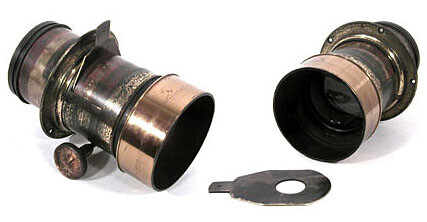
The word "stop" is older than any of this, and older than the man usually credited with it. Photographers were already calling them stops before 1858, when the way to change aperture was to unscrew the lens and slip a drilled metal plate in between its components. What John Waterhouse of Halifax, England contributed in 1858 was convenience, a set of thin plates with holes of different sizes that dropped into a slot cut in the barrel, so nothing had to come apart. Even that priority is not clean, since Waterhouse described a version as early as 1856 and H. R. Smyth appears to have reached the same idea independently. The plates themselves were largely finished by the early 1900s, displaced by the iris diaphragm, and the name has outlasted them by more than a century.
The numbers on them settled into powers of the square root of two, because halving the area of a circular opening means dividing its diameter by 1.414. That series is also rounded on your lens barrel. What is printed as f/11 is 11.3137, and f/22 is 22.627.
The granularity has a film-box shape to it. DIN was a base-ten logarithm multiplied by ten and expressed in degrees, so three degrees doubled a film's speed and one degree was a third of a stop. The familiar ladder of 100, 125, 160, 200, 250, 320, 400 runs in those same thirds, and the third-stop apertures your camera offers, f/3.2, f/3.5, f/4, f/4.5, f/5, f/5.6, f/6.3, f/7.1, f/8, sit on the same grid. Whether the camera dial inherited its thirds from DIN specifically, or whether both were built on the same base-ten preferred numbers, is not something the standards record settles, so treat that lineage as a family resemblance rather than a documented descent. There is nothing sacred about thirds either. If you dial a lot and want fewer clicks between decisions, most cameras will let you switch the exposure step to a half stop in the menu, and the setting has been sitting there unloved since your first firmware update.
6. Exposure Compensation Has the Shape a Roll of Film Gave It
A meter needs to know how sensitive the film is. On a film camera, you told it once, when you loaded the roll, and it stayed told for the next 36 frames. If you wanted the meter to aim somewhere other than where it was aiming, one trick was to lie to it, setting a roll of ISO 400 film to 200 so every reading came out a stop brighter. The dedicated dial did not come from that trick, though. It arrived with automatic exposure and was already ordinary by the mid-1970s, the Olympus OM-2 of 1975 carrying a compensation dial good for two stops either way. What Kodak's DX coding did, from 3 January 1983, was put the film speed on the cassette as a conductive pattern, and many cameras then offered no manual override at all. That turned the plus and minus dial from a convenience into the only sanctioned way to overrule the meter.
Digital removed the constraint. You can change ISO between one frame and the next. The reason for the control is untouched, though, because a meter that averages a scene still has no idea what you want the picture to look like. Exposure compensation survives as a bias applied to whatever the camera is deciding for itself: in the automatic modes, it shifts the exposure the camera picks, in manual with Auto ISO, it moves the ISO, and in manual with a fixed ISO, it usually does nothing except slide the meter display.
It still earns its place as the fastest way to expose to the right when you can see a histogram and the camera cannot. The dedicated dial is the liability, because it holds its position with the camera switched off and remembers a decision you made three weeks ago about a backlit portrait. Look at it before every shoot. On bodies like the Nikon Zf and Fujifilm's X-T series, you can set the dial to its command position and drive compensation from a thumb wheel instead, which puts it back under your eye in the viewfinder where you will actually notice it. On the Zf, that position also widens the range from three stops either side to five.
One Fossil You Can Still Screw Something Into
7. The Threaded Shutter Button
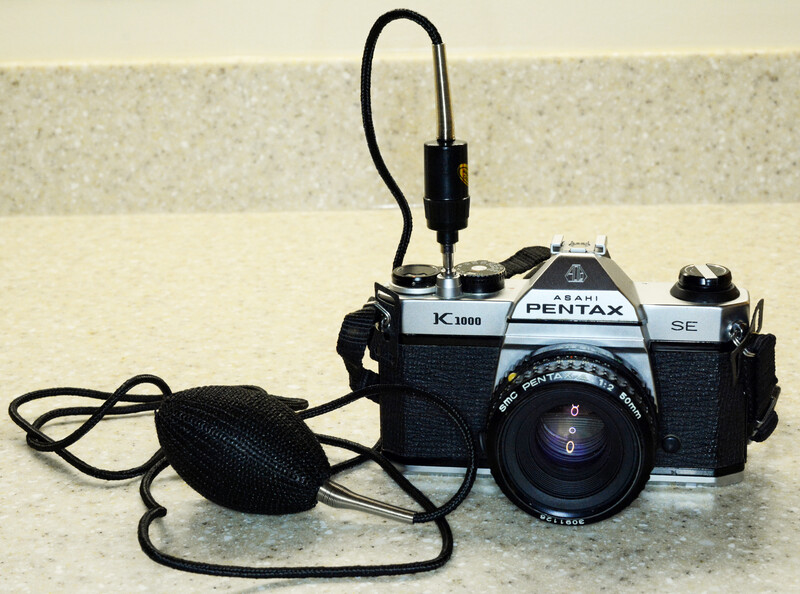
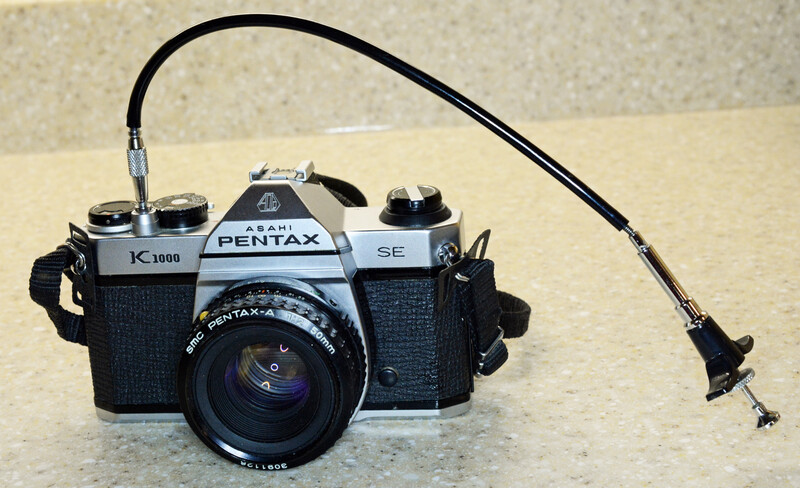
A mechanical shutter needed a mechanical push, and pushing a camera with your finger during a long exposure moves it. The rubber bulb solved that first, and wire releases replaced it soon after, working on the flexible-cable principle Ernest Monnington Bowden patented in 1896: a stiff inner wire sliding inside a flexible sheath. Bowden's patent is a general mechanism for transmitting motion, drawn as a bicycle brake, with nothing photographic in it. The camera version added the parts that made it a shutter release, a tapered thread that screwed into the button and a lock collar so you could hold the shutter open on B without standing over the camera. Bowden is routinely confused with Sir Frank Bowden of the Raleigh bicycle company, who had nothing to do with it and was not a close relation. ISO 6053:1979 later wrote down the dimensions of the cable release tip and socket, with the stated aim of ensuring international interchangeability, codifying a taper the trade had already converged on. That is why a cable made decades before the standard still threads into gear sold this year.
Some of it is still real. The Fujifilm X100VI and X-T5 take a standard screw-in mechanical release. Some of it is not. On the Leica Q3, owners consistently report that the thread accepts a decorative soft release button and nothing more, because there is no through hole for a cable to push against. Several other retro-styled bodies sell a soft release button as the headline accessory for that thread, which is worth reading as a hint. The socket has become jewelry.
Check yours before you buy anything for it. Screw in a soft release if you like the feel, since the larger surface genuinely does reduce the shove you give the camera. For actual remote triggering, the port you want is the 2.5 mm socket that Fujifilm lists on the X100VI as a microphone and shutter release input, or your manufacturer's app.
Three That Almost Made the List
Mirror lockup is the near miss. It existed because a swinging reflex mirror slaps the camera at the exact moment you are trying to hold it still, and mirrorless cameras do not have one. The function survived in another form. The electronic first curtain shutter and the shutter delay timer in your menu do the same job of separating the vibration from the exposure.
The tripod socket is a fossil of industry rather than of film. ISO 1222 specifies 1/4-20 UNC and 3/8-16 UNC threads, which carry the diameters and thread counts of the older British Standard Whitworth sizes the photographic trade settled on well before ISO existed, even though the modern thread form is the 60 degree Unified profile rather than Whitworth's 55 degree one. That is how an inch-based thread ended up as the one truly universal interface on a metric camera.
Then there is the counter. On a roll, the number in the little window was exact and it mattered, because 36 was 36. Your camera still shows you a number of remaining frames, except now it is an estimate the camera revises as it learns how well your files are compressing, and the file names it assigns run to 9999 before rolling back to the start. You are still being counted down to a limit.
Lead image: the shutter speed dial of a Pentacon Praktica LB2, marked B and 1 through 1000. Photo by VSchagow, CC BY-SA 4.0. Source.







.jpg)


Join the Fstoppers community for free
-
Post comments and join in the discussions
-
Browse the site ad-free
-
Share your work and get featured in the community
-
Compete in the photo contests for fun and prizes
3 Comments
Wow. Don't read this on a Friday night — two drinks in — unless you want to go back in history and cram for a test. Still, it's very interesting, and it explains things frequently taken for granted. BTW — kudos to the author.
Much appreciated, John
I always knew that "B" stood for Bulb, but instead of the rubber release, I thought it came from a period before synchronization, when shutter was held open until the flash bulb was manually fired.
As far as tripod sockets, I have long wondered why for decades cameras made abroad had these U.S. thread sizes, while on the other hand, lens focal lengths were metric. So it's the Brit's fault!