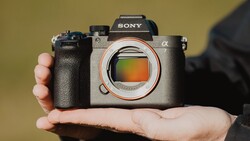
Sony's RX1R III puts a 61-megapixel full frame sensor and a fixed 35mm f/2 lens into a body small enough to carry everywhere, and it costs more than most professional mirrorless cameras. A few weeks of testing can tell you how a camera like that performs, but only a year of weddings, family trips, and every season of Pacific Northwest weather shows what it's like to live with.
After a full year and tens of thousands of frames, Benj Haisch still picks up the Sony RX1R III with real enthusiasm, and much of that starts with the sensor. It's the same chip in his Sony a7R V, the camera that handles most of his paid work. His presets carry straight over, and his files behave identically whether he shot a reception or a walk to the coffee shop. The price puts it closer to a Leica Q3 than to a typical interchangeable lens body, and he points out that a phone can still make great family and travel pictures. The size is the draw, though it won't slip into a pocket, and even with the hood off it's thicker than the slimmest compacts.
Haisch draws one firm line around professional use, and image quality has nothing to do with it. The camera has a single SD card slot, so there's no redundant copy as you shoot, and he won't depend on it for the moments a client can't get back. Within that limit, it still earns a place at weddings. During one recent cocktail hour, he took off his larger bodies and worked only with the RX1R III, getting the same files through a 35mm f/2 that still separates subjects and copes with dim rooms. Autofocus isn't the fastest he's used, but he calls it remarkably accurate, and he rarely misses focus at events or with his kids. He also covers the Godox iT30Pro and Godox iT32 flashes he pairs with the camera, why battery life lands at good rather than great, and the small grip add-ons he now treats as essential.
Fixed-lens compacts have turned into one of the busier corners of the market, with the Fujifilm X100VI, the Leica Q3, and the Ricoh GR IV all aimed at people who want serious files without a bag of lenses. Each one balances size, sensor, and focal length differently, and the RX1R III sits at the full frame, 35mm end of that spread. Its leaf shutter brings some exposure math with it. The old sunny 16 rule puts a bright day at about 1/100 s at f/16 and ISO 100. Open up to f/2, six stops brighter, and you'd need roughly 1/6,400 s, well past the 1/2,000 s the camera allows at that aperture. A 2-stop ND filter brings you back under the limit at base ISO, and a 3-stop filter leaves room for snow, sand, or bright water. That same leaf shutter syncs flash at any speed, so a light ND lets you shoot wide open with daylight fill without the power loss that high-speed sync costs you on a focal-plane shutter.
The longest stretch of the update covers filters and hoods, where Haisch clears up something from his earlier coverage. The mist filter he often uses adds a soft glow and cuts roughly a stop of light, which helps with that shutter ceiling at f/2 in sun. It can't share the lens with the compact third-party hood he likes, so you're picking between flare protection and the filter every time you head out. On a recent trip to California, he also found the effect too strong in some scenes, with highlights blooming heavily as the light dropped. The Zeiss Sonnar lens already has plenty of character, with a little softness and the occasional chromatic aberration that reminds him of older Zeiss glass, so he'd rather have something far gentler on top. His plan is a plain 49mm ND filter of about a stop, tucked under the hood so he can stay wide open in daylight and pull it off when he needs every bit of light.
Watch Haisch walk through the rest of his year with the RX1R III in the video above.




Join the Fstoppers community for free
-
Post comments and join in the discussions
-
Browse the site ad-free
-
Share your work and get featured in the community
-
Compete in the photo contests for fun and prizes
No comments yet