
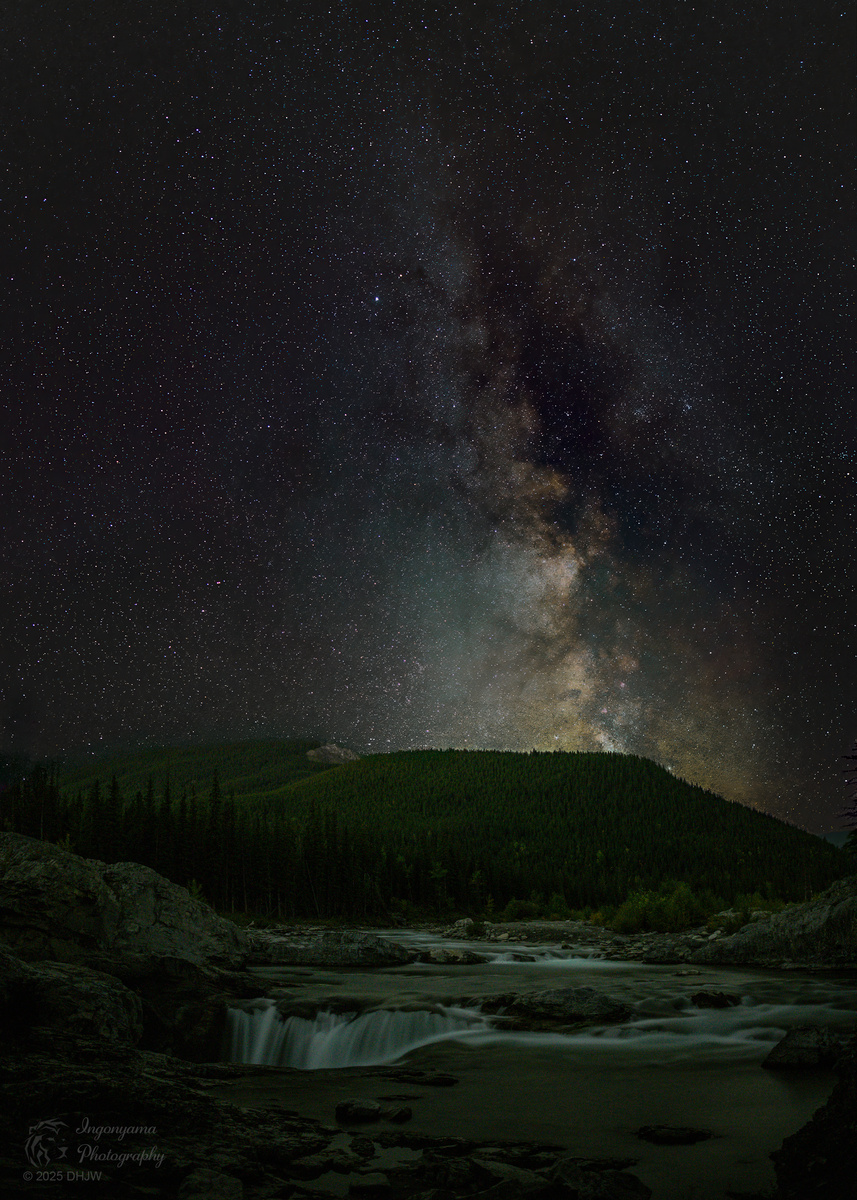
Doing my best to improve my Milky Way photography
I am fairly new to Milky Way photography and after going out a few times with a Canon RF 15-35mm F2.8L lens, which is great, I was craving more. More light that is. Two days ago I received my new Canon RF 20mm F1.4L lens. Two stops, 4 times more light, incredible. Had to go try it out.
Just prior to the New Moon in September and because we had a clear and cloudless night, which may not be the case closer to the New Moon, my wife and I drove to Elbow Falls for Milky Way photography.
Elbow Falls is in Kananaskis Country in the Rocky Mountains in the Elbow Falls Provincial Recreation Area.
The photo is a stack of 19 photos (light frames) and 5 dark frames using Starry Landscape Stacker and then edited in Photoshop.
I have come to learn that editing and the right software seems to really improve Milky Way photos. What are other photographers finding?






8 Comments
excellent shot(s) - image
Thanks Marius, really appreciate it.
Nice photo. And yes, I believe that editing is essential for Milky Way photos. They look “meh” in RAW, even in the best of circumstances (dark skies, high elevation, little light pollution, etc.).
Thanks Ken,
I've also come to realize that stacking and dark frames also make a difference, not as much as editing, but does help to improve noise and provide detail.
Quite a tricky genre. Not always easy to practice as new moon is only every 28 days and cloud cover and other factors also play a role.
A few clouds can add a lot of mood to a night photograph. Here i just got too few images for the foreground (3 lights, no noise frames) and clouds (1 light, 15 darks) were really fast.
Very nicely framed shot of the night sky. Nicely done!
I agreed that clouds in the night sky can work and work really well in the right setting. Even with the Northern Lights.
But, my personal opinion is that if much of the focus of the photograph is the Milky Way and its nebulosity clouds could detract from the planned photo.
Each photo is different and often we're pleasantly surprised when we thought something would detract from a photo really adds interest. I love those moments.
I agree with Dg9ncc /portable. Clouds can add a very beautiful element to the night sky, whether during a full moon, no moon, or anywhere in between. In fact, one of my favorite times to photograph at night is partially cloudy with a full moon. I love the way the clouds can frame the subject and smear slightly to show movement, adding dynamics to a photo.
In my opinion, high clouds can add a lot to the Milky Way (see example), while low or mid-clouds can sometimes be more hit and miss.
Ken,
Love the advice (confirming what Dg9ncc/portable said) and example. Next time I will not be so hesitant to go out is there is some cloud.
Thank you.